

Letter from the Editor
By John Hardberger


Slow, meditative music played from an iPhone to a small speaker at the front of the meeting room at the Presbyterian retreat center in the Colorado mountains. I had been hired to teach a creative workshop Saturday afternoon, then invited to stay until the retreat ended after breakfast on Sunday.
Women silently rose from their places at round tables and filed into lines at the back of the room. Church leaders, all women, sat on one side of long tables. In front of each leader was a serving bowl with warm water, a bottle of scented soap, a hand towel, and scented hand cream.
The pastor, a woman, had quoted a Bible verse about Jesus washing the disciples’ feet. “We wanted to offer you comfort, to give you what Jesus gave his disciples, to serve you in a way that would be uniquely female.”
The only sounds were the soft muttering of prayers from leaders as they washed and dried hands, the shuffle of footsteps over the carpet, the whoosh of chair cushions when each woman sat or stood. Outside a large window at one end of the meeting room, the sun gradually turned the sky orange and pink, then deepening shades of blue.
Twenty-five years earlier I stood at the bottom of a staircase in the church I had gone to since birth. I backed into a kids Sunday school room, the tall youth pastor towering over me. He was stern.
“What you reported is serious.”
I was sixteen. I had reported my dad for sexual and physical abuse, had been placed in foster care. It had been several weeks. I begged for a ride, went back to church expecting hugs, offers of places to live.
I nodded, looked at the pastor’s belly. I couldn’t get around him, I knew.
“You love your church family?”
I nodded again. My dad was the assistant pastor and music leader. My mom was the bookkeeper. I had been dedicated into the fundamental Baptist congregation as a toddler, run down the hallways with a younger brother after services, memorized verse after verse, gone to church twice each Sunday and on Wednesday nights as long as I could remember, learned how to convert people, followed rules that forbid secular music, TV, movies, alcohol, tobacco, playing cards, dancing, and more.
“I know you love them. I know you want to guard your church family’s hearts.” He took a step toward me.
I backed up. I studied the toys on the shelves for what would hurt him the most—a metal toy truck, a marble ramp—and moved closer to the shelves. My stomach lurched and burned. My skin tingled.
“What you reported, what you said, what you…” The pastor looked up and down my body. Disgust curled at the corner of his lips. His gaze lingered at my breasts. “Until you are ready to repent and confess to your sins, it’s best if you aren’t here. You need to take some time to make your heart right before God, before the church. You understand, right? Love is not easy.”
I crossed my arms, curled my shoulders forward. I was dirty, dangerous. I would learn later that my parents stayed in the church, that the church put up the bail money for my dad until his trial, that they advocated for my dad to be sentenced to probation rather than prison time.
At the retreat, I watched the sky turn purple, then black, stars flicker above a mountain. I hadn’t planned to take part in the handwashing ritual. I was there to teach women to play with language. Despite the gap in time, my exile from the church was still tender.
Women at the table where I sat gestured toward lines, urging me to have my hands washed. I no longer believed in God, but reluctantly took a place at the end of a line. The leader was the woman who had hired me. If I was going to have my hands touched by a religious person, I wanted it to be someone I knew. The line moved forward. A woman sat down, extended her hands. Soap, towel, hand cream.
I would be next. I sighed, imagined the leader saying she was glad I was there, that the workshop had gone well. I imagined my hands wrapped in a towel, the leader holding them for a moment, then massaging hand cream into my parched knuckles.
The woman ahead of me stood. Whoosh. I stood back to let her pass. Another woman slid into the seat and laughed. “I was waiting for the end of the line,” she said. “I knew you’d want to wash my hands.”
The woman and the leader laughed softly.
“This will be my last one,” the leader said to me.
Another leader a few lines away saw me. I didn’t know her. She waved a hand over the empty chair in front of her station.
My stomach lurched. Reluctantly, I walked toward her.
The leader held her palms out. I lifted my hands from my sides, then stopped before I might give something I couldn’t get back. I shook my head slowly, then more vigorously.
“I can’t,” I said to the bowl. I smelled lavender and a hint of lemon. I craved touch, that gentle moment, to feel in her touch that I had become clean again. My hands shook.
“You can’t?” The leader’s hands were soft, her fingers curled gently.
I imagined my hands falling into hers, the sound of her voice lulling me into belonging, watching my sin dissolve in the bowl. Grief threatened the peace of the moment.
“I’m sorry,” I said. I shoved my hands into my pockets and backed away. “I can’t.”

Shawna Ervin is a Pushcart nominee and has an MFA from Pacific Lutheran University. She attended the Mineral School residency thanks to a Sustainable Arts Foundation fellowship, is a poetry reader for Adroit Journal, and founding faculty of the Tupelo Press Teen Writing Center. Shawna is an alum of Bread Loaf and Tin House workshops. Recent publications include Bangalore Review, Tampa Review, Cagibi, Rappahannock Review, The Maine Review, Sweet: A Literary Confection, Sonora Review, American Literary Review, and elsewhere. She lives in Denver with her family.
Janina Aza Karpinska is a multi-disiplinary Artist-Poet. Her collages are worked quickly and intuitively, with an innate sense of order, re-configuring chaos and brokenness to make a new and pleasing, cohesive wholeness. Her work has appeared in Bath House Journal; Young Ravens Literary Review; Grim & Gilded; The Empty Mirror; 3 Elements Review, among others.
By Lindsay Wilson
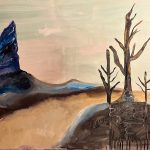
By Victor Hugo Mendevil

By Windy Martinez

By Jackie Martin

By Samantha Edmonds
By Jeffrey J. Higa