Letter from the Editor
By John Hardberger

2nd Place Nonfiction
2021 Summer Contest
From the first sentence on, Lucas infuses “Stars from a Burning House” with a sense of the liminal, the mercurial, the transmutable–what can be seen and not seen, known and not known, put together and torn apart, trusted one moment and feared the next. The tension of what exists between worlds informs every image and object. A child’s telescope becomes a harmonic metaphor for the lens of story and how it shapes trauma, myth, and memory. Wildly broken children become shapeshifters, changelings, their way guided by ancient constellations—one way, Lucas suggests, we might finally find our magical way home.
– Kim Barnes
Maybe I was seven years old. Maybe my age doesn’t matter. It was cold. I was barefoot and wearing Snoopy pajamas in the driveway of my parents’ house. The telescope had been given to me by my parents for Christmas, or maybe it had been my birthday. After hours of learning how to set it up, hours of pleading with each of my parents for help only to come up empty, I pressed my eye tight against that cold piece of metal and saw the moon.
It was full, slightly yellow. I could see the shadows on the surface, one big spot with cracks radiating out from the center. I took my eye off the scope, looked at the moon with only my eyes, then went back for a closer look. I remember the difference—how much I couldn’t see with just my eyes, how much I had been missing. My world narrowed then.
I remember a vastness coming next. A feeling that propelled me through that tube, upward and outward into a space much more than anything.
Over and over, I took my eye from the scope and put it back. Over and over, I narrowed and expanded the world. The intensity of my hunger rooted my small feet in place.
But my stepfather came out on the driveway where I had set up and said, If you don’t come inside I’m taking it away. So, I went inside, telescope in hand.
Take it apart, he said. I said that it took forever to put together.
Take it apart, he said again, angrier, and I saw his jaw do what it did when bad things brewed.
I can’t, I said. He snatched the telescope from me and took it apart in a way where it would never fit back together.
Later, when I looked one more time at the moon through my window, I felt the ghost of that unspeakable feeling I had felt in the driveway.
Oh, I had thought, a way out.
The telescope came with a circular star-map, a guide for what stars could be seen depending on the time of year. It had all of their names—Cygnus, Draco, Lyra, Orion, Pegasus—stamped in their center in glow-in-the-dark ink. It was here that I learned the stories of thousands that had come before me, a connection passed down through the years. Even now, I can find Orion the Hunter by his belt of three close-knit stars, guided only by muscle memory.
Lyra, the lyre Apollo gifted Orpheus, I know by its triangular shape. I can use Polaris—the North Star, the tip of the handle of the Little Dipper, always the brightest in the night—to trace a line to the Big Dipper.
These Dipper constellations have different, older names: Ursa Major and Ursa Minor. Or older still: Callisto and her son Arcus. Callisto was a handmaiden of Artemis—the virgin goddess of the hunt, the moon, and of wild places—or perhaps, depending on interpretation, the goddess’s lover. In her story she is raped by God King Zeus disguised as Artemis. To punish or save Callisto, depending on the version, the goddess Artemis turned her into a bear. And now Callisto and her son walk the sky together, always, pointing us north.
Gods would often place those they deemed worthy of remembrance in the sky as stars. Sometimes the remembrance was a punishment meant to embarrass, like with Queen Cassiopeia who, when boasting that she was more beautiful than sea-god Poseidon’s nymph daughters, was placed in a throne in the sky that rapidly spun around the north pole. Cassiopeia had to cling desperately to the throne to not fall. She still spins, even now.
Sometimes though it was done as a reward, born from admiration and even love. Orion the Hunter was born of the latter. Orion’s origin stories vary, but in one he was the giant son of Poseidon, and so favored by his father, he was granted the ability to walk on water. Eventually, he became a hunting companion of Artemis. Two versions of Orion’s death say the goddess fell in love with the hunter and this love enraged her twin brother Apollo. Apollo, conniving, then made a bet with Artemis. He pointed to a distant and partially obscured object in the sea and boastfully proclaimed that Artemis would be unable to hit it with her arrow. The goddess of the hunt laughed. She drew her bow, took aim, and hit her target. But the target was Orion’s head; Apollo had seen him swimming.
Another version says that Orion boasted to Artemis that he could conquer and kill any beast alive. His boasting enraged Gaia, the goddess of the earth, and she birthed a giant scorpion that struck Orion and killed him.
In both versions, Artemis in her grief at his loss, placed Orion in the sky.
The wonderful, glorious thing about Orion is that his constellation is one that nearly every single culture across the world has a name for. His shape differs depending on who is doing the naming, but still, they all see him. They all know him in his grave of stars—the remnants of a love that’s lasted eons.
I grew up in a neighborhood of broken things—broken places, broken people. We were all splintered and cracking, spoiling.
One boy lived with his two younger brothers and his divorced mother who made her children visit their father because “he was their father,” even though he liked to knock them around—even though she knew.
The girl that lived next door to this boy had a religious zealot for a father—the kind that bans Harry Potter because it’s about magic and “devil-worship.” Her mother might as well have been a ghost; I never saw her speak, never saw her defend her daughter.
One boy lived with his alcoholic father and spent most of his time at the neighborhood basketball court. He never talked about his house. We never asked.
My neighbor was a girl whose biological father was in prison, her mother in the military and remarried to a military man. When the military mother was shipped off to Afghanistan, the military man liked to kick her daughter around. And if her daughter called her to say what he was doing where she couldn’t see, her military mother told her she was lying.
I met this girl in high school, on one of the days the military man was knocking her around. She knocked on my door and said she had forgotten her house key. She didn’t tell me until a year or two later that that had been a lie—her stepfather had locked her out of the house after they had argued. But she had grinned when she saw me and told me her name.
The second thing she said was I’m a lesbian, just so you know. Then she asked me if I wanted a cigarette and we disappeared into the woods to smoke and listen to nothing. She asked me what kind of music I liked. Years later, when that broken neighborhood was becoming a memory, we went back to its playground, and she kissed me as I sat on a swing.
Told you you weren’t straight, she said, her hands on my blushing face, kissing me again. I kissed her back, then. It was night. There were stars above us.
We broken children orbited around each other for years before drifting apart, pulled to each other for reasons we knew without needing to say.
We would go to the house of whoever’s parents were coming home late that day and play video games or watch trash MTV or make instant ramen and smoke and laugh. Or we would act like idiots in the playground: jumping off swings to see who could land the farthest, tackling each other in touch football, breaking see-saws on accident by balancing on the middle of them and jumping up and down. Once, a neighbor spied us smoking on one boy’s porch and he called the police. We ran into the woods. And after, we started going on adventures there. We found new unexplored corners so we could sit in silence unbothered or sit in silence and smoke. We were made of wild things then, hungry and crazed and burning.
I remember our silence never really felt quiet. There was a small noise bubbling up in each of us, a noise only we could hear. We noticed it in each other, I think. Perhaps we were trying to make that small voice louder by our orbiting, that small voice crying out for anything, Look! I’m here. I’m here. I’m here.
I think a truth too often forgotten is that children never asked to be born.
Magic and myths originated as ways for humans to understand an unknowable world, a world they didn’t have words for, to give it shape and meaning. For instance, stories of Helios that describe him riding a chariot drawn by golden horses across the sky were ways of explaining why the sun seemed to move during the daytime.
Bad weather and water lashing at ships at sea was blamed on Poseidon’s temper, and on those sailors on the ship who may have incurred his wrath.
Some myths of the moon goddess Selene were ways to explain the lunar eclipse. It was said that when the lunar eclipse happened, evil witches had succeeded in drawing Selene out of the sky to take her blood for their spells.
Every time I looked up at the night sky above my small world, I thought of these stories. Every time men that did not love my mother took away her magic—every time they all drew me downwards to try and steal mine—I thought of these terrible, beautiful things to explain all things.
I never saw my mother look at stars; she never asked me about them either. She had to have seen me looking. Maybe she would have looked, or did, once or twice—before different men taught her the wrong way to love, rotting her from the inside out. A rot that then spread to my foundations.
Maybe that’s nothing more than a pretty story made up by a broken woman’s once-broken child.
When we ventured out into the woods, I always imagined what it would be like to be spirited away, by the will-o-wisps, wild things or other fairies—fairies that likely didn’t exist in suburbia, but I was stubborn with dreams. I imagined them leading me into their world and replacing me with a changeling. I imagined if I went deep enough into the forest, was respectful enough, clever enough—breaking nothing, gently brushing branches from my path—I would be noticed by something wondrous. I imagined it would set me free, would give me something more.
Three of us broken children had been walking along one of the paths cleared into the forest, before my neighbor said, oh, look! and ran off through the trees. I watched as she disappeared into fog. I watched as one of the broken boys ran after her, shit, stop running. Stop!
I imagined for a moment that my neighbor had been picked instead of me.
I took my time catching up with them, following the sound of their voices as they complained at how slow I was. I was taking care to not trample on anything growing.
The fog was thicker in the small clearing where they sat on a fallen tree slowly being eaten by lichen and rot. I couldn’t see farther than three feet in front of me.
Look, they both said, and my neighbor pat a spot beside her on the trunk.
There was nothing but brown and white and gray. The birds weren’t singing. There was no wind, no rustling leaves. Only a stillness and the rise and fall of our breaths.
We looked at the mist that ate the trees. We looked at each other.
When we left, we ended up in a spot much farther away from where we thought we had started. We spent some time arguing over if it counted as getting lost. A few times after that, my neighbor and I went looking for the spot in the trees, but we could never find it. It had vanished.
Magic, she said.
The deeper I dug, the more I learned the names, the shapes. A system for understanding. Our sun, for example, is just “The Sun,” or “Sol.” A lot of other suns, like a lot of other moons, get names—like Arcturus, or Sirius—or like Betelgeuse, the sun that makes up Orion’s left shoulder. Suns are really just big stars, big balls of molten gas and other elements, that lie in the center of planetary systems. They are the objects all the other objects orbit; their gravity is large enough to overpower all the others. Earth’s Sun is large enough that 1,000 Jupiters would fit inside it. This is 1,300,000 Earths.
Betelgeuse is the second brightest star in the sky, and the second brightest in the constellation of Artemis’s beloved hunter Orion. It is one of the largest stars visible to the naked eye, so large in fact, that were it to replace The Sun, it would eat us and Mercury and Mars and Venus. Scientists think it might even eat Jupiter too, for a total of roughly sixty percent of our solar system. It is large enough to devour our entire world and four of the others that we know.
It is also six-hundred and forty light years away, which means that its light could have gone out this second and we probably won’t notice until six-hundred and forty years from now, because it takes the light Betelgeuse emits six-hundred and forty years to reach us.
When science taught me this, it taught me that to look into the night sky is to look into the past. We are offered a glimpse into something unnamable, something older and more constant than we could ever hope to be. When we use telescopes to look at distant planets and stars and suns, we are looking back in time into a history large enough to hold us all—a blanket of reminders and infinite stories.
Orion the hunter, Artemis’s boastful beloved, is heavier than the rest. Older. He is visible across the world, across time, and has as many names as stories. Likely even more, still, than the ones that were written down. The oldest known illustration of Orion’s constellation was found on a mammoth ivory carving in a cave somewhere in Germany. It is estimated to be 32,000 to 38,000 years old.
Babylonian sky catalogues contain illustrations of him and call him “The True Shepherd of Anu.” In Ancient Egypt, he was known to be Sah, the father of all other gods. In Hungarian folktales, Orion is called “magic archer,” or “reaper.” In Indian myth, Orion is instead Nataraja (“the cosmic dancer”), an avatar of Shiva. In Scandinavia, his belt was “Freya’s distaff.”
Even the Bible references Orion, though the name it gives the constellation, “Kesil,” translates as “fool.” Though, there is debate that that is a mistranslation, that his actual name is “kesel,” which means hope. Perhaps there is not really a difference. Perhaps both are fitting for the man who fell in love with a goddess such as Artemis. Perhaps his shape is the shape of love.
Perhaps that is what it comes down to: when I see Orion, I am reminded of a love so deep the only way to really show it is to have it burn.
We lay on a cold black pavement—my childhood best friend and I—dead center between two basketball hoops in my neighborhood playground. It was the time of night where a hush blankets the air, helped along by a faint late autumn chill. She had spirited me outside—away from my parents’ anger she heard through the phone, away to where they couldn’t see. She often did things like this for me; often heard the storm in my voice before I even knew it was forming. She had this way of interrupting everything. She still does, perhaps, even though everything she was is now ashes scattered in a lake.
Look, we whispered to each other. She took my hand in hers.
Dozens, hundreds, countless stars suspended, surrounding us. The sky was alive in the still night, bright white—the wisps of clouds reflecting the stars. I think maybe we saw the Milky Way, not clouds. Either way, we didn’t speak, afraid to break the hush. Afraid to break our shared moment of magic. We recognized something that had no use for words, no need. She leaned into me. We lay there, gaping up.
The Earth was a fishbowl, we were the fish. We stilled against our current and listened.
Then, unprompted, she started to sing. I don’t remember which song, but I remember the feel of her voice as I looked up. I remember how clear it sounded, how my arms goose-pimpled with the sound and a slight chill breeze. I remember, for a moment, there was nothing else. No broken and burning neighbors or broken and burning houses. There was nothing; there was everything. There was just us, our hands, her nameless song, and the stars.
Most of the things we see in the night sky are not stars. They are planets, metal satellites, moons, suns, and nebulae. But there are stars too. It’s just all the other stuff can emit or reflect light all the same. They are all bright and countless. Every planet and its sun are contained in a solar system that is contained with other solar systems together in a galaxy.
Earth is merely one of these; the Milky Way is one of countless, infinite others.
The universe is expanding constantly, consistently, but not only at the edges. It expands everywhere all at once: this means that the space between planets, between galaxies and suns, is expanding. We understand the universe to be roughly spherical, but we don’t know for certain if that’s true. There is no true concept for outside the universe because we are contained within it. The universe isn’t necessarily expanding at the edges because it has no edges, and we truly have no idea what the whole of it looks like.
But we do know carbon, nitrogen, hydrogen, oxygen, sulfur, and a few other trace elements make up all life as we know it. Those same life-making elements are found in the stars we see in the night sky. Before we measured these things, the stars fed us fragments of dust and let us grow fat off their magic.
Years later—after the neighborhood, after my kisses with my old neighbor, after my friend’s sudden death, after realizing that no gods were coming for me—I went back to see the night sky of the town that I had grown up in. I took two new friends with me, friends who came from a different world than I had: one that was whole. I told them I wanted to show them something special, some part of me that isn’t meant for words.
I drove them down an old country road, the type that is a loose contract of dirt and scattered bits of rock arranged in a together-enough pattern that prevents mud. My neighbor and I had found it years before.
The two friends were silent and grew more so the darker and longer the old dirt road revealed itself to be. One joked I was taking them out in the woods to murder them. I drove anyway; turned left into grass and weeds.
After the trees were finally behind us, I stopped. Turned the key off. I got out and they followed me into a field.
Look.
Our necks bent backwards. My eyes, responding to a magnetic pull, landed on my hunter Orion. I traced his belt with my finger. One of my new friends whistled.
Look at that, he said. We eased back, together, back into the stillness. Back into the silence, back onto the still-warm hood of my car.
Sometimes, when they are lost, sailors use an old navigation trick which turns their knowledge of constellations into a guide. “Astronavigation” it’s called. According to the official definition, the method “enables a navigator to transition through a space without having to rely on estimated calculations, or dead reckoning, to know their position.” There are, officially, fifty-eight stars across several constellations that are used. The most common is Polaris, the North Star, found in Ursa Minor, or the Little Dipper. It is favored because it is the brightest star in the sky, and also because it never dips below the horizon, no matter the time of year. The others used include stars from Cygnus, the swan; from Aquila, the eagle; Boötes, the herdsman; Sirius, the great dog; Hydra, the great serpent; and from Orion, the hunter.
In this way, sailors don’t need a map. They don’t need to know how to read—don’t even need to know how to speak. All they need is to know the shapes of the myths hanging above them. All they need is to see. And then in the stillness, the stars will guide them home.

Rowan (they/she) is a marketing editor and adjunct professor of English living in Richmond, VA. They hold an M.A. in English from Virginia Commonwealth University. Their previous work has been published in Amendment, Ghost Parachute, The Boiler, and Pidgeonholes. Rowan’s nonfiction piece “The Water of the Womb,” published in The Boiler, was nominated for a 2019 Pushcart Prize.
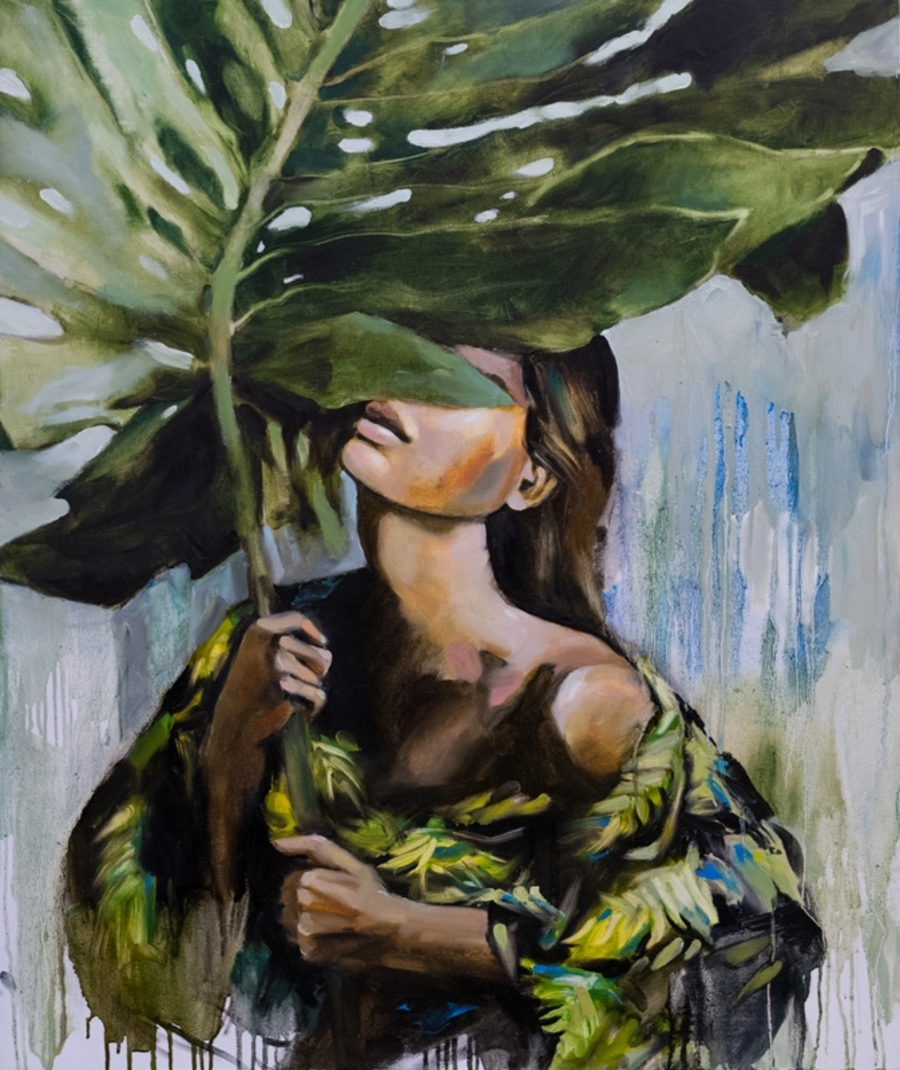
Valeria was born in a closed Siberian town where nuclear waste is still stored. Lifeless desert polygons, where there is not a single tree created the dull look of her hometown. She received two educations in painting and landscape architecture, which are closely intertwined in her artworks. She is a full-time artist and runs an art school where grow over 50 types of plants. With her artworks, Valeria tries to comprehend how it happened that we went so far from our natural essence and created something as destructive and terrible as radioactive energy and weapons.
By Lindsay Wilson
By Victor Hugo Mendevil

By Windy Martinez

By Jackie Martin
By Samantha Edmonds
By Jeffrey J. Higa