Letter from the Editor
By John Hardberger

2nd Place Nonfiction
2020 Summer Contest
“Shitkicker” is a frank and necessary exploration of western masculinity–its tone bravely confessional and hardscrabble like the land itself. This story hangs its hat on half-truths, deftly navigating the hazy borderlands of privilege and bi-racial identity in crisp, tightly packed scenes that invite us, with irony, into an America that is anything but either-or, black and white. That it does so with such vulnerability and tenderness is to show us a better world beyond the barbed wires of patriarchy.
– Amy Irvin
Wearing this hat doesn’t make me a cowboy. I feel like an imposter, not a “cowboy.” There is not a singular reason why I wear it or why I started wearing it in my thirties. It wasn’t a conscious decision. It just stuck. My dad wore hats, boots, and bolo ties. He doesn’t anymore. He gave me his boots, an old-white-straw Stetson and sourly said, “You can keep’m. I don’t dress country no more.” He looked into the ground as if disgusted by the notion of donning a hat again. I looked at the newly waxed black boots on my feet. They made me feel like a man. They made me feel straight, not like the pretentious intellectual homosexual my parents thought I was.
“What do you mean by that dad?”
“I mean I don’t dress country no more. I don’t like it.”
“Did something happen?”
“Nope, I just don’t like it no more. There’s some pearl snaps in the closet you can take if you want.”
So I took them, along with some pants. Wranglers, bootcut. I wore them until my knees bled through the denim and my money clip shot through the back left pocket. My dad stopped being country and I started pretending to be.
He gave me all this stuff shortly after he got out of rehab for drinking too much cheap Early Times whiskey and holding my mother hostage at gunpoint. When my sister called me in the midst of it, I thought he’d killed himself. My brother-in-law was a Sheriff and the first one on the scene. My sister called me from the driveway when my dad let my mom go, fired two rounds inside the house, then snuck out the back into the black bleak plateau of the desert grasslands spanning from our back yard 50 miles south to Deming. He just walked out the back door because the three deputies just stood behind their vehicles facing the front of the house. They all just waited with tears and guns pointed at the house for him to emerge or just not.
He eventually came out of the darkness. They didn’t notice him; my dad walked right up to one of the deputies with a .308 rifle over his shoulder and surrendered.
No charges were pressed. My mother pressed none and my brother-in-law was one of the Sheriffs that arrested him. He later told me when he first arrived he walked right up to the front door and knocked, he was greeted with the barrel of a rifle to his chest and my dad said: “I’ll fucking kill you if you try and come in here.”
“It seemed like there was some sort of demon that took over your dad. It didn’t even sound like Russ.”
The only tangible reminder of the incident are two bullet holes in the kitchen ceiling. We never talked about it then, and haven’t since. My mother stayed with him through it all because she’s a poor old Mexican and he’s a slightly less poor honkey. She stayed with him out of necessity and circumstance, not love. Separation easily becomes too inconvenient, and codependence looms large. A divorce at 70 is like uprooting a 2,000 year old Juniper.
Old white women love the hat; they always smile at me. Straight, young white women like the hat; young lesbian women hate the hat; black women think I’m a racist. A guero in a hat. Law enforcement love the hat. They don’t profile white males with cowboy hats in diesel trucks. I haven’t been pulled over in years. “The hat demands authority,” is my sardonic explanation for friends who ask, but it’s not the explanation I offer for the aesthetic privilege it has entitled me to. The hat is only half me, and half the hat is only half of what I am. Marlboro-Man wannabe and bean-eating wetback. Grandson to a bigoted World War II vet, grandson to a Mexican mineworker who went on strike against the Empire Zinc Company. The perfect crown of an embattled white-passing Chicano male. The platitude of duality embodied in a single piece of apparel.
I’m usually the only one with a hat on in any given room—even in Albuquerque. The first time I ever wore a hat semi seriously was years after I’d left Silver City and graduated from college. I bought a cowboy-cut black blazer and some tight Chicano-brown Wrangler slacks from the thrift store for a party. I borrowed an ivory shantung straw Garth Brooks hat from a friend. When I walked into the room my girlfriend at the time screamed, “That’s my boyfriend everyone!” The hat demands authority. It was the single most flagrant display of public affection I’ve ever received in my life. “It suits you,” she said. “You look like your dad. Very handsome.”
The next time she’d see me in a hat would be six years later. I was in a Cavender’s Twister 2X Dallas black felt cowboy hat that I’d bought two years prior before a trip to the Grand Canyon. It’d gathered a lot of dust and wear at that point; she avoided me while her new boyfriend stood in the corner. He oddly evaded people while taking pictures of them with a Horseman 35mm camera. He had on a grey gambler hat, the posh porkpie alternative to a commoner’s cowboy headpiece. For once, I wasn’t the only man in any given room with a hat on in Albuquerque.
The second time I seriously wore a cowboy hat was to a funeral for my dad’s best friend Wayne. He was a necessary acquaintance at best. I never saw my dad seek out Wayne’s friendship, or any friendships for that matter. It was always just Wayne needing my dad for money here and there. They’d been truck drivers together somewhere. I remember him making us pancakes in a trailer in Battle Mountain, Nevada. The funeral was in the front yard of his house in Hurley, New Mexico, 20 miles southeast of Silver City. He was buried under the only tree there, and his wife Nancy was drunk on Miller Lite by the time we arrived.
“She’s a fucking piece of shit,” my dad told me as we pulled up. “She probably killed the poor bastard.”
The yard was only big enough to let a small dog piss on the edges of the fence. I thought it was appropriate to dress the part. It almost felt like a uniform. At that time my dad was still dressing country.
Before the standoff, my dad was working at a Ford dealership as a mechanic in a small town called Lordsburg, 40 miles southwest of Silver City. A bunch of shitkickers picked on him there. Men ground by masculinity to the point of blind apathy. They bullied a 70-year-old by drinking his Cokes marked “RWK” and eating his lunches marked “Russ” until he quit. My dad always went to work to work and that’s all. He never felt the need to make friends or pander to upper management; he just did his job and went home. He loved what he did in small sparks of accomplishment and inspiration, but mostly worked for the necessary wittles his whole life. I imagine it was those small-minded young mechanics that drove him over the edge, not his first son Robert, my estranged older half-brother, dying. An emotionally bitter man raised by a bitter man, my dad let life cascade over him. Sentiment sinks in a parabolic tease. It sinks in me too. I wanted to kill those men.
One of the only times my father talked about my brother was one of the few times I saw true fear in his eyes. “I wouldn’t shake your brother’s hand without a gun in my waist. Some people are just bad. Your brother is bad that way.”
Robert spent more than half his life in prison and was gunned down by a couple junkies in his home. Unfortunately this and one other memory is all I have of him.
The third time I wore a cowboy hat it stuck.
The boy inside me wants to be a cowboy; boys inside the husks of men, little boys who don’t know what a cowboy is anymore, never knew. Not like we knew 150 years ago. We never knew what a cowboy was. Boors in hats. Gentlemen holding doors open. Killers. Healers. Whisperers. Racists. Natives. Tillers. Women. Contractors of meat. Rednecks and country bumpkins. Shitkickers. A culmination of misplaced sentiment poured into a void romantic figure riding into the sunset. Outlaws, frontiersmen, pioneers. The idea is far more beautiful than reality, and the reality only a little less terrifying than the fantasy.
I feel the need to tell strangers in cowboy hats that I grew up on a ranch in order to validate my head ornament. It seems as if they always feel a curious obligation to approach me, like we’re in a circle jerk boys club. I’d rather not engage them for fear they find out I’m some sort of imposter, for fear I find out they’re some sort of imposter. We act as if there is a prerequisite to wearing a cowboy hat, but no one knows what that criteria is. A lot of them seem to think it’s rooted in the toughness of one’s upbringing—thinly sliced sharp white machismo. It’s the look of mud splattered on innocence, smeared with the fingers of fear and hate that our fathers wash off with the act of simple provision. The mirrored encroachment of this is what I aim to avoid.
“You look like a real shitkicker. Can I bum a smoke from you?”
“Where you from?”
“Turkish Royals? I wouldn’t expect you to smoke these.”
“I grew up on a ranch,” I say. “It’s about 15 miles east of a little village called Mimbres. You’ve never heard of it.”
“Try me.” A half-fibbed explanation of where they are from ensues.
“Noonday Canyon. Ya heard of it?” I ask.
“No I haven’t.”
“That’s because it’s half-fibbed, like the ranch you’re from.”
“What’s half-fibbed mean?”
***
Noonday Canyon rests in the bed of the Blackrange Mountains on the outskirts of the Gila National Wilderness. Our family’s ranch house was about 10 miles down a road of sun-soaked unforgiving dirt, cavernous washboards, and two arteries of water you have to cross that bleed into the Mimbres River. The incline of the road above the second creek crossing nearly feeds vehicles to the heart of the canyon at 40 degrees, rising about 50 feet in elevation. The access levels to a plateau of only two residences: our ranch house a little north against the border of the Gila, and our neighbors (whom we called the meditators) directly south. The walls of the canyon formed and folded into each other, slated pink rock turning and tossing as a natural accordion of erosion shouting in the symphony of a million glorious years before a human eye could even process it. On the plateau we could look east to the canyon’s creek and the mountains, and north to the hills rolling onward into the Gila, and south to the meditators’ meticulously built stone and concrete retreat.
I had an unlimited amount of space to roam, and none with whom to roam. My dad worked at Chino Mines, same as my grandpa, as a mechanic, and tended to the cows as a ranch hand when he could to pay rent. My mom stayed at home and cared for me, the youngest child, and my sister, who was in her early 20s at the time.
This place was the fertile ground of the Mimbreño, Chilende, or Warm Springs Apaches. I saw the stars in the ground: the obsidian of shattered arrowheads, the smooth eroded white of rare pottery shards, and the bones of the old souls that called this home. I desecrated their land with my soft white palm.
I was less inclined to learn about cows, build barbed-wire fences, or kill large game. I wanted to dig and find those rare pieces of ornate pottery. I awkwardly shifted into the paradigm of rural life. A shitkicker, lifting dried cow patties up and digging my fingers into the basura.
I didn’t like riding horses, or cutting the balls off bulls or branding their hides. I probably have the process mixed up because I didn’t like it. I never minded killing small game: rabbits, gophers, squirrels, and such. I used to get a rush out of hunting them down. It scares me that I enjoyed it; it scares me that I might enjoy it now. The one time my dad took me deer hunting I hated it. This wild, majestic animal shot in the spine on the side of a hill spilling its shit out and trying to crawl to safety left a sour taste in my mouth. I looked through the scope and had him right in my sights. I stopped before pulling the trigger.
“I don’t know if I want to kill him dad.”
“You want to kill him.”
I put my eye back to the scope and shot him. I now know it was because I was the better shot.
“I’d rather be looking for pottery,” I thought while carrying the hind legs of this lovely stinking beast. “I’d rather look to the ground until I’m nearly blind.” The ground begins to shift with life when you look into the navel of the Earth long enough. That’s no kind of shitkicker, one who prefers books and collecting to killing and collecting. The shitkicker that actually kicks shit and sticks his hands in it in the off chance a cow accidentally ate a pottery shard. I never minded it; cow and horse shit doesn’t stink nearly as bad as our shit. My dad would look on in blind astonishment, laugh, and think, “What kind of weird faggot-ass kid do I have here?”
Let me kill this Holy Land, father, let me kill it with you in my own way. This is how we can exist together.
My dad wore a lot of cowboy hats then. They served a practical purpose. Out there in the watching sun marking us as indistinguishable inhabitants of time. He was out there a lot. I was out there too, but he never gave me one. I never thought to ask. I never cared to have one, and he never cared to offer.
I’d been escaping it, and just let the thing crawl upon my head in an act of irony, vain homage, or need. That childish need of some sort of fatherly acceptance that rises later in life. It’s probably because of all three.
Mr. McDermot wouldn’t sell my dad the ranch house. We just wanted the residence and the few acres it existed on, but he couldn’t part with it, despite having an empire matching Turner’s. I remember our last day there; my dad looked to the folded pink stone of the canyon, his white hat engraved upon the landscape like an epitaph, and said, “You’ll miss this place.” His cracked and swollen hands cupped a large white plastic cup, its outside streaked with dirt. Inside was a lot of Early Times and a little bit of Coke.
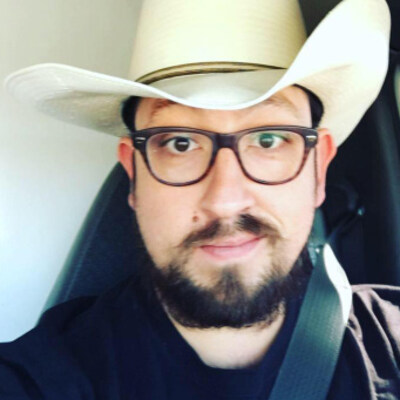
Jeremy Mata Kinter is a writer from Silver City, New Mexico and currently resides in Albuquerque. He has written and edited for the arts and culture online publication Pyragraph. He earned his degree from Western New Mexico University with a Bachelor’s in English Literature. He draws inspiration from his rural Southwestern upbringing, as well as American Southern Gothic influences.
Frederick has a BA in philosophy (Boston University, 2006) and pursued graduate study of the same at Loyola University before leaving his combined MA/PhD program for mental health reasons in 2011. He now works part-time for a mental health nonprofit, doing outreach and education at high schools around Chicago and assisting with trainings for the city’s first responders. Frederick lives and paints in Rogers Park, where he has been for 13 years. Frederick is also an active member of Chicago’s improv comedy community.
By Lindsay Wilson
By Victor Hugo Mendevil

By Windy Martinez

By Jackie Martin
By Samantha Edmonds
By Jeffrey J. Higa