Letter from the Editor
By John Hardberger

Poems by Joy Harjo, from the book In Mad Love and War, © 1990 by Joy Harjo, published by Wesleyan University Press, Middletown, CT and used with permission.
“For Anna Mae Pictou Aquash, Whose Spirit Is Present Here and in the Dappled Stars (for we remember the story and must tell it again so we may all live)”
Beneath a sky blurred with mist and wind,
I am amazed as I watch the violet
beads of crocuses erupt from the still earth
after dying for a season,
as I have watched my own dark head
appear each morning after entering
the next world
to come back to this one,
amazed.
It is the way in the natural world to understand the place
the ghost dancers named
after the heart/breaking destruction.
Anna Mae,
everything and nothing changes.
You are the shimmering young woman
who found her voice,
when you were warned to be silent, or have your body cut away
from you like an elegant weed.
You are the one whose spirit is present in the dappled stars.
(They prance and lope like colored horses who stay with us
through the streets of these steely cities. And I have seen them
nuzzling the frozen bodies of tattered drunks
on the corner.)
This morning when the last star is dimming
and the buses grind toward
the middle of the city, I know it is ten years since they buried you
the second time in Lakota, a language that could
free you.
I heard about it in Oklahoma, or New Mexico,
how the wind howled and pulled everything down
in a righteous anger.
(It was the women who told me) and we understood wordlessly
the ripe meaning of your murder.
As I understand ten years later after the slow changing
of the seasons
that we have just begun to touch
the dazzling whirlwind of our anger,
we have just begun to perceive the amazed world the ghost dancers
entered
crazily, beautifully.
In February 1976, an unidentified body of a young woman was found on the Pine Ridge Reservation in South Dakota. The official autopsy attributed death to exposure. The FBI agent present at the autopsy ordered her hands severed and sent to Washington for fingerprinting. John Trudell rightly called this mutilation an act of war. Her unnamed body was buried. When Anna Mae Aquash, a young Micmac woman who was an active American Indian movement member, was discovered missing by her friends and relatives, a second autopsy was demanded. It was then discovered she had been killed by a bullet fired at close range to the back of her head. Her killer or killers have yet to be identified.
“City of Fire”
Here is a city built of passion
where live many houses
with never falling night
in many rooms.
Through this entrance cold
is no longer a thief
and in this place your heart
will never be a murderer.
Come,
sweet,
I am a house with many rooms.
There is no end.
Each room is a street to the next world.
Where live other cities beneath
incendiary skies. And you have made
a fire in every room.
Come.
Lie with me before the flame.
I will dream, you a wolf
and suckle you newborn.
I will dream you a hawk
and circle this city in your
racing heart.
I will dream you on the wind,
taste salt air on my lips until
I take you apart raw.
Come here.
We will make a river,
flood this city built of passion
with fire
with a revolutionary fire.
“Santa Fe”
The wind blows lilacs out of the east. And it isn’t lilac season. And I am walk-
ing the street in front of St. Francis Cathedral in Santa Fe. Oh, and it’s a few
years earlier and more. That’s how you tell real time. It is here, it is there. The
lilacs have taken over everything: the sky, the narrow streets, my shoulders,
my lips. I talk lilac. And there is nothing else until a woman the size of a fox
breaks through the bushes, breaks the purple web. She is tall and black and
gorgeous. She is the size of a fox on the arm of a white man who looks and
tastes like cocaine. She lies for cocaine, dangles on the arm of cocaine. And
lies to me now from a room in the DeVargas Hotel, where she has eaten her
lover, white powder on her lips. That is true now; it is not true anymore. Even-
tually space curves, walks over and taps me on the shoulder. On the sidewalk
I stand near St. Francis; he has been bronzed, a perpetual tan with birds on his
hand, his shoulder, deer at his feet. I am Indian and in this town I will never
be a saint. I am seventeen and shy and wild. I have been up until three at a
party, but there is no woman in the DeVargas Hotel, for that story hasn’t yet
been invented. A man whose face I will never remember, and never did, drives
up on a Harley-Davidson. There are lilacs on his arm; they spill out from the
spokes of his wheels. He wants me on his arm, on the back of his lilac bike
touring the flower kingdom of San Francisco. And for a piece of time the size
of a nickel, I think, maybe. But maybe is vapor, has no anchor here in the sun
beneath St. Francis Cathedral. And space is as solid as the bronze statue of St.
Francis, the fox breaking through the lilacs, my invention of this story, the
wind blowing.
“The Book of Myths”
When I entered the book of myths
in your sandalwood room on the granite island,
I did not ask for a way out.
This is not the century for false pregnancy
in these times when myths
have taken to the streets.
There is no more imagination; we are in it now, girl.
We traveled the stolen island of Manhattan
in a tongue of wind off the Atlantic
shaking our shells, in our mad skins.
I did not tell you when I saw Rabbit sobbing and laughing
as he shook his dangerous bag of tricks
into the mutiny world on that street outside Hunter.
Out came you and I blinking our eyes once more, entwined in our loves
and hates as we set off to recognize the sweet
and bitter gods who walk beside us, whisper madness
in our invisible ears any ordinary day.
I have fallen in love a thousand times over; every day is a common
miracles of salt roses, of fire in the prophecy wind, and now and then
I taste the newborn blood in my daughter’s
silk hair, as if she were not nearly a woman
brown and electric in her nearly womanly self.
There is a Helen in every language; in American her name is Marilyn
but in my subversive country,
she is dark earth and round and full of names
dressed in bodies of women
who enter and leave the knife wounds of this terrifyingly
beautiful land;
we call ourselves ripe, and pine tree, and woman.
In the book of myths that fell open in your room of unicorns
I did not imagine the fiery goddess in the middle of the island.
She is a sweet trick of flame,
had everyone dangling, laughing and telling the stories
that unglue the talking spirit from the pages.
When the dawn light came on through the windows,
I understood how my bones would one day
stand up, brush off the lovely skin like a satin blouse
and dance with foolish grace to heaven.
“Transformations”
This poem is a letter to tell you that I have smelled the hatred you have tried
to find me with; you would like to destroy me. Bone splintered in the eye of
one you choose to name your enemy won’t make it better for you to see. It
could take a thousand years if you name it that way, but then, to see after all
that time, never could anything be so clear. Memory has many forms. When I
think of early winter I think of a blackbird laughing in the frozen air; guards a
piece of light. (I saw the whole world caught in that sound, the sun stopped for
a moment because of tough belief.) I don’t know what that has to do with what
I am trying to tell you except that I know you can turn a poem into something
else. This poem could be a bear treading the far northern tundra, smelling the
air for sweet alive meat. Or a piece of seaweed stumbling in the sea. Or a
blackbird, laughing. What I mean is that hatred can be turned into something
else, if you have the right words, the right meanings, buried in that tender place
in your heart where most precious animals live. Down the street an am-
bulance has come to rescue an old man who is slowly losing his life. Not many
can see that he is already becoming the backyard tree that he has tended for years,
before he moves on. He is not sad, but compassionate for the fears moving
around him.
That’s what I mean to tell you. On the other side of the place you live stands
a dark woman. She has been trying to talk to you for years.
You have called the same name in the middle of a nightmare,
from the center of miracles. She is beautiful.
This is your hatred back. She loves you.
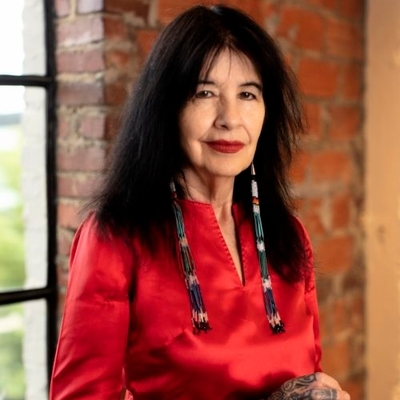
Joy Harjo is the U.S. Poet Laureate. She is the author of What Moon Drove Me to This?, In Mad Love and War, The Woman Who Fell from the Sky, She Had Some Horses, and Crazy Brave: A Memoir.
Author photo by Matika Wilbur
Julianna Bolanos is a student at the University of Hawaii at Manoa, on her way to obtaining a bachelor’s degree in Studio Art with a focus in glass blowing and sculpture. Originally from Austin, Texas, she hopes to travel to and experience art in every form from all cultures, building connections and creating collaborative masterpieces until the very moment she dies.
Tessa Anderson is a student from the University of Minnesota studying human physiology, neuroscience, and public health on an exchange program at the University of Hawaii. While in Hawai’i, she’s tapped into her creative flow, drawing inspiration from the healing powers, beauty, and sacredness of Mother Earth on the island of Oahu. She hopes to use her mind, body, and soul together to create a space of healing one day.
Franklin De La Cruz is a 21 year old student of the Dominican diaspora living in the US mainland (Occupied Calusa and Seminole land). While studying away at UH last fall he found inspiration in the beauty that surrounded him. More than ever while in Hawai’i, he realized the opportunity for light in a world smothered by darkness, and vowed to relay that in everything he creates, in hopes of creating a radically distant future.
By Lindsay Wilson
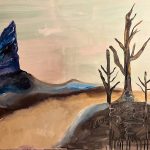
By Victor Hugo Mendevil

By Windy Martinez

By Jackie Martin
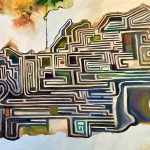
By Samantha Edmonds
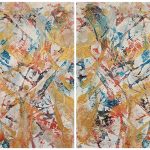
By Jeffrey J. Higa