Letter from the Editor
By John Hardberger


1st Place Nonfiction
2018 Summer Contest
“Pergelation” tells a story about a desolate Antarctic coastline at the edge of the world, but its deepest excavations—into the residence of loneliness and the fragile surprises of intimacy—deliver us to far more intimate reaches of the ordinary, infinite human heart. It’s funny, tender, visceral, curious, and constantly attentive to the small fissures and desires that contour—like forces of weather—the landscape of our living.
– Leslie Jamison
I stood inside a tiny unheated trailer on the Antarctic coast and tried to convince myself that leg lifts were relevant to anything in my life. I had unearthed a pile of VHS exercise tapes while doing inventory, plugged the ancient black and white TV into the one working outlet, and was attempting to perform what home-exercise guru “Jenifer” called “Power Yoga.” Onscreen, Jenifer directed an unseen public of fellow home exercisers (the rest of whom, I hoped, had recently taken amphetamines) from a beachfront in Miami. Inside the trailer, one of five modular units that comprised the helicopter refueling station called Marble Point Air Facility, I sweated along with the heavily pixilated green-tea chugging Bond girl armed with five-pound hand weights. Outside, a wind-scraped coastline abutted the Wilson-Piedmont Glacier on a tiny spit of exposed land about fifty miles from the nearest research base and a continent away from civilization.
I couldn’t go running, my usual habit, on the ice-pocked shore or the crevasse-riddled glacier. At thirty degrees below zero, I couldn’t really do much of anything athletic outside besides walk and shovel snow, not while wearing fifteen pounds of parka and boots. Ever since my job had transitioned from the daily unburying of entire buildings with a snow shovel, to sitting around inside those buildings and waiting for a helicopter to refuel, I had begun to watch my waistline with suspicious foreboding. Taking out my own anxious boredom on my body wasn’t exactly original, but it was classic in a way that was never threatened by self-awareness. When I found the old exercise videos, it hadn’t been a jump to shut myself inside the pilot’s bunkhouse and try the bulky VCR leftover from a more populous season. The crackling image of Jenifer encouraged me to push myself, but also warned me that this move was difficult. Then we would move on to triceps together. Everyone feeling alright? Let’s go.
I turned the video off and briefly considered burying it in the snow, but then thought better of it—once unwound from the confines of the plastic cassettes, the VHS ribbons would make great wind telltales or could be used for tying bows on impromptu gifts. As I relayered my multiple shirts and insulated overalls over my increasingly unfamiliar skin, I resigned myself to my long daily walks for exercise.
After lacing my boots and zipping my parka I stepped outside, letting the trailer door bang shut behind me. The sound echoed hollowly. White assailed me, and it took several moments of blinking spots before my eyes adjusted and the world realigned into snowy gradients. The glacier rose behind our encampment as an icy white wall, adjacent to a snow-encrusted coastline, which curved around rectangular slabs of frozen white sea-ice in the bay.
I had been working in Antarctica for a time period that seemed to stretch, continuous—one long day. The sun had not set in five months. It was hard to think about time clearly. I had dreams in which my hair grew beyond my waist overnight, my unconscious’s protest against the decision to work somewhere with virtually no environmental indications of the passage of time.
The skies were clear enough that the mountains were visible, white peaks looming in the distance from behind the glacier. It looked like flyable weather. It had been days since we’d heard the whop whop whop of a helicopter approaching. With nothing to refuel and no one to feed, the only three residents of Marble Point Air Facility were getting restless. I trudged toward the largest trailer that served as our heated living space. I didn’t feel ready to be back in the same room as the other two, but I was getting cold.
Griff had hired me, he told me later, for three reasons. First, it was good form to keep the position filled, despite the fact that this was slated to be the slowest season on record and he didn’t really need me; he didn’t want to risk the government pulling the funding for the assistant manager/cook position for all future seasons if he went without one once. Second, I was a Yankee. Third, I had just finished a contract at South Pole, the landlocked station at the center of the Polar Plateau. Griff himself was a New Englander who had spent over a decade working at South Pole, so his biases were clear. Gray-haired and sun-ravaged, Griff looked like he was pushing sixty, but moved and spoke like a man in his twenties, an incongruence so complete that I sometimes had to look directly at him to remember who the banter was coming from.
Andrew, the only other denizen of Marble Point—mid-forties, ginger-bearded, bespectacled, and enamored of his own lexicon—had been hired as the fuels specialist because he had once beat Griff’s least favorite administrator in a Scrabble tournament.
Both men were on the couches in our main living area, predictably engrossed in one of their favorite topics: The Long Emergency. About 40% of their conversations concerned this, the coming period of crisis when oil would run out and global warming destroyed civilization as we knew it. Griff and Andrew priced out off-the-grid real estate, researched visas to hospitable-seeming foreign countries and local planting techniques, and compiled practical information on moonshine. They planned around the pylons of society with ideas involving everything from steam engines to pandemic prevention. I found it both ironic and apropos that they were deep in preparation for a total separation from society while living on the most far-flung reaches of it.
Both men looked up when I came in. “Hey,” Griff said.
“Hi.” There was a pause in which I considered saying something about the ridiculous exercise videos, bikini season, neuroses and whichever past residents had brought the videos down in the first place, but this wasn’t the crowd for it. Instead, I looked blankly at them. They looked blankly back.
Sometimes I wondered what they thought was going through my head during my increasingly frequent moments of socially isolating self-censor. Sometimes, I wondered if they noticed.
Griff smiled vaguely, then, having acknowledged my presence and seen that I did not look like I was going to say anything more, picked up the thread of a self-sufficient greenhouse again. “So, if you connect the stove pipe to the glass…”
I hung my mittens up slowly, then my hat, and my top two sweaters, putting a lot of effort into infusing my puttering with as much purpose as possible.
The last plane on or off the continent had left six weeks earlier in February. The next one would come to the nearby research base, McMurdo, at the end of April. That last flight would be the one all three of us left on, the only flight before the long, dark winter season. Until then, there would be no mail from off-continent, no fresh food, no new supplies. At Marble Point, we had even less access to goods than folks at the main base. Fresh apples had been the most recent new produce I had seen, and I’d diced and baked them to make them last.
All helicopters into the Dry Valleys came through Marble Point for fuel and food. I was responsible for feeding and, in the event of an emergency weather hold, housing all pilots, helicopter technicians, and passengers—usually near-sighted microbiologists and alcoholic glaciologists—who passed through the valley. In the high season, this meant several flights a day. Now it meant one or two a week.
Except, of course, when bad weather kept them from flying at all.
In my free time, I did the bare modicum of preventive maintenance on the few areas of camp that had been deemed my jurisdiction, and spent a lot of time trying to coax “seasonal” meals out of our supplies. I rejuvenated dried fruit by soaking it in water, recreating dishes like “Autumn Pork Sauté” with dehydrated cider packets. I was the only one who cared. If I put it on the floor and stepped on it, Griff would eat it. His recent decision to microwave thirty-year-old Fig Newtons and subsequent declaration that they were “as good as new”—a declaration made while extinguishing the one that had caught on fire—only cemented this certainty. Still, I persisted in my quest to make frozen fruits and vegetables and hydrophobic, shrink-wrapped salmon taste like more than average food. I wasn’t sure if this put a little extra meaning into my life, or if it was just one more scene in the ongoing middle school play that was “normal life” in Antarctica. I kept doing it either way, covering defrosted textures with powdered yogurt sauces.
My boyfriend had mixed feelings about my decision to accept the three-month contract at Marble Point. These consisted of part disappointment that we would not be together for my birthday, part anger that I had abandoned our plans to travel together in New Zealand in favor of the job, part jealousy that I had gotten a coveted position in the field camps, and part mysterious male emotion that was only communicated through quasi-affectionate pot-shots and the downgrading of email closings from “Love, Chris” to “-C.” As long as the emails kept coming, I figured it was probably not a good idea to point out this last demotion.
In my own emails I avoided whiny statements such as “I haven’t seen another woman in five weeks,” or, “the batteries for the vibrator you mailed me are dead.” Instead I wrote him details of my long walks, described the different colors I was beginning to see on the coast as the months drew closer to sundown, and made pointed remarks about adventures that we could go on together once my contract ended.
Griff, Andrew and I were capable of spending hours clued to our respective laptops in a still life around the table. We lugged our drinking water from the nearby glacier, maintained an elaborate grey water evaporation system, had only one scratchy, semi-useful phone line that was largely ignored in favor of the more functional VHF radios, and were completely dependent on helicopters for all goods and materials, but we had wireless internet bounced off of a now-defunct Russian satellite four days out of every seven. In bad weather, the system often stopped working, causing predictable mayhem and social chaos in our tiny community. Today, though, the connection was up, and while I wrote determinedly cheerful emails to the boyfriend who might or might not still be my boyfriend, Griff and Andrew were consumed by the pastime second only to planning for the Long Emergency: options trading.
Options trading was a new activity for the two men. I had come back after a long hike one day to find them both particularly quiet and consumed by their computers. I was immediately unsettled. “What’s going on?” I’d asked.
“We’ve been getting smart,” Andrew told me. “We just watched an instructional video on options trading with the stock market.”
“Yeah,” Griff said. “Some guy in McMurdo did a talk and they filmed it, and Bob sent it to us last week. I think he knows what he’s talking about. The options trading guy.”
“He has a really big mustache,” Andrew said. Since then, options trading had been a highlight of their day on the World Wide Web.
They were pouring over dividend payment dates when without warning, the internet went down. After 30 minutes and 180 clicks of “refresh,” they ascertained that the internet was not flickering, but indeed gone. Griff and Andrew paced for a bit, then sat on the couches, sullen. Bad weather in McMurdo meant no helicopters, no helicopters meant no fuel to dispense and thus no work to do, and now, the final indignity, the internet had gotten the kibosh. It was so overwhelming they didn’t even have the energy to discuss alternative farming methods in the event of nuclear war.
“I’m going on a hike up Hensleigh Hill,” I said, naming a nearby landmark that doubled as a visibility marker in our regular conditions reports. “I’m bringing a radio. Call me if someone launches from town.”
“Take a thermos with you,” Griff said from his sulk on the couch. I made a peanut butter and jelly sandwich and a large carafe of hot chocolate, threw both into a backpack and set off.
More than the white, more than the cold, was the silence. After just ten minutes of plodding, the camp’s small generator could no longer be heard. The dry snow crunched loudly under my feet, echoing in my hat-muffled ears, but if I stopped walking for a minute, pulled the hat off and waited for my breath to slow, the only thing I heard was the thud of my pulse.
I revered that stillness, but occasionally it crept its way towards uncanny. Then—or sometimes when I just wanted the contrast—I would talk to myself. I gave speeches or recited other people’s words, the odd poem I had memorized or a nice set of phrases remembered from a recently-read book. When the stillness either swelled too big or, conversely, shrank to no longer noticeable, I would conjugate verbs out loud. Then the silence would become just what it was again, a simple lack of sound, neither unnoticed nor personified.
The scale of the valley made for misleading proximities. The snowscape was foreign enough to confound normal estimations, and the mountain ranges seemed to expand the horizon rather than hem it in, the dominance of white multiplying the mountains like an infinity mirror. I was glad for my dark goggles even under the gray tinge of clouds.
Near the top of the hill an odd shape caught my attention, something discrete and linear partially buried in the snow. My first thought was a tree branch, though of course, there were no trees. As I looked a larger shape emerged, bigger than the small piece I’d seen at first. It wasn’t until I saw teeth that it clarified and I realized what I was looking at: a desicated, partially decayed seal skeleton.
It took conscious effort to not jump backwards. In the cold it had no smell, otherwise I might have noticed it sooner, not almost tripped on it. The skeleton showed more teeth than I was used to seeing on the live seals that lolled on the shore—the lack of mouth around its jaws made it look like it was in the act of biting something. I couldn’t figure out what a dead seal would be doing so far up a hillside. I’d never seen one more than 200 yards from water.
I sat on a nearby rock, close enough to the seal corpse that I could still stare at it but far enough away that if it decided to come alive and attack me—an absurd notion, I knew—I would have time to scramble away. It was several minutes before I could wrest my eyes away to look around at everything else below me.
I could only just make out our camp—five orange specks below me. I got out my thermos and ate the now partially-frozen PB&J, pretending the ice crystals were nuts. Then, on hands and knees, I crawled the last of the way up to the summit. It was steeper than it looked from camp. The skeleton felt like a warning, and chastened, I took care not to slide on the snow covered rocks.
Three days later the weather at McMurdo finally broke and two helicopters launched. Both the Bell 212 and an A-Star landed for lunch and fuel and a crowd trooped in: the pilots, Charlie, John, and Bob, as well as the two helicopter technicians, Ted and Evan. After the enduring silence of many traffic-less days, the chopping blades descending over the camp seemed deafening, and the sudden onslaught of other people’s voices just as much so. I put stacks of fresh cookies on plates near the entrance to the kitchen in an attempt to buy more time to serve lunch. One by one the new arrivals stumbled into the building, the younger men swatting at their helmet hair and the older ones wishing they had enough hair to be mussed.
“We figured you lot had died out here,” Ted said around a mouthful of cookie.
“We thought about it,” Andrew said while I knocked out a tray of corn muffins onto a cutting board. “But then we remembered eBay, and knew we still had something to live for.”
The guys banged around the kitchen, grabbing mugs and glasses from the cupboards and pouring long draughts of Kool-Aid and coffee. Evan smiled widely and earnestly complimented my cookies, then stood awkwardly for a ten-count in the middle of the kitchen. This was par; Evan came out strong and floundered immediately. The youngest of the crowd, only ten years older than me, you could tell he’d have moral qualms about picking me up even if he was succeeding.
“I have a theory about creepiness in guys,” Griff explained once. “Evan fits it perfectly. It’s like this: the longer you go without being laid, the creepier you get. As soon as you get laid, you stop being creepy. Women can smell it on you.”
“Huh,” had seemed like my safest response at the time, so I’d gone with that. That same day a group of volcanologists had gotten stuck at Marble Point on their way back to McMurdo from Mount Erebus, and had spent an evening throwing back Griff’s whiskey and debating whether or not the volcano would erupt anytime soon.
“We need to sacrifice a virgin to it,” Andrew had said.
“Won’t find one in McMurdo.” “We can throw in Evan,” Griff had suggested. They’d all laughed until someone had threatened to puke Griff’s 18-year-old scotch.
I cringed at the untimeliness of remembering that particular conversation at that particular moment and hastily thanked Evan for the praise of my baked goods before shoving bowls at him to pass around. I set condiments on the table before everyone could bolt their chili down without the thawed blocks of cheddar, tortilla chips, and only slightly expired jarred jalapenos.
“Don’t let the helicopter crews bully you,” Griff had told me when I first arrived. “They’re all good guys and some of the best pilots around, but they’ll tease you something awful. It’s all in good humor so dish it back and you’ll be fine.” Forewarned, I had come out swinging, announcing on my first day that I was serving two options for lunch: take it, or leave it, with the added consideration that if they didn’t like either of those options, they could go do something unlikely with a screwdriver. They were delighted. Since then, I’d learned a bit of what they liked, mostly that anything hot and hearty (read: not vegetarian) would be well-received.
The two helicopter crews decimated the vat of chili, a few blocks of cheddar, and half a pot of lentil soup before sitting back around the table. Charlie and Bob traded notes about the military.
“You all got your pilots licenses through the service, didn’t you?” Andrew asked.
“Everyone but this guy,” said Charlie, jerking his head at Jim.
“Where’d you get your license?” I asked Jim.
Charlie answered for him. “John got his license in a Cracker Jack box.” They bullshitted over their coffee, trading stories. I had been longing for more company and people to talk to, but now that they were here, I was quiet. I held onto my coffee mug in my corner and listened to the talk being chucked around.
An hour later, the radios crackled instructions sending the helicopters two field camps over. There was a five-minute flurry of jackets, cookies tucked into pockets and food requests for their next stopover made, and suddenly the camp was empty again. I blinked. Then I started washing the dishes, letting the water trickle slowly onto the pots to conserve it.
When I first arrived in February, there was still open water in the middle of the bay, and the edges of the coastline at Marble Point were ringed with slush instead of solid ice. Green and blue pools, peppered with cracked ice sheets and the marks of seals’ air holes, ran between the sea ice and the coastline. Seals emerged to loll on the shore, and I could watch the slow rise and fall of their flanks as they breathed.
I found then that I could draw an oddly comforting connection between this coast and the shores of home. The ocean here didn’t crash with surf, but small waves, weighted down with cold and hidden under icebergs, made barely perceptible motions against the shore. I could hear these waves if I listened for them, the slow, suppressed rush of water in and out against the rocks, it’s rhythm slightly slower than the musky snores of the seals’ breathing. The slush that dotted the water clumped and swayed in time with this still-discernable cadence, a slow motion telegraph tapping out the message: the ocean lives under here. The seals only proved the point that the broken ice was just a lid on a living body of water. I could listen to it from the shore, a safe distance from the indolent bulks of the Weddell seals, blinking frequently to keep my eyelashes from freezing together.
As the weeks passed, though, and the sun began to dip under the horizon—first for one hour, then four, then seven hours a day—the solid ice crept all the way up to the rock’s edges. One day I was surprised to notice that I no longer saw any blue at all that wasn’t the sky: the water was all white, all solid. Neither, I realized, had I seen the seals, not for days. I felt oddly bereft.
With the freezing of the shores came an equally marked slowing of my communications with the outside world. I paused over my keyboard now. Instead, I went on longer walks. Sometimes I stood on the glacier and shivered not because of the cold, but because of the desolation in the beauty, and the feeling of life trapped under my feet. Two valleys over, microbiologists had recently discovered that it was possible for cells buried deep in the ice sheet to continue evolving and growing, even during the darkness.
Griff announced that I would be spending two nights in town: Charlie and Ted would helicopter me to McMurdo on Saturday morning and bring me back on Monday. The pretense for this trip was booze-and-grocery procurement and our laundry, but I knew better—Griff just wanted me to see some people my own age, namely other women.
“Okay,” was all that I said when he told me. But I looked forward to getting away from Marble Point for a few days. This trip was a chance for me to see Catherine. She was my one female friend still on the continent, a woman who had also worked at the South Pole Station and who was posted at McMurdo for the winter, supplying the field camps. Catherine was the reason why that last box of mail had contained six bars of dark chocolate hidden among the air filters Griff had requested.
The helicopter back to McMurdo was late, waiting on a geologist who had been dropped on a nearby mountain to collect samples. Bad weather was rolling in and Charlie fidgeted, then radioed him again. “I just need a little more time,” the geologist said.
“No, you don’t,” Charlie told him. We flew him back to his camp at Lake Fryxel. There was uncharitable chuckling at the unpracticed way he rolled out from under the rotor wash. The field camp manager attached a sling load to the bottom of the helicopter and we were off, headed to McMurdo at last.
I had worked it out in my head, and if we got to McMurdo by five, I would have time to hit the station’s gym and run three miles, then take a real shower—my first in weeks—and I’d still be able make it to the galley before it closed to meet Catherine. I obsessed over this timetable as we flew, imagining the joy of shorts and sneakers in a heated indoor space followed by the ecstasy of hot water. Outside everything was an ugly, monochromatic gray—gray helicopter, gray sea below and gray clouds all around. Charlie and Ted grumbled about the weather and the visibility. I half-listened as they talked about the wind gusts from the south.
In the talk I had been given before getting into a helicopter for the first time, I was told two things about crashing. First, not to get out of the helicopter until the rotors stopped turning—you didn’t want to survive a crash only to be decapitated on your way out. Unless it was on fire. That was the second thing. If the helicopter was on fire, you got out right away. And if it was on fire and the rotors were still turning, you were supposed to figure out yourself what you wanted to do.
Listening to Charlie and Ted’s terse conversation, I thought about what it would be like if the helicopter crashed. If a gust of wind lifted the sling load under the helicopter up into the air and then dropped it, the sudden yank on the sling-line might pull the floor beams out of the bottom of the craft. I wondered if and when I would know if we were crashing. I could imagine a dramatic fall, the helicopter swinging wildly, but I could also imagine that it might be like a normal descent, only with less talking. I would probably realize what was happening when we were four hundred feet from the ground and just have time to think something like Jesus Christ, I just wanted to get there by five and go to the gym, and then we would hit.
A few years earlier, Helo Seven-Nine-Uniform had gone down in the Dry Valleys. One of the first responders to the crash still worked at McMurdo and had told me about it. He said he’d taken the downed helicopter apart with his ice axe and Leatherman tool to get a passenger out. That was the part he talked about: how lightweight and flimsy the metal had been, how malleable. How he could disassemble the transom with handtools. He didn’t talk much at all about how sturdy the man inside had been. Nor had he gotten back into a helicopter since. I reached out now with one gloved hand, pressed it against the side of the hull, imagined how hard you would have to press to be able to make it bulge outwards.
Statistically speaking, 7.5 helicopter accidents happen every 100,000 hours of flying. About 0.105 helicopter accidents happen every season in Antarctica. Odds were that 0.05096 people would survive helicopter crashes every season in Antarctica. Only about 60-65% of Americans eat breakfast. Chances were only 0.03 Americans would survive a helicopter crash in Antarctica after eating breakfast.
What were the odds that someone would survive a helicopter crash after having a bowl of Rice Krispies with powdered milk, a microwaved Fig Newton, and 2.5 cups of coffee?
We didn’t crash. We landed safely on schedule despite the bad weather, but I didn’t go to the gym, or look for Catherine. I climbed out of the helicopter, looked at the dirty sprawl that was McMurdo, and went straight to a private pay phone tucked in the back of a seldom-used housing building that I had found on a previous stopover and called Chris. His phone rang unanswered. I thought about calling my parents, the only other number I had memorized, but it was three in the morning where they lived. I dialed Chris again, with less hope this time, just to listen to it ring. I set the receiver back in the cradle. Then I cried for the first time in months, tucked into an anonymous corner where I would be neither overheard by my coworkers nor risk having my face freeze. I hid there until after the galley had closed for the night.
The next morning I stepped gingerly around the research base. By the back entrance of the galley two men sat on the steps smoking cigarettes. I couldn’t differentiate between their exhaled smoke and the usual frozen breath, and wondered if the fact that smoking and breathing looked the same out here took a little of the joy out of the cigarette.
Catherine found me in the hallway outside the galley. She made a small, sibilant sound before wrapping her arms around me. Catherine smells like she’s been granted regular showers, I thought as I rested my chin on my friend’s shoulder.
Catherine kept her hands on my shoulders when she stepped back, looking from my right eye to my left and back again. “You’re here until tomorrow,” she said, a statement, not a question. She ran the flight manifests.
I nodded and lifted the right side of my mouth in a half-smile. “I’m fine,” I said.
“I figured.” She still hadn’t let go of my shoulders. “You know what? You’re going to cut my hair today. Short.”
“I’ve never cut hair before,” I said.
“I don’t care.”
“This is a bad plan.”
“It’ll be fun. Short-short. Boy cut. You’ll do great.”
Catherine shoved me up the stairs to her room, put scissors into my hands, and told me to have at it. Reluctant and terrified at first, I made tentative snips, but soon the floor was littered with Catherine’s hair and I was ordering her on how to tilt her head, throwing water on the ends to make them stick up.
Two hours later we were drinking coffee in the galley. Catherine shoved her hands through her new haircut once every few minutes, giving a small shriek of nonsensical delight. My muscles relaxed bit by bit. Later, we did Marble Point’s laundry together and I caught myself lecturing Catherine on the dangers of oil dependencies.
I picked up a few more novels and bought a bottle of Johnnie Walker to bring back to Marble Point. In the morning I returned to the helipad, got into another helicopter and took off.
“Welcome back,” Griff yelled at me over the din of the turbine. He kept his hand on my backpack as we half crouched, half ran out from under the shadow of the rotor blades.
“Thanks,” I shouted.
Griff patted my back a few times, his ear protectors perched crookedly on his head, then ran back to refuel the helicopter. I had taken my outdoor gear off and dropped my backpack in the kitchen when he came back in. “So…” he said. “Okay trip?”
“Fine,” I replied evenly. He nodded but kept looking at me, it seemed, for me to say something more, “It was okay,” I said. “It was good.”
“Good.” He waited another moment, then: “Did you bring us whiskey?”
Andrew stuck his head into the kitchen. “Hey! How’s it going?”
“Fine. I’m hungry. What have you guys been eating?”
Griff and Andrew exchanged a look. “Well. We thought about what would happen if the helicopters couldn’t fly and we had to spend the whole winter out here. So we tried getting some algae from the lakes, you know, we dug it out from under the ice hole where we pump our water from, to see if it was truly edible. We’ve been baking it.”
“It’s not bad with teriyaki sauce or Tabasco,” Andrew put in.
“That’s absurd,” was all I could say.
“Yeah, you’re right. We’re kidding. There’s lasagna that’s probably about your age but the expiration date had worn off the box, so who knows.”
It was a Tuesday, and the temperature was thirty-four degrees below zero. All conditions were normal.
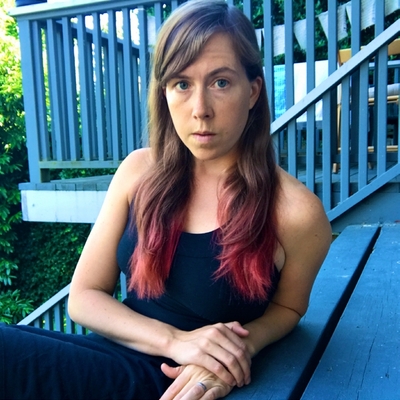
Margaret Adams is the author of short fiction, creative nonfiction, and essays. Her work has appeared in Joyland Magazine, The Pinch Journal, Monkeybicycle, and The Baltimore Review, among other publications. She won the Pacifica Literary Review 2017 Fiction Contest and was a Finalist for the 2017 Glimmer Train Very Short Story Award. She is a fiction editor for JMWW. She currently lives on the AZ/NM border in the Navajo Nation.
Julia Wang is a senior at Saint Francis High School in Mountain View, CA. She is an aspiring concept artist hoping to work at companies such as Pixar and Bandai Namco one day. Find her online at http://juumeithings.tumblr.com.
By Lindsay Wilson
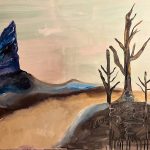
By Victor Hugo Mendevil

By Windy Martinez
By Jackie Martin
By Samantha Edmonds
By Jeffrey J. Higa