Letter from the Editor
By John Hardberger

our visibility is made manifest
only in the discussion of our absence
the outside gaze
that quantifies & qualifies our skin our content of character
our submissive
be patient . . . waiting
but in a survivable way
like apparitions
given shape by fear
who can move through stop & frisk all-white juries &
mandatory minimums
we are skewed to the margins invisible!
as outliers that move about on the perimeter
summoning any demon
willing to knead us into freedom a figurative shade of soul on ice
sculpted by any means necessary &
the articulation of in-just-us
we are sleeping while standing up & dis-remember who we are
that some things should never be taken for granted
because Amerikkka is playing one big trick on us: the moment
the Terminator’s eyes glow red
& locks in on its target: the police
watching for us
waiting for us
to make a move any move
not because they did not see us
but because they thought No One was standing there
some dark semblance of self that is criminally seen: visible
the minute we pick up a toy gun pull on a hoodie protest
peacefully or reach for something in our pocket
become the stereotypical
menace to society
a mug shot as evidence of criminal visibility
we are the flawed One-Drop melanin-ed skin
with our Angela Davis halo of hair we hope
that God mistakes it for a mic &
speaks unto just-us for all
we be designated spooks in the hate-scented air of Amerikkka
whirling dervish on the head of a pin
stabbed into the outside gaze
of Freedomland: a white picket fence
made of chain-link & concertina-wire
& our teeth
a bio-luminescence
that contrasts
the stain of blackness surrounds us
a civil invisibility
that put our names on lists
just so they could point to those lists: we know it wouldn’t free us
or render us seen
some days we just didn’t care
we were watching bodies
that looked & felt like ours
gunshot & choked
& beaten
& then we were watching our bodies buried
beneath the spectacle of
a nationally televised weeping wailing & gnashing of teeth
the t-shirts & the tweets
become a hashtag: #blacklivesmatter
most days we only wanted to create
the sense of a safe space
despite remembering
we were never meant to survive
but approaching the everyday
with a keen eye for subtext &
pretext &
proprioception
telling us where we were
in relation to prison the morgue
the racist pigs
of predatory badge & guns the downward years to come
Note: Quotation in italics from “A Litany for Survival” by Audre Lorde.
Note: Pentimento—the presence or emergence of earlier images, forms, or strokes that have been changed and painted over.
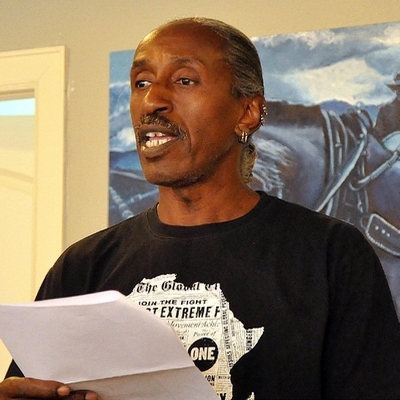
henry 7. reneau, jr. writes words of conflagration to awaken the world ablaze, an inferno of free verse illuminated by his affinity for disobedience, like a chambered bullet that commits a felony every day, an immolation that blazes from his heart, phoenix-fluxed red & gold, exploding through change is gonna come to implement the fire next time. He is the author of the poetry collection, freedomland blues (Transcendent Zero Press) and the e-chapbook, physiography of the fittest (Kind of a Hurricane Press). He has self-published a chapbook entitled 13hirteen Levels of Resistance, and his collection, The Book Of Blue(s) : Tryin’ To Make A Dollar Outta’ Fifteen Cents, was a finalist for the 2018 Digging Press Chapbook Series. His work has also been nominated for the Pushcart Prize.
Sasha Burshteyn is fourteen years old and has lived in Brooklyn her entire life. She attends Stuyvesant High School in Manhattan, one of New York’s most prestigious schools, and is one of the photographers for its newspaper. Both of her parents are photographers, which is what interested and inspired her to do it as well. She takes photos both digitally and on film, and especially enjoys taking portraits and photos of cityscapes. Beside photography, she is interested in music, academics, and cultural places around New York City.
By Lindsay Wilson
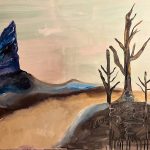
By Victor Hugo Mendevil

By Windy Martinez
By Jackie Martin
By Samantha Edmonds
By Jeffrey J. Higa