Earthskin
By Hana Rehman

Dear Readers,
Over this past year, we lived through ground-shaking history. Right in front of us, we witnessed the world change. It started with COVID, a global crisis claiming the lives of many, forcing worldwide lockdowns and in-home quarantines. Then there was the US Capitol insurrection, for which people are still being charged, months later. There was the other national crisis, the “other pandemic,” the racial struggle for institutional equality that people of color face. Yet, there were also moments of justice and triumph: a biracial women Vice Pesident, vaccine distribution, the guilty verdict of Derek Chauvin for the murder of George Floyd. The assault on an unarmed Black man took me back to the early nineties, when the country witnessed the LA riots and Rodney King assault. But this time, police were held accountable, an officer sentenced to prison. It might not feel like equality or justice, but the historic decision was unparalleled, and long overdue.
Yet, despite the world turning upside down, we at BMR somehow prevailed. We navigated through new digital territory to produce two great tributes in memory of Rudolfo Anaya. We emailed, Zoomed and texted. Blogged, Facebooked, tweeted and Instagrammed. Through it all, we read your submissions and collected images while remaining social-distanced, designing a couple of issues that I hope carry-on Mr. Anaya’s vision, regardless of the lockdown.
I’d like to thank our leader and faculty advisor, Lisa Chavez. Her support and overall guidance throughout all of this has been a blessing. Also, a huge thank-you to Melina Vizcaíno-Alemán for providing photos, giving an interview, contributing writing and networking on BMR’s behalf. Because of Melina’s vision and professional connections, we’ve had the privilege of working with acclaimed writers like Joy Harjo and Denise Chávez. I’d like to thank María Teresa Márquez, for her warm, informative interview, covering what Mr. Anaya meant to our literary community in New Mexico. To Denise Chávez, for helping with two consecutive issues, along with her husband, Daniel Zolinsky, for providing photos. A special shout-out goes to our editorial staff, Mikaela Osler and Jennifer Tubbs, for design, and Rhea Ramakrishnan, for managing our website and blogs. Huge thanks is owed to our team of grad and undergrad readers as well, who read over 3,000 submissions in three months. Amazing! To incoming staff, Tyler Mortenson-Hayes, Cyrus Stuvland, Evelyn Olmos and Ruben Miranda-Juarez, good luck carrying the torch. Guided by Editor-in-Chief, Rhea Ramakrishnan, I look forward to great creative work out of our literary magazine.
Recently, I returned to the BMR office for the first time in fourteen months, to check on things. Located on the UNM campus, the facility was empty and dark, a few ceiling lights on, for housekeeping. The floor buzzed with an electric hum I’d never noticed among the regular clatter and conversations. Inside our office sat three messy desks collecting dust, books and boxes piled to the ceiling. A neglected bookshelf ran along one wall, not housing a single publication. With new staff coming in, it was my duty to give organization to the chaos. I unpacked the first few boxes, discovering print copies of past issues, dating back to 1987. There were four copies of our premier issue, simpler artwork on the cover. I found five copies of issue three, and a small stack of issue fours and fives. What happened to issue two? Did Rudy have a copy of that somewhere? Because if not, there was no record of it. In numerical order, I placed the backstock neatly on abandoned bookshelves, reaching up to issue 25.
Then they stopped, likely because we moved to a more accessible, cost effective online digital format, consistent with modern trends. Blue Mesa Review had come a long way since its inception in the late 1980s, before the internet, our full history laid out in front of me. Thirty-four years of Southwestern literary production, produced by UNM students and staff. It was only a minor part of Rudolfo Anaya’s lasting legacy. I thumbed through Issue One. I reread BMR’s original mission statement declaring that BMR was “a new literary magazine designed to serve the writers of our region.” Like Denise Chávez, Joy Harjo and Jimmy Santiago Baca. But Anaya also states “our focus is the Southwest, but we publish writers from any area.” Our history proves it.
In Chicano Authors: Inquiry by Interview, written by Chicano Lit critic Juan Bruce-Novia, Anaya explains how he worked for the Coordinating Council of Literary Magazines in 1979, eight years before BMR. “I have seen changes,” he says of the publishing world. “Writers have become more interested in what Chicanos, Blacks, and women are doing…I see a great new generation of Asian American writers… We do have a lot in common with many groups and we are beginning to work together.” Was this the same line of thinking that created Blue Mesa Review?
I’m not sure, but I know that I’m proud of BMR and all that it’s accomplished throughout the years. I’m also proud of what we accomplished with issues 42 and 43. And I’d like to think Rudy would be proud, too.
Sincerely,
Mario Joseph Montoya
Editor-in-Chief, Blue Mesa Review
May 3, 2021
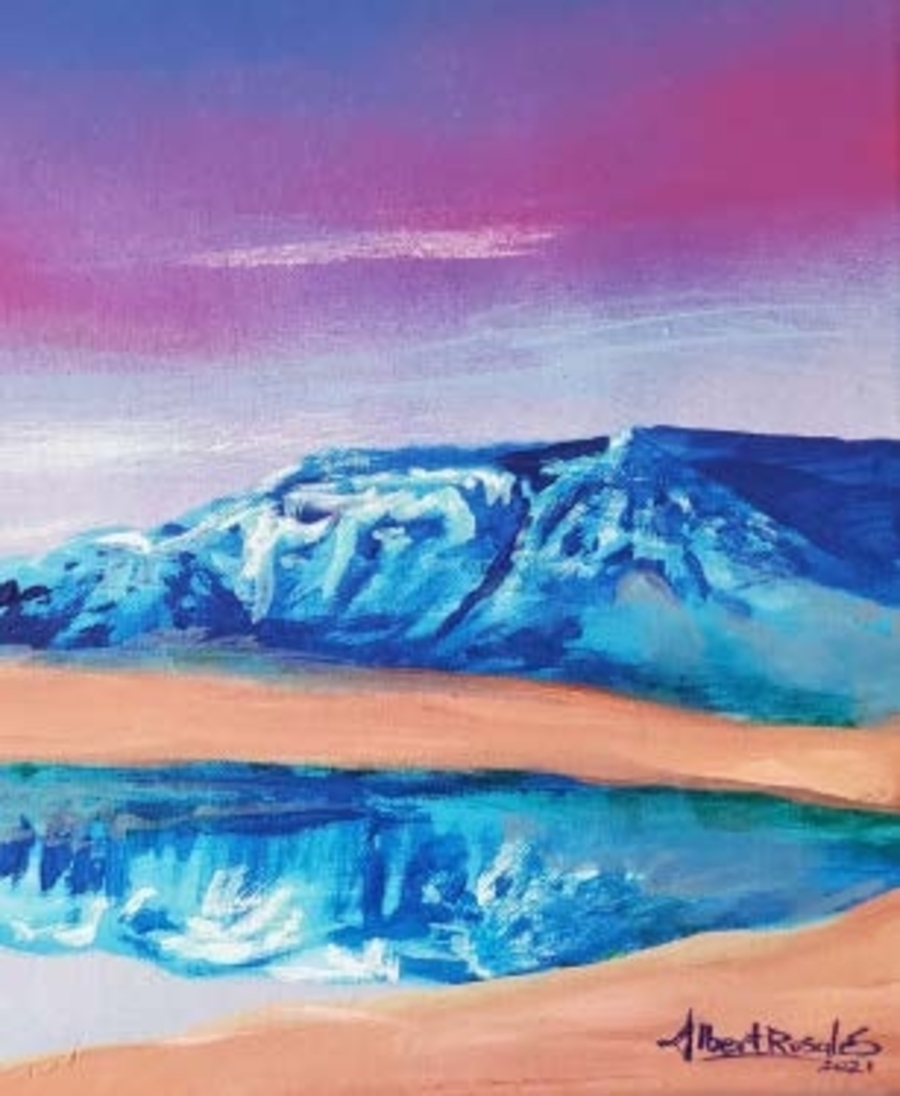
Albert sold his first art piece in 4th grade, to the Albuquerque Children’s Museum. By age 13, he was airbrushing and selling t-shirts, learning graffiti techniques with both airbrush and spray can, allowing for quicker application and more realistic effects. At 18, he learned composition and mural creation at the Mayor’s Art Summer Institute. Since, he’s done art for various city and community projects, namely, the Albuquerque BioPark & Zoo, as well as restaurants Annapurna’s, O Ramen, and Poki Poki. As a native New Mexican, he hopes to bring awareness and change to the issues that face society through art and teaching.
By Lindsay Wilson
By Victor Hugo Mendevil

By Windy Martinez
By Jackie Martin
By Samantha Edmonds
By Jeffrey J. Higa