Letter from the Editor
By John Hardberger
***
Father goes in for a doctor’s appointment. This alone brings anxiety. His cancer, which has now been eliminated, has destroyed any plans I had for the future. You have to live in the present, B— says. It’s the only thing that exists. The past is too subject to our own interpretations, and the future is too permeable; it doesn’t exist yet. I understand this on a rational level yet cannot swallow my own fear. I hold it like a penny under my tongue. Some questions lately:
Who would I be? Without this thing, which smashed into my life on my twenty- fifth birthday?
How do I be strong for my family, who needs me now more than ever?
Why do I feel the need to make everything about myself?
***
I can’t do this, I told B— when the diagnosis hit. I can still hear my mother’s voice on the phone as she spits out the word—cancer—like an epithet. Like a linked chain of sausages, the news gets worse and worse. We hear surgery, then chemotherapy.
You have to do this, B— says. You have to. You don’t have a choice.
Unfortunately, my reaction to stress is to have a severe mental health crisis, run away to Tennessee, and go crazy, in that order. I feel like I’m being torn between two sick people, my mother comments.
Imagine being one of us, my father says, shutting her complaints up for good.
***
4. So I watch Dawn of the Dead and America’s Next Top Model instead of doing paid editorial work, as if by consuming media I am somehow more than myself. I correspond, via email, with various editors about various projects. I contemplate. Summer is over, says Mars, which coincidentally is the title of their new song. It is over, and with its end brings new possibilities: B— and I living together, my father’s clean blood tests and sixty-eighth birthday, B— and I’s two-year anniversary.
5. I feel as if I am teetering on a ledge, about to fall. There is so much good—and after a long stretch of bad, it’s impossible for me to believe in it—I can’t bring myself to have faith that things are okay. I want to place my hand on B—’s chest and feel his heartbeat, feel the solidness there. What would you do first in a zombie apocalypse? Omar asks. I would kill myself, I tell him, which is my stock answer for everything. When the world ends, I don’t want to be there.
***
I make a cruel remark to B— offhand, then immediately regret it. I don’t know my own strength sometimes—the strength of my own words. We fight. Later, I realize we’re playing out my own parents, in miniature.
My self-doubt multiplies, grows legs and crawls around the apartment. As January comes closer, my anxiety increases. The days tick by, notches in my belt. I hold my breath.
We’re partners, I say in a phone call, our voices rubbed against the night. I’ll follow you anywhere.
I know this hasn’t been an easy year. Are any of them easy? I can’t imagine myself without him, without this half of my body that has been somehow disconnected and walks around without me.
I am grateful for all of it—the fights, the making up, the talk of the future. The fact that, for the first time, we have a future. I hold it in my palms like an egg. It does not break.
***
***
And so things are okay. I don’t expect it when it happens, and when it does, I’m not looking for it. This little pocket of fine-ness, a moment where there are no calamities, when I can simply be, feels like a port in the storm. In two months, B— and I will cohabitate. We’re in the eye of the hurricane. This weekend, I have just been released from the Emergency Room with the benign diagnosis of a pneumomediastinum, or air around the cavity that holds my heart. It sounds scary but is actually completely safe, albeit painful. He frets over the phone with me, calls me while I’m in the hospital, and I strain to hear his voice over the noise and bustle of the doctors and nurses.
I love you, I say, waiting for his call and response.
He doesn’t say it back, but I know that his call, his care, is his way of telling me. Not everything is a metaphor. I get a chest X-ray, then a CAT scan. I love you.
And he’s there the whole time, metaphorically holding my hand. Soon we will be roommates. Soon we will be more.
***
7. I can’t place my trust in doctors—they’re the ones who gave my father the cancer diagnosis, and although they’re the ones who healed him, too, they will always be the ones who gave me the pills that made me crazy, didn’t tell me when I was at risk of ischemic stroke from my birth control, patronized me in the Emergency Room about my own illness. Each time I go to get blood drawn I feel like they’re taking something away from me, something I’ll never get back. 8. You’re not easy, my mother says, speaking of B—’s way with me. He’s very patient with you. 9. What does it mean to be okay? What does it mean to be ne? How does one know when one has achieved it? How does one know, if possible, when one has lost it? How does one get it back?
***
In the morning, I look at apartments online. We talk, in hushed voices on the phone, in the dark, about where we’ll live, proposed budgets, design schema. East Harlem, Hamilton Heights. I press the names like beads into my palm.
I want to take the future and swallow it: I want to get to the end of the book already. I want to skip ahead. I feel incredibly lucky, yet anxiety looms around every corner. I need instructions on how to believe. All’s well, B— says, breaking the tension. I need instructions on how to believe him.
***
10. There is so much I am grateful for. My father and I, talking about the role of the artist over lunch. I think when you’re as old as I am, you don’t wonder why we do this anymore, he says, cutting his Impossible Burger into smaller and smaller bites. You don’t stop to ask why. 11. This has been the year of almost-loss: almost losing B— to my chaos, almost losing my father to illness, almost losing my own mind. But I got lucky—I got to keep everything, everyone I loved. I will not always be so lucky, I know. For now, I am glad. For now, I am grateful. I hope it is enough.
***
Late night, B— reads my essay drafts, makes cogent points, and then asks: Do you really want my opinion, or what? I do, but the criticism is like pouring vinegar in a wound. We laugh about nothing, cry about everything. We love.
This is what I want—this minutiae, the everyday. I want him to tell me how his day was. I want to know. I really, really want to know.
***
12. In this way, I learn how to have faith. It takes a long time; there are stops and starts. I have anxiety about the future. Stop that, he says. And so I do. No, it’s not as easy as that. No, there isn’t a magic cure. It takes his voice, slow and slurred on the phone, reassuring me, for weeks, before I learn.
13. I believe.
Joanna Acevedo (she/they) is the Pushcart nominated author of the chapbook List of Demands (Bottlecap Press, 2022) and Outtakes (WTAW Press, forthcoming) and the books The Pathophysiology of Longing (Black Centipede Press, 2020) and Unsaid Things (Flexible Press, 2021). She received her MFA in Fiction from New York University in 2021.
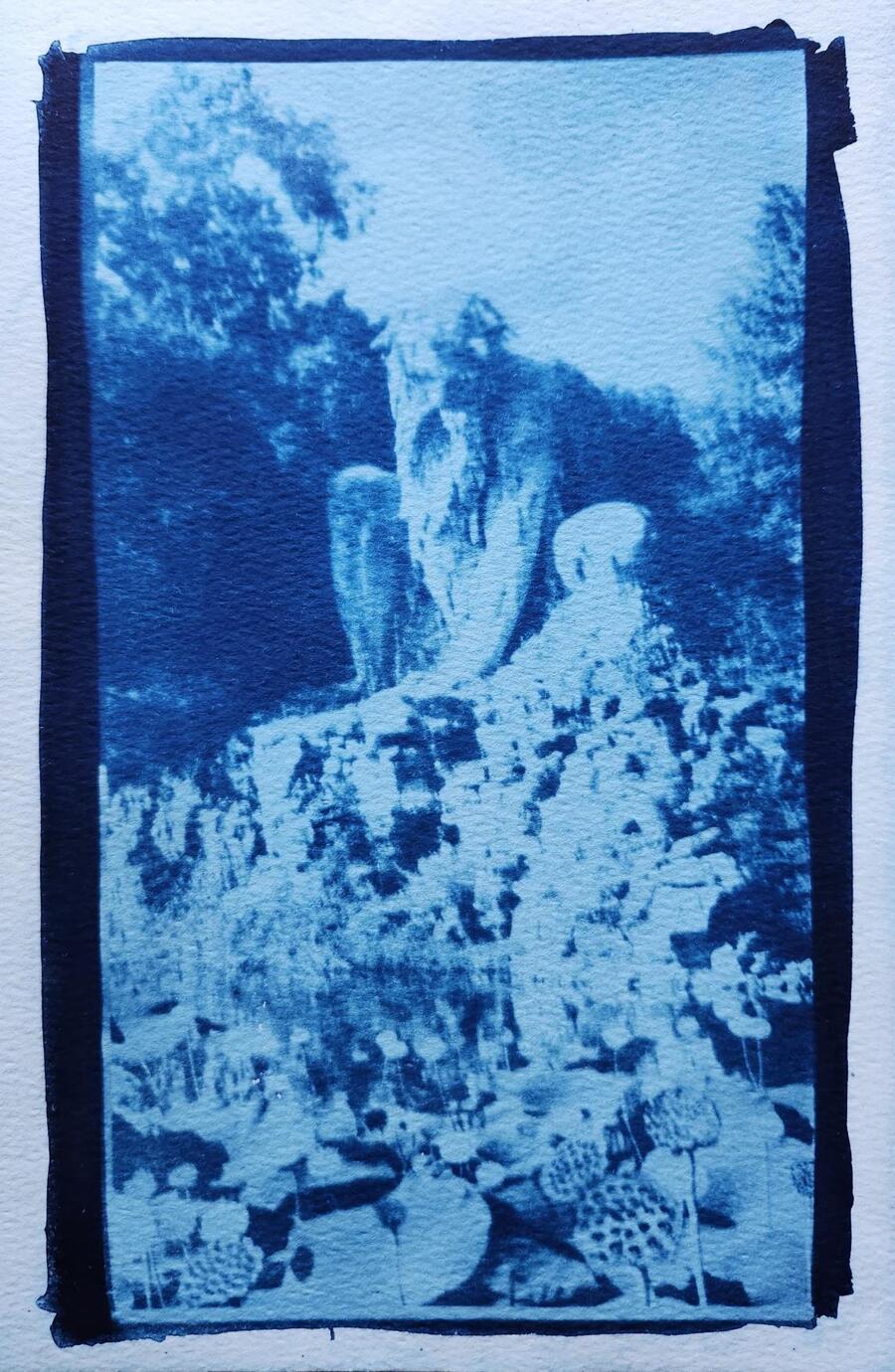
Rachel Dziga is an American artist who received her M.F.A in Florence Italy for Interdisciplinary Art and has exhibited and participated in international artist workshops. As well she has recently been featured in the book: Women Makers of Arkansas. Her practice is built upon a foundational need to disseminate and analyze collective concepts. This series of cyanotype prints beckon one to look deeper. Can one feel nostalgia for a place they have never been? All works were developed in plein air allowing the sun to impart variance. Employing the spectrum of indigo to imbibe the viewer to slow down and fall into the resonance of mystery.
By Lindsay Wilson
By Victor Hugo Mendevil

By Windy Martinez
By Jackie Martin
By Samantha Edmonds
By Jeffrey J. Higa