

Letter from the Editor
By John Hardberger

1st Place Fiction
2019 Summer Contest
What is lost when one is forced to parent from afar? What, if anything, is gained? The author imagines a scenario given breath with deliberate, lovely prose. The characters are drawn to exacting detail, and over the course of an afternoon, the author delivers the expansiveness of a life lived.
– Lesley Nneka Arimah
Elsie sat on a bench in the middle of nowhere, nervous to meet her own son. She hadn’t seen him in a month, and in that time, he’d turned into a teenager.
Women pushed strollers while jogging in spandex. Elsie’s therapist had printed out directions for how to get there and had written 2pm at the top of the page. As if Elsie would get trashed and forget. She’d been solid sober all month and could tell when someone didn’t trust her.
She pinched at a banana-nut muffin from Safeway and flicked a piece on the ground. Two squirrels fought over it. She had a blueberry muffin in another bag for her son, his favorite. At least it used to be.
In the last year, she’d seen Alec a dozen times in meetings surrounded by nosy do-gooder therapists, most of them chubby ladies who laughed at dumb jokes about their husbands eating all the cookies before they could take them to meetings. A month ago, near the end of her second – and last – residency in rehab, her case manager handed her an orange piece of paper. I typed up your options, she’d said. It’s orange because we ran out of regular paper. Option 1: continue therapy/ rehab while Alec stays at the Boys Home, until the court deems you fit for custody; Option 2: enter the Foster-for-Family program/ you and Alec get your own therapists/ Alec lives with a host family for at least six months. She had stared at that orange paper so long that the burn she’d been feeling every day when she’d pick-up Alec from school now had an orange layer to it, like the tip of a cigarette when she inhaled.
A car pulled up with a woman and a boy. Elsie’s boy. An Audi, and it parked next to her Corolla from the early 90s.
Alec got out and looked in the window of her car, then at the park. He wore a green collared thing that made him look like one of those preppy kids at Westwood Academy – Elsie had to stop for groups of those kids to cross the street on her way to work, all of them chatting and waving like mini-businessmen. Someone told her it cost 12,000 bucks a year to send your kid there. That would be most of Elsie’s earnings most years, since something always prevented her from working twelve months at the same place.
Elsie stood up and said, “Alec.”
“Mom!” He ran towards her, walking the last three steps. He was there, her son, and she wrapped her arms around him. He was taller than when she saw him last, in a courtroom one month ago, and skinnier, but he had the same hug.
The woman from the Audi opened her trunk and retrieved a backpack. “Hello, I’m Terry.” Elsie had chosen Option 2, and the “family” Alec had been assigned to was one lady. Terry, who worked some government job, was tall. She wore khaki shorts to her knees, with a purse that looked like alligator, probably costing as much as Elsie’s car. Terry held out her hand to shake – light, brief — then gave Alec’s backpack to Elsie, which wasn’t the Green Bay Packers one Elsie had gotten him for middle school.
Terry said, “Have fun, kiddo,” and smiled like the ladies in the brochures for the treatment center that cost as much as Westwood Academy. “So nice to meet you, Elsie.” Terry got in her car and drove away.
“How’s living with that lady, Smarty?” Elsie asked. She gave him his muffin. She had called him Smarty since the beginning of first grade, when he asked what a Smart Alec was.
“It’s okay,” he said.
Elsie felt the words in her chest, an ache like craving a cigarette.
“Did you get the presents?” She’d sent him a package for his 13th birthday, a red shirt of The Incredibles, a movie they saw together, and a box of Thin Mints. The box was probably searched by Elsie’s therapist in the program, or maybe by Terry. Maybe both women pulled out the sleeves of cookies, just in case.
“I got it, thanks Mom,” he said, fidgeting like there wasn’t space in the seat.
“Did it fit?” She turned out of the park and scanned for a gas station.
He crossed his arms over his stomach, and she noticed, even without him wearing it, that the shirt should have been L not XL. “Damnit,” she said, hitting the steering wheel with her palm. “Shirt didn’t fit, did it? Mom fucked up again.”
If they’d let her see him more, she’d know how to buy the right damn size. She felt the pressure in her chest, making her say stupid things sometimes – that’s anger, her new therapist said. This one’s name was Mel, and their first meeting ended in Elsie listing out everything that made her angry: her ex-boyfriend, Tom, who called the cops on her son; the cops, who separated her from Alec like she was some crazy person, sending him to the Boys Home, and taking her to jail for domestic violence; Alec stealing candy, another charge on his record, all because they kept making him live with criminals; Payless Shoes closing without offering a transfer, right when she needed her job most; her second trip to rehab; orange pieces of paper with shitty ideas. She didn’t write all that, just
Tom
cops
Payless
assholes
She knew what she meant. “
It fit,” he said. He broke the muffin in half and took a bite.
Maybe he liked that kind of dorky, collared shirt now. He looked different. His face was thinner and, Lord, small hair fuzzed over his upper lip. Maybe she looked different too. Better since she’d been sober. Or maybe she looked older.
“Pardon my French,” she said. She pulled over at a Conoco.
“That’s not really French.” He took another bite.
“You speak French now?”
He gave her that smile with the sideways look, the one he flashed whenever she accused him of cheating at Go-Fish. It was one of her favorite smiles.
“I got a new job,” she said.
“Where at?” He rolled some muffin between his fingers into a mushy ball that he popped into his mouth. He did that with hamburger buns too.
“Walgreens.”
“That’s cool.”
She wanted to tell him how all morning they had her working in toys, the best section. She wanted to tell him about the Batman toy packs she’d hung on racks, the new Lego kits she’d stacked, how now they had a surfing set and a fishing one too. But he was too old for that now. She wanted to tell him she’d been nervous to see him, how in the break room, where the TV was on Hoarders, up too loud like always, her manager asked why she had taken the afternoon off. And how good it had felt to say, “I’m seeing my son.” But Alec was too young for that.
“You want to pump the gas?” she asked.
“Nah.”
“Suit yourself.”
He used to beg to pump the gas. She only had four hours with him, and she was already fucking it up. She pictured a barrel filling, like Therapist Mel told her to do when she felt pressure in her chest. She pictured pulling a plug at her belly button, angry water chugging out.
Elsie started the pump, lit a cigarette, then watched the back of Alec’s head. He didn’t stretch or look through the glove box, just sat still as stone. He was off the Prozac he’d been on since he was eight, too many side effects. Now he was on whatever was newest, and he seemed different somehow. Or maybe he was just growing up. The dial on the pump switched from 9.89, to 9.90, to 9.95. She pulled the handle up at 10.00 exactly. Alec used to think that was a pretty neat trick.
He got out the car, crumpling the muffin wrapper. “Thank you,” he said and threw it in the trash. He always had good manners. She made sure of that.
“Did you know you’re not supposed to smoke at a gas pump?” he asked.
“Who told you that?”
He shrugged.
“Why don’t you go pay,” she said, handing him a ten. He walked into the store, her boy, whose movements and sounds she would always know by heart. He moved slower, like he’d learned to take his time, growing upwards instead of out, even though doctors kept saying he was overweight. No one believed she knew her own son better than what studies show.
She smashed her cigarette on the ground and avoided the eyes of a man watching her from the other side of his truck. She had given up men with trucks, proving it by wearing less makeup and ditching small skirts. She’d never forget that asshole she dated her first time in rehab, when she was looking for an apartment and Alec had to start the second grade living in the Boys Home. That man offered to take Elsie out with Alec, his treat, anywhere they wanted to go. Alec chose CiCi’s Pizza, and it went okay until later that night, after they dropped Alec off, when the jerk said, ‘How’d a giant kid like that come out of a body so fine?’ Like he paid her a compliment, waiting for a reward. But instead, Elsie slapped him and told him to put his clothes on or just carry them with him out the door.
She should have stopped with men after Alec’s daddy. Men wouldn’t help her with her boy. She checked her face in the car door mirror. She felt clear and strong. She swore her eyes got greener every day she stayed sober.
When Alec was ten, Tom and his little girl, Lonnie, moved into their apartment. Elsie and Tom met at AA. Back then, they both had that serious look about them, neither of them rolling their eyes anymore. Tom was tall, wore big boots and a Carhartt jacket, and made sure Alec stayed quiet around him. No whining, no complaining. He never said what made him so serious, but Elsie knew it had to do with the protection of his daughter. Lonnie was eight, and her mom had died giving birth to her, which made Tom more worried than most daddies. The four of them squeezed tight into two bedrooms, but it only lasted a week.
Alec got in and put on his seatbelt.
“What do you want to do today, Smarty?” she asked.
“Can we go home?”
A month of missing him was worth hearing him say that. He called her apartment home, even though he’d never seen it. She squeezed his hand and said, “Baby, I wish we could. They told you we can’t, right?” Mel had said, ‘No Home Visits for the first two months of the program.’
Alec shrugged, looking out the window.
First, they had to spend time in the open. The words Mel used were “in the community.” They probably worried there’d be a half-empty bottle of vodka on the counter at Elsie’s and she’d ask Alec to help her finish it.
“Ice cream?” she asked. Mel had given her a five-dollar gift certificate to Dairy Queen. “Then Home Depot?” On the weekends, Home Depot had a place for kids to build stuff out of scraps of wood and cardboard, and they used to wander the aisles making up designs for what they’d do when they were rich. Things like fish tanks for walls in the shower, or a room where you could paint on the walls whenever you wanted. Home Depot also had free coffee.
Someone honked. Elsie looked back: three cars waiting for the pump. “Shit,” she said. She started the car and pulled out. Cars came at them fast, but she gunned it. More honks. “Shit.” She should have waited to merge, but she didn’t know where she was going exactly. Who cared about a stupid barrel if you didn’t have time to pull the plug?
“Sounds good, Mom,” Alec said quickly.
She got over to the slow lane, breathed. Calmed down. He never said sounds good before. It used to be whatever’s clever, wherever he picked that up. They drove on Draft Road, wide-laned and walled in by fast food joints and drive-through liquor stores. The latter should be illegal, Elsie thought.
Those were the best years, when he was seven or eight and she hadn’t met Tom or the jerk before Tom, and they lived in the same apartment long enough to be recognized at the closest Home Depot. They never bought anything. But the manager gave Alec his own little table with caution tape around it that said “Do Not Touch, Work in Progress” so he could keep at it every Sunday. Once he’d trimmed a small, plastic tree leftover from Christmas, then glued popsicle sticks around the trunk like a spiral staircase.
“There’s one,” Alec said. He pointed at a Baskin-Robbins.
“Let’s do Dairy Queen,” she said.
“Baskin-Robbins is way better.” He turned his whole body to watch it go by, like he used to do when they passed a pack of bikers on Harleys.
“How do you know?” Elsie said. She pushed his shoulder, wanted to leave her hand there. “Huh?”
“Kristen, my therapist, took me. They have marshmallow and strawberry.”
“What the hell kind of ice cream is strawberry marshmallow? Aren’t you supposed to be doing therapy with her?” She pushed his shoulder again, again, again, until he smiled. “I don’t get ice cream in my therapy.”
“We do therapy,” he said. “She’s just really nice.” He looked away.
Jesus, he’s got a crush on his therapist. It was hard enough to keep all those ladies straight: Terry’s where he lives, Kristen’s his therapist, Mel’s Elsie’s therapist, and Sarah runs the show. Maybe they should trade therapists. Mel would be hard to crush on with those bushy eyebrows.
In her last session with Mel, Elsie wondered what Alec did in therapy. Mel said it was confidential, between Kristen and Alec. She wondered if he talked about all the moments she couldn’t. Did he remember when Tom called the cops and Elsie hit him with a doorstop? Did he remember his mother shivering naked in the bathtub, a bottle drowned by her side? She had wanted one drink with her grilled cheese, just one to celebrate her new apartment and being with Alec again.
“Bet cha Dairy Queen has all that crazy shit, if that’s what you call ice cream. What happened to vanilla and caramel?”
“I don’t know,” he said. “There’s one.” The red and white fish sign swam by. “Mom, you passed it.”
“We’ll get the next one.” They passed a bank with a marquee that flashed the time and the temperature: 2:28pm, 87 Degrees Fahrenheit. “That woman not feed you or something?”
Paths of sweat fell from Alec’s temples. “Can we do AC?”
“If you’re paying for it. Roll your window down, Smarty.”
Alec worked the crank, lines of sweat slitting across his belly.
“That’s what you get for wearing jeans, Goof. You gonna build today?”
“Build what?”
“At Home Depot.”
“Mom, that’s for little kids. I’m not even allowed.”
“Who told you that?”
The traffic light turned red, parking them next to a group of girls jogging in place and laughing on the sidewalk. An old Chinese man walking his dog stopped at the same light, surrounded by the girls.
“What a pervert,” Alec said to himself.
“A what?” Elsie asked. He kept facing the window. “I don’t like that word, okay?” She pushed him on the shoulder again. “Look at me. I don’t like that word.”
“Okay,” he said, slouching, picking a scab on his arm. He couldn’t use words like that, not with his record. Elsie didn’t know what happened that day, if he and Lonnie played doctor or if Alec saw something on TV; it all happened so fast. She was in the bathroom and heard Tom come home, the usual slamming of the door, then working the ice machine on the fridge. Then he started yelling like a cop and Elsie thought he was. Then she heard “You sick, fucked up kid!” and she rushed out the bathroom, and there was her boy, his little butt hanging out, Ninja Turtle boxers and jeans clinging to his calves, shoulders hunched like he was peeing. Lonnie sat on the floor in front of Alec, her brown eyes wide, her hair all over the place like usual. Tom had his arm up and Elsie ran in front of her boy, shielding her face. Tom looked at her like she was nuts. He said, Fucked up perverted family, then took the phone off the kitchen wall. It took Elsie too long to realize he was calling the cops on her ten-year-old son. But once she understood, she panicked. The doorstop was the first thing she saw, an old brick that had been laying in the apartment hallway, used to prop the door open when carrying in Tom and Lonnie’s things.
She realized now that if she had left the brick there, the cops might have laughed Tom away. Maybe. But instead they arrested her, adding a Domestic Violence charge to her trails of overdoses.
Elsie hoped Kristen and Sarah and Terry were teaching Alec he’s not like other boys with that kind of charge. He couldn’t say words like pervert. He would have to behave better than others. He had a record.
“Six eighty-nine.”
“What was that?” Elsie asked.
The kid behind the counter handed Alec a mountain of ice cream, candy and syrup, in a waffle bowl. It was too big to hold with one hand, so he cupped it with both, the way some people drink coffee.
“Six eighty-nine.”
“Jesus, hold on,” she said. Alec hovered by her elbow, which he never used to do. “Find a table, Smarty, I’ll be there in a sec.” She picked coins from her purse and planted them on the counter until she had one eighty-nine. “Hold on, I got a certificate.” A second employee held out her vanilla cone with caramel sauce. The voucher was bright red, and she had put it in her emergency pocket, next to a twenty-dollar bill.
“What the fuck?”
“Ma’am?”
The red voucher was there, but no twenty. She dropped her purse on the counter, raking through her wallet again. “Unbelievable,” she said, “I can’t fucking believe it.” She left her purse on the counter and headed for Alec, who sat at a table of newspapers. She stretched her wallet open so he could see. “Hey, Smarty, something missing?”
He clamped his mouth over a spoon of pink bubble gum and cookie dough, giving her the dumb look he made when he was lying.
“Something missing?” She shoved the wallet in front of him. He’d stolen from a gas station once, at the Boy’s Home, but how could he take money from his own mother? They both worked so damn hard with all this therapy and bullshit, and now he was blowing it.
“What?” he asked, his mouth so full, pink leaked out the side.
“What?” She mocked, imitating him. “Your own mother.”
He coughed, splattering caramel syrup onto the table. Then he threw up, thick and dark like a sick animal. He had done this ever since he was little. Throwing up instead of growing up, she had called it. Maybe he wasn’t even trying. Maybe he didn’t want to live with her again. “Get in the car,” she said. “I’m calling Sarah.”
“I didn’t take nothing,” Alec said.
“Code barf,” the kid at the counter called to the kitchen. “Ma’am?” he said, her vanilla and caramel dripping pools on top of the counter. “That’s five dollars still.”
“Six bucks for a fucking ice cream, Jesus,” she said. She grabbed her purse and slapped down the red voucher. An employee came out pushing a mop bucket that overflowed and splashed bubbles on the floor.
In the car, Elsie’s heart pounded, and it smelled like throw-up. Alec had his back turned to her, looking asleep. He wouldn’t be speaking to her for a long time. They had been here before.
She rolled down the window but didn’t start the car. She waited, and breathed, and waited, and breathed. Finally, she was calm, a different person than the one buying ice cream. This person was able to consider all the possibilities. A few months ago, she’d felt the same panic and dug through her wallet, forgetting she’d had to break her emergency twenty to pay for parking at the stupid courthouse. Maybe she’d spent it again and forgot. She had never been good with money.
“Smarty, I’m sorry.”
Alec stayed quiet, like she knew he would.
“I got an idea,” she said. “But we can’t tell anyone, okay?”
He still didn’t turn toward her, but he sat up.
“Let’s go home. I have your old clothes. We’ll clean that up, watch some TV.”
Elsie waited.
Finally, Alec said, “She’ll know it’s a different shirt.” But she started the car. She got her son back with the same focused energy she used before to get drunk. She’d get off work and head straight for the bar, knowing that whatever bad feelings she had would soon disappear. But now, it was her and her son, together, and they would make it through this crazy program their own way, even if they both fucked up a lot by breaking the rules. Alec and Elsie were the only ones who knew how to fix each other, and themselves.
Elsie gunned it on the first opening in traffic, not looking in the far lane. Sometimes you have to close your eyes and go.

Alison Turner grew up in the mountains of Colorado, where she learned to endure large amounts of time in inclement weather waiting for buses. She is a PhD candidate in Literary Studies at the University of Denver interested in community literacy, historical fiction of the American Old West, community-engaged scholarship and archives. She is the co-host and co-creator of the When you are homeless podcast miniseries, and her creative work appears in Wordrunner eChapbooks, Little Patuxent Review, Meridian, and Bacopa Literary Review, among others.
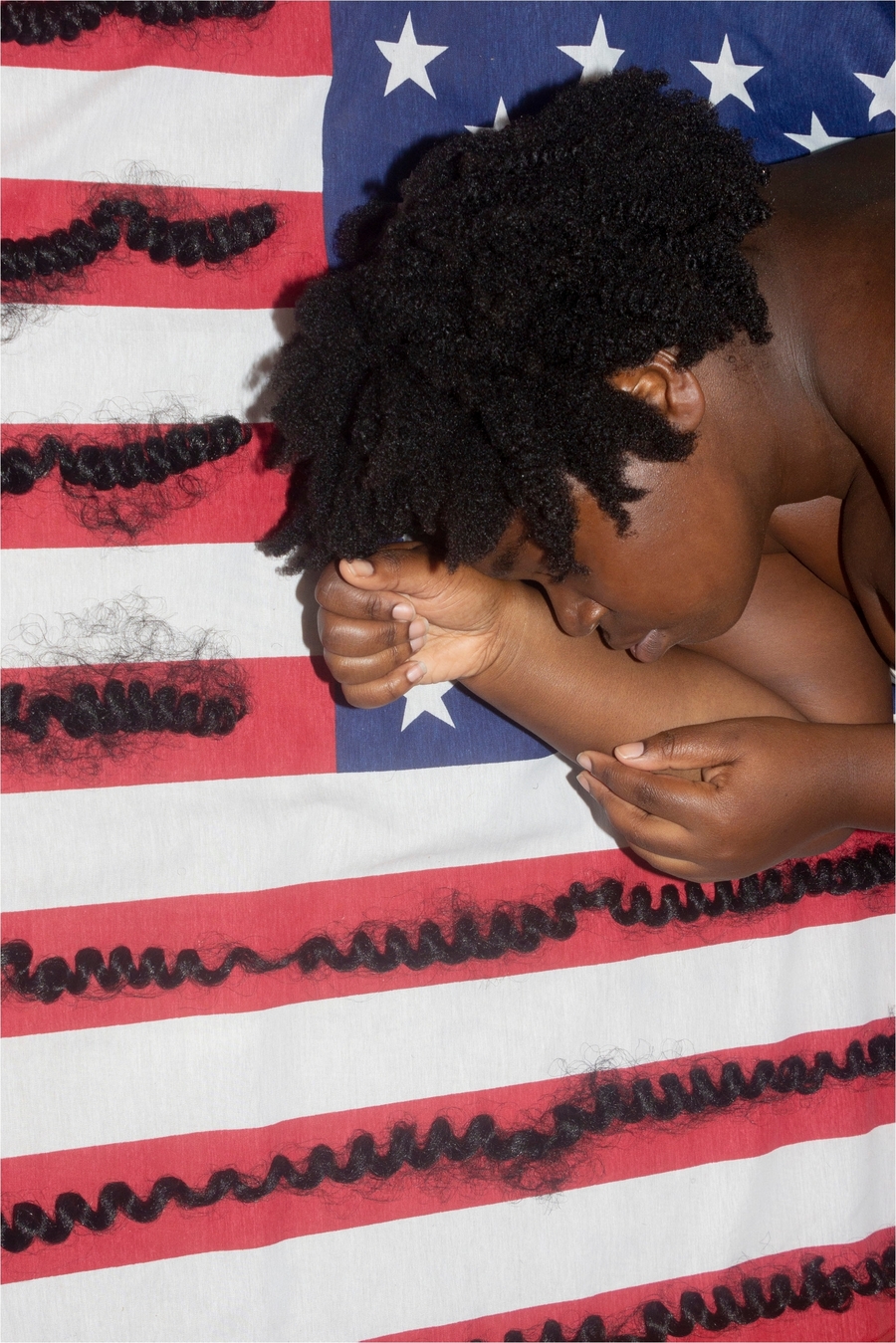
Vicky Charles, based in New York, has a BFA in Photography from SUNY New Paltz. Her work consists of self-portraits that deal with issues about black identity, the body, and relationships with oneself. Vicky achieves her visual effects in camera with such procedures as staged studio work and double exposures. Her photography expresses itself without words, but by showing.

By Lindsay Wilson

By Victor Hugo Mendevil

By Windy Martinez

By Jackie Martin

By Samantha Edmonds

By Jeffrey J. Higa