
Letter from the Editor
By John Hardberger

Ba ba
“Popo, do you know who I am?” She turned her face toward me. Her eyes had faded to the color of bleached raisins, but her hair was still more black than white, and she still had more of it than some of her children.
I sat on her bed to place myself within her line of sight. Dad and Mom sank into the chairs behind us. “It’s Jessica. Jiahui.”
She nodded slowly, eyes scanning my face, so different from the grandmother who once spotted visitors across the nursing facility, eyes brimming with anticipation. This time, I could not tell if she recognized my name or my face. Probably my name. At least I still resided somewhere in her memory, though more and more that seemed uncertain, ebbing and flowing with the days.
Grandma suffered a series of strokes and heart attacks in the last five years, and though she once bounced between the hospital and stints with her children, she now spent more and more time in nursing homes. Her shared room was as sparse as a dormitory: two beds, two dressers, two chairs for visitors.
Three months ago, before her last major stroke, she would have reached her hand out to me, as I always held her hand when I visited. Now it sat limply in her lap. I reached for it, and the motion triggered a half-buried memory, for she lifted it to meet mine. I looked into her eyes and smiled, and she returned the smile tentatively.
As I did each time I saw her, I reminded her that she stayed with us for several months when I was a baby. Perhaps I was misguided in believing that if I linked my face to her memories, she would keep recognizing me. Perhaps, if I kept repeating the same memories back to her, this would keep them from fading. I told her all the anecdotes she once told me, stories I could not possibly have remembered, and which she could no longer recall unbidden. How, as a baby, I used to wave and call for her every time I saw her, insistent, standing up in my pen, eyes following her everywhere. How I used to pat the ground next to me, because I wanted her to play with me. How I was guai, well-behaved; how she was my first Chinese teacher, before I went to daycare and forgot everything and had to be taught again.
“I have one brother.” I held up my index finger. “Do you know who that is?” She waited expectantly for the punch line. Dad prodded her to guess, but she shook her head. “Michael. Jiaqing.” I drew out the syllables to mimic the way she would have pronounced it in her Wuhan accent.
“Mi-chael,” she repeated obediently. “Jiaqing.”
“He’s in New York, studying to be a doctor. We’ll bring him to see you when he’s back visiting.” As her memory faded, there was an unofficial competition among the extended family over who she still remembered and who she did not. Every time I visited, I made sure to update her about Michael. I wanted him to beat our cousins.
In all of this, my edge was that my Chinese was the best of my generation, and Grandma had taken to pretending that she no longer understood English, especially with the staff. Dad chided her over this, but she just chuckled, a gleam in her eyes. She had such little control over her life, and this was one of her few remaining pleasures.
Even though she was days from her ninetieth birthday, because eight is a lucky number in China¹, I liked to tell her she was eighty-eight years old. She usually laughed, cheered at the thought of the double auspiciousness, or maybe quietly humoring me. Really, I wanted to freeze her in time. As long as she stayed eighty-eight, maybe the twin eights could continue to protect her from the dual companions of stroke and heart attack that followed her for so many years.
This time, she just nodded.
“Popo, can you believe that you’re eighty-eight?” I tried again.
Nothing. Dad thought she still understood the number itself, but had lost the ability to conceptualize her age. The cognitive decline made me the saddest, watching as she was slowly robbed of her memories and linguistic abilities. I had always felt closer to Grandma because we spoke Chinese together, one of the few people in my life with whom I had this connection. And as that slowly disappeared, I felt her slip away from me.
Luu Chaoren
Luu: pictograph of vertebrae; a surname.
Chao: surpass, exceed.
Ren: assume a post²; appoint; allow, let.
Grandma was born Luu Chaoren in Wuhan, China in 1923. Her mother was a peasant and her father was a schoolteacher. Enamored with western ideals of a love-based marriage, her father left Chaoren and his uneducated wife for a fellow schoolteacher. Thus it was that Grandma was raised in her grandfather’s household—her paternal grandfather’s. In 1923, China was in a long slide into civil war. The republic that replaced China’s final dynasty had quickly succumbed to internal politics. Soon, there was an all out brawl between warlord factions, a tumult that eventually coalesced into the conflict between the Nationalists and Communists.
When Grandma was eight, Japan invaded Manchuria. Japan harbored ambitions of a pan-Asian empire; China was weak, its doors forced open with the 1868 Opium Wars and Unequal Treaties, its territories far-flung and poorly protected, a nation facing an identity crisis about the best path to modernity. The skirmishes started in the northeast, at the Marco Polo Bridge in Manchuria, and inched their way south and inland, toward Wuhan.
When Grandma was thirteen, China and Japan stood on the precipice of war. China’s internal squabbles, between the Nationalists and Communists, still hadn’t been resolved, in spite of the broader threat to national security. Grandma’s grandfather was the head of Wuhan’s triad, and it was rumored that he collected so much money each day he kicked it under his bed at night without counting. Wuhan was China’s second largest port, and Grandma’s grandfather hadn’t risen to that position without political acumen. As tensions with Japan escalated, sensing danger, he asked Grandma to take her eleven year-old cousin 500 miles south to stay with a relative, further from the fighting³.
So at thirteen, Grandma set off across a war-torn country, her younger cousin in tow. She brought her mother, for Grandma was her mother’s main tie to the household that hosted them, and where else could her mother go? A traveling theater troupe promised to take them to their final destination, then promptly swindled them of their money. Grandma was so mad she cried, but what could she do? The troupe was gone, as was the money she had been entrusted with to make it south.
Instead of turning back, they forged ahead. At one point, the three shelled nuts for a living. They were paid by the piece; it was just enough to get by. Eventually she delivered her cousin to the relative safety of the south. Mission completed, Grandma turned her eyes to the provincial capital Kunming, buried deep in southwestern China, 700 miles away. People all along the east coast were fleeing to Kunming, dismantling factories that were vulnerable to Japanese bombing and resurrecting them there, out of harm’s reach. Universities relocated there as well. Kunming became a Nationalist stronghold, and Grandma was swept up in a nationalistic fever, eager to contribute.
When Grandma was eighteen, her home country was one of many fronts for World War II. The Communists and Nationalists had struck an uneasy truce to throw off the Japanese. Grandma was in college in Kunming, on a Nationalist-sponsored scholarship. She found a tiny room under a stairwell where she and her mother could stay, and when she could, Grandma smuggled leftovers from the school canteen to feed her mother. Initially she wanted to become a doctor, but after she threw up during anatomy dissection, she studied to become a postmistress instead.
When Grandma was twenty-two, Japan was defeated and the long-simmering tensions between Nationalists and Communists broke out again in earnest. Newly married, she gave birth to her first child. I imagine Grandma in bustling, chaotic Kunming, hurrying up and down rows of vendors, a baby strapped to her back as the tropical sunshine swirled through the dust. She would have investigated square baskets holding vegetables, wide shallow baskets displaying roasted pumpkin seeds, wooden trays heaped with dried chili peppers, their skins shriveled and bright. Eggs were a luxury, powdered milk scarce, but Grandma would have wanted a protein source for her husband and daughter, and she would search until she found one.
When Grandma was twenty-six, the Communists emerged victorious and Grandma caught one of the very last planes to Taiwan, where the Nationalists were fleeing to regroup and formulate plans to retake the mainland. Her husband was an aerospace engineer with the losing side, and was therefore able to secure passage for himself, his wife, and their three children. Dad was one month old. On the crowded train, she threw a blanket over him to shush his cries.The train swayed, bags brushed her knees, children complained of boredom. Suddenly Grandma started. She hadn’t heard the baby fuss in a number of minutes, and she scrambled to remove the blanket, afraid she’d smother him.
Liangyidian
When I was twelve, I asked Grandma to teach me to knit.
At six I’d taught myself to crochet by following a how-to book; at eight, my aunt showed me how to hand-sew doll clothes and mini quilts. Grandma seemed surprised by my request, probably because it was the era of flannel shirts and combat boots, CD players and slap bracelets, boy bands and divas. But she brought two sets of bright aluminum needles to the next family event, and we found a quiet spot on the downstairs couch, where she handed me a small ball of curly yellow acrylic yarn, leftover from a project. In her hand she held a navy ball. Grandma’s fingers were gnarled and bent by arthritis; while my index finger rested flush against the cool metal needle, her right fingertip bent away from it at a 90-degree angle. Yet the needles were so stable in her hands, her fingers so deft as she used needle to manipulate yarn, whereas mine slipped and wobbled all over the place, unable to carry the yarn or guide it through the loops. The needles quickly warmed to our touch.
Thus began my pattern of withdrawing from my extended family. They were a dense cacophony of siblings and in-laws and children who blustered about science and medicine and material success and prestige. I was an introvert who liked to knit and loved the Chinese language. Knitting and conversing with Grandma were spaces I could carve for myself in this larger group.
Our sessions may have revived Grandma’s interest in knitting, for in the following years she gifted each grandchild with a hand-knit blanket, large enough to cover a queen bed, formed from variations on the two basic stitches—knits and purls—that she showed me in our first session.
In my mid-20s, as knitting began its resurgence and online tutorials proliferated, I graduated into more complex stitches and with them, projects beyond the realm of rectangles and squares. My first hand knit sweater was a fitted raglan boatneck with bell-shaped sleeves, knit entirely in stockinette stitch with hem and neck facings. I chose a deep rose wool, and shortened the pattern to hit at high hip. Grandma cast a professional eye over me. “Did you make that?” she asked.
I nodded and grinned. A small chorus of ooh’s and aah’s collected around me. Grandma noted the evenness of my stitches and the neatness of the construction, said nothing of my unsteady increases and decreases, instead complimenting me on the gentle slope they created at the waist. Aunts wandered out of the conversation, unsure of its content.
“I like the color,” she said finally.
“I like colors that are liangyidian,” I agreed, meaning colors that are brighter, warmer, and livelier. It was a phrase I’d learned in China and I pulled it out now, sensing it might speak to Grandma. Her face lit up. She plucked at the sleeve of her red sweater. We both nodded and laughed. In those later years, Grandma always wore some shade of red. She loved colors that were liangyidian.
When she was a child, Grandma said, she also knit herself sweaters. One new sweater a year. Sometimes money was tight, and she ripped out last year’s sweater for the yarn to make next year’s. She even, and here she bent her head conspiratorially, brought her sweater to class and knit under the table. “We all did!” she laughed. She held her hands in her lap, imaginary needles sliding against each other, eyes wide with faux concentration as they followed an invisible teacher who paced the classroom.
When Grandma laughed her shoulders heaved, synchronizing with her slow hiccupping mirth. I loved it when she laughed. I’d grown up with stories of Dad goofing off in school while Grandma hounded him to study, and I was glad to hear she’d had moments of childhood mischief.
Knitting was the last thing Grandma could do. After she stopped helping in the kitchen, after she stopped taking walks, after she stopped hunching over Dad’s Jin Yong martial arts books with a magnifying glass, she continued to knit, the swoop and glide, wrap and pull, slip and tug of needle and yarn still manageable. The further she got into her illness, the bigger her knitting needles became.
Eventually, she gave up knitting. Maybe she finally succumbed to the arthritis, although it’s tough to imagine Grandma giving in to anything. Sheer determination had carried her through war, two rounds of immigration, raising seven children while working full-time as Taizhong’s first postmistress when her husband pursued a PhD in America, learning a new language in midlife, retraining in the field of accounting at an age when others retired. More likely, that last stroke stole her motor skills, particularly on the right side of her body, the side most affected by the disruption in blood flow to her brain.
Yan Jiahui
Yan: strict, rigorous, severe; a surname.
Jia: household, family; house, home; specialist.
Hui: intelligent.
Taken one way, my Chinese name is aspirational, a wish bestowed upon a newborn. In it, you can read the optimism of new grandparents, eager for the arrival of the next generation. Taken another way, you could say my grandfather valued intelligence above all else: he named his two oldest grandchildren after the trait (my cousin and I are intelligent-heart⁴ and family-intelligence). Taken a third way, it’s a lot to live up to.
Grandpa was an aerospace engineer who left Taiwan at forty-eight to start a PhD program in physics. His classmates were half his age, if that. He scrimped through the cold Pennsylvanian winters to send home as much of his graduate stipend as he could spare. Still, I imagine Grandpa was in his element. He prized learning, and at a time when the world had not yet put a man on the moon, science was the king of learning and physics the king of science. Then Grandma developed breast cancer, so he left his program with a Master’s degree, found a job, and brought the family to America where the medical treatment was better.
In America, dinner conversations were all science, all the time. Grandpa loved brain teasers and mind puzzles, and he often applied scientific inquiry to daily life. When a car drives through the rain, what determines the angle at which water is thrown from the spinning tires? Dad spent days working through that one. Science was the way to engage Grandpa in conversation, the yardstick by which to measure intelligence and career aspirations. Most of his children studied science, although when it came to jobs, many blended Grandpa’s reverence for science with Grandma’s hard pragmatism, landing in a health profession.
I never really knew Grandpa. He developed Alzheimer’s disease when I was young, but Dad said he had a poetic soul. He named his two eldest daughters after a poem⁵, and I imagine I could have bonded with him over Chinese. But Grandpa passed away in my early teens, so I bonded with Grandma.
In college I majored in Chinese Literature. I’d attended a bilingual Mandarin immersion program up through middle school, and the intricate cadence of Chinese entranced me. As I dove into my studies I began to see that literature, philosophy, history, culture, geography, and art all wound their way through the language. It was beautiful and intuitive, and it led me to a stronger relationship with my cultural heritage.
Grandma was a living, breathing talisman of this heritage, and I relished the opportunity for in vivo encounters in the midst of my otherwise in vitro studies. Plus, she fed me tidbits about her life in China and Taiwan, like joining the Nationalist Youth Brigade, or feeding herself only after her children and husband had finished, moistening rice from the bottom of the pot with bacon oil. Grandma was from another world and another generation. Knitting and Chinese were the two bridges I had to cross that chasm.
When my brother Michael and I were small, I’m told my uncle Chung once wandered over to play with us, then ruffled Michael’s hair, saying, “I feel sorry for you—having an older sister with a brain like that.” I’ve never seen much difference in our intelligence, except that Michael is better at science and spills forth incisive social commentary, whereas I have a more creative, associative, integrative mind. Although I now believe there are more important measures of self-worth than intelligence, back then I felt my family’s judgments keenly, how it was a waste to throw intelligence away on a fluffy major like Chinese, one pre-meds used to pad their GPAs.
Because I wasn’t yet ready to distance myself from their ways, I said I planned to go to medical school, and since admissions committees loved applicants from diverse disciplines, Chinese improved my odds of admittance. I don’t think my family bought it. I needed a way to rationalize my decision to them and to myself, even if, deep down, part of me knew I could never stomach medicine.
I must have puzzled them, this wayward child facing the wrong way along the assimilation gradient, but I had enough distance from Chinese to love it like a foreign language.
After all, Chinese didn’t accent my English and mark me as Other. It wasn’t the language I needed to forget in order to build up a new life from scratch. I had the luxury of nostalgia, of a roof over my head and food on the table, and I was one of those assimilated kids who picked up all the wrong parts of America, the parts about following your dreams to impractical places, instead of doing it right like my cousins, using my privileges to launch myself into a stable, prestigious, lucrative career that secured my future.
Grandma never pestered me about classes or careers; I’m not sure she even knew I’d chosen Chinese, and as long as my grades were fine, she was content.
Liangmashi
Grandma was stubborn. After her first major heart attack, she refused to ask for assistance in the middle of the night, only to send a loud bang through the house, where she’d be found on the bathroom floor in a pool of blood, having hit her head on the way down. At this point her children had brought her to northern California for medical treatment, and then insisted she live with one of them. They wanted to keep an eye on her, and the local doctors and hospitals were known quantities.
Grandma was furious. She wanted to go home. I wasn’t privy to those conversations, because I was of the younger generation and only heard about select matters long after the fact, and even then only in a carefully filtered way, but the little I knew seemed challenging enough.
Grandma could badger you from the minute you got home from work until the time you went to sleep, trying to get back to her house, trying to change her living situation, trying to change her treatment. One by one, she lived with four of her five children in the area. She was in regular contact with all my aunts and uncles, offering up different angles of the story, currying sympathy and indignation, trying for any angle she could. I wonder now if she felt echoes to her childhood, living in her paternal grandfather’s household, a charity case dependent on the goodwill of others. Those ghosts must have been particularly difficult at an age when, but for immigrating to America, she would be in her golden years, revered as an elder instead of shunted between households.
By this point I was largely absent, having veered from medicine to land in a safety net clinic as a project manager, where I spent my days wrestling personalities and putting out fires, trying for the trifecta of security, prestige, and a good paycheck so valued by my extended family, but on my terms. Silence had crept into my relationship with Grandma. My life no longer centered on Chinese, and I hadn’t taken the time to find the vocabulary to translate my world to her.
I once came home to find Grandma on the sofa, eyes trained on the television. Dad beckoned. Would I take Grandma for a walk? he wanted to know. All she does is sit around, he said. I’m trying to get her to do a mile a day, he told me as he helped her into a black down jacket, under which she wore a gray sweater over a fuchsia turtleneck.
We set out. Red leaves shimmered overhead, glowing in the afternoon sun. To our right, tires sped over papery leaves.
“Come on Grandma, just a little farther,” I said.
“No.” We stood in front of a major bank, one street off downtown. Office workers hurried by, disposable coffee cups in hand, brimming with gossip, their words tangled with the jargon of tech and venture capital, human resources and finance.
“How about to the end of the block?” I said.
Grandma turned sideways and eased herself onto a brick planter that surrounded pink and white flowers. I shrugged and sat down next to her. There was only so much cajoling you could do with Grandma. It was strange seeing her give in, as walking had always been a point of pride for her. As a child, Grandma was the fastest walker I knew; whenever we visited her, I was forever hurrying to catch up, Grandma striding under the relentless LA sun as I hopscotched between spindly patches of shade.
I could have used this walk as an opportunity for a rare conversation with Grandma, but she’d already started our walk with one of her standbys, “Grandma ku.”
She said this nearly every time she was with family: Grandma’s life has been difficult, or Grandma’s life is difficult—it wasn’t always clear, as Chinese don’t conjugate verbs⁶. Maybe she meant both. Having exhausted her list on the way over, or the portion she was willing to share with me, she was now silent. And I, tired of massaging egos all day, let the quiet linger.
In a way, our relationship was like my relationship with China, its language, and the culture. I lived in China for a year after college, and though part of me fantasized about staying indefinitely, another part of me was aware that the honeymoon period had ended, and I didn’t trust that I was yet mature enough to let our relationship evolve into something more complex.
I patted Grandma’s hand. When she looked up, I raised my eyebrows in the direction of home. She shook her head. I nodded and began counting the blocks between home and us.
“Four blocks,” I thought ruefully, calculating how short I’d fallen of the mile benchmark.
“Four blocks,” she was probably thinking, wondering how she would make it all the way back.
Grandma spent her whole life being useful, and it must have been hard, at the end, to have no contribution left that others would accept. She’d taken the move to America in stride, going from running an entire post office to running a household. She left the house at dawn every day to buy the day’s groceries, walking over a mile each way, her strong hands grasping bags and bags of food on the trip back. Apparently, at one point she cooked nine meals a day: a Chinese breakfast, an American breakfast, and Chung’s breakfast; a Chinese lunch, an American lunch, and Chung’s lunch (I think her youngest son was in a hamburger phase); and so on.
When Chung left for college, Grandma worked toward her Associates degree. She took English and Accounting classes, eventually landing a position with FICO that she’d keep well into her 70s. When Chung called home, she badgered him about his grades. “I’m getting A’s, why aren’t you?” she’d say.
“Mom! I’m at Stanford—you’re at Saddleback Community College!” To her, it made no difference. Liangmashi, I thought when I heard this story, apples and oranges. The phrase would have turned the exchange into a joke; transplanting old world logic into a new world context often made Grandma laugh. It was one my uncle could not have cracked, not only because he immigrated at the age of five, but also because a granddaughter’s relationship is weighted with privileges that are absent from a son’s.
Nenggan
At Grandma’s funeral, my third aunt wraps me in a hug. “Oh, honey.”
In Grandma’s last years I moved away to Oregon, and finding the California sunshine unexpectedly oppressive, I take the opportunity to hide behind large, dark frames. Even so, my aunt spots my red eyes. Dad scheduled several hours for the viewing, and people mingle in the courtyard, helping themselves to banh mi and fruit. Every time I slip into the darkened room to view Grandma’s casket, it’s her hands that get me; she’s the only person I knew whose fingertips stood at right angles to the rest of the digits. Those nenggan, or capable, hands, which symbolize everything I knew about Grandma.
“Don’t cry,” says my aunt. Her arms are still around me, like a leech. I know she’s trying to comfort me, donning the role of elder, protector of the younger generation. I want to wriggle out of her grasp, shout at her to let me have my emotions, as they are my way of honoring Grandma and saying goodbye. Instead I say, “She was a strong woman.”
My aunt releases me. “You have some of her in you. More than the rest.”
I shudder. I’ve never worn my Chinese degree with pride around my family. I’ve been a coward my whole life, only removing my mask with Grandma. I used our relationship to flaunt my Chinese, a passive aggressive way to justify my choices without having to outright defend myself.
By request from my aunts and uncles, the funeral is small and private: family only, no friends. One by one, Dad’s generation speaks about Grandma. Toward the end Chung stands, the family baby whose hair is more white than black. He stares out at us, speechless. His eyes are tinged crimson and bugged wide. They seem to say that if only the floodgates could open, he would cry. If only he knew where to begin, he would speak. This image of grief will haunt me for months.
The day after Grandma died, I sat in the storage closet at work for nearly an hour. Dad had warned me Grandma was dying, but after so many strokes and heart attacks, I believed I had more time. I called Michael. Michael said he was working on his application to residency programs, that he’d been working on them before he heard and was now working on them again. It registered but it didn’t, he said. I nodded. I was planning meetings but in a distracted way, repeatedly forgetting who I was inviting, or to which meeting.
At a loss, I called Dad. He told me his cell phone had been off when Grandma passed; the nursing home called his brother, who called Dad’s landline. Going in to identify the body. The death certificate. Funeral arrangements. Who was where and when, what plans they made. I cataloged Dad’s reactions— the need to take care of business, relay the details, coordinate logistics—all corporeal minutiae, completely devoid of emotion. I noted myself cataloguing Dad’s reactions; ever the writer: making notes, drawing connections, conferring meaning.
“After she had her last stroke and couldn’t swallow,” he said, “I knew the end was coming. She couldn’t get enough nutrition to live.”
“Ever the doctor,” I thought. As I processed his words, I tasted salt gushing into my mouth. He’d lived with that knowledge for so many months. I swallowed hard, trying to keep my breathing even, conscious of my coworkers seated outside the door. I was perched on a footstool beneath a row of computer servers; normally they warmed the closet to an unbearable stuffiness if the door was shut for too long, but I could feel no heat. I pressed my lips together, not trusting myself to speak.
Dad cleared his throat into the silence. “She told me once she would’ve ended it, but she didn’t have the courage,” he said.
I knew he wanted to ease my sadness, but now I felt her unhappiness mingle with my grief. We saw her increasing listlessness, and still we approved medical intervention after intervention, tethering her body even as she displayed little interest in staying.
“Don’t be sad,” Dad said. “She’s no longer suffering.” He sounded mournful that nothing he said halted my shuddering inhalations, as though if he kept his focus on comforting me, he could ignore the fact that his mother just passed.
“I know.” My voice wobbled again. “But selfishly. I’m just trying to figure out how to say goodbye.” He said nothing. The servers beeped and chattered around me. Then he, too, began to cry.
I imagined Grandma as I last saw her, curled up in a tiny ball on her side, swaddled in patterned pajamas that smelled vaguely of disinfectant. It didn’t seem anybody could be so small. She snored slightly. Her exhales were dank, as though the nursing home staff only made cursory passes at brushing her teeth. A sign above her head said: No socks, fungal feet. “That’s new,” I thought.
I remember marveling at these tiny, odd, unremarkable markers of decline before returning my gaze to Grandma. I had knitted her a pair of red and pink and purple socks, liangyidian, and each time I came I brought them for her to wear. I wondered if these new restrictions were applicable to them.
Usually if I found Grandma napping, I wrote her a note in blocky Chinese, thirty characters to a page so she could read it without a magnifying glass, my characters lopsided from disuse. I never realized the pride she took in those letters. She read them repeatedly, pointing out to Dad the places where I missed a stroke in a character or accidentally wrote the wrong word. I’d sent her several letters in college, and she always replied in her square, boyish handwriting. She also corrected my letter and included it. The first time that happened, I was hurt. Those letters were for Grandma; I wanted her to have them. But Dad said she did the same to his letters when he was in college. That was Grandma.
Touxiang
Yan: strict, rigorous, severe; a surname.
Ji: to ford a river; to aid.
Kuan: wide⁷; lenient.
Dad was Grandma’s oldest son and the family’s sole physician. He was faithful in his visits, and after that last stroke, whenever she stayed in a nursing facility close to his hospital, he dropped by most days out of the week, plus a weekend pilgrimage twice per month. He pushed her wheelchair into the garden, and he tried to see her during meal times to take over feeding duty, carefully spooning oatmeal or pudding into her mouth. When she drooled onto her chin, he gently wiped it away with a napkin.
He came so often the staff called her Mama, and he knew this dormitory-like room well, settled himself readily into one of the two uncomfortable chairs intended for visitors. Once I finished with my stories and my promises to bring Michael to visit, once I trotted out my jokes and noted which ones— eighty-eight—now fell flat, he bent over Grandma to examine her ankles and hands, searching for signs of edema. “You can see the swelling,” he said, pointing out the wrinkles that encircled his knuckles, the way those disappeared in her swollen joints.
To alleviate this, he had her do light exercises to maintain her range of motion and increase circulation. He prompted her to do leg lifts in her wheel chair. Grandma complied dully. Then he pressed a foot on top of hers and asked her to kick up against him. Dad grinned at the force of her kick. “She likes that one,” he said.
“Now raise your hands above your head!” said Dad.
I was stroking her right hand in slow, circular motions, hoping to improve her circulation. That hand was cold and limp, and I tried to ignore the faint stench that came from it, a combination of spittle and decay that permeated the entire place. At his words, I relinquished my hold and leaned back to watch.
“Ju gao! Gao! Gao!” He coaxed her arms higher, higher, higher. Grandma sat in her wheelchair, her left arm by her ear and her right arm at shoulder height. “That might be as good as she’s got,” he said to me.
Then he turned back to her. “Touxiang!” Surrender!
Grandma laughed, her shoulders heaving. It was her first laugh all visit. Watching them together, mother and son more bound by Chinese than any of her other children, I laughed too. For a moment, the three of us could pretend the last stroke was no different from the previous ones. For a moment, I could believe Grandma was still enveloped in the protective power of those twin eights.
He had her lower her arms, then raise them again, then down, then up.
“Touxiang! Touxiang!” he cried. She laughed.
1 Eight is ba, which sounds similar to “good fortune” or fa.
2 Used in phrases like zeren (responsibility, responsible).
3 His request proved prescient. Two years later, Wuhan was the site of a four-and-a-half-month battle where casualties topped half a million.
4 Traditionally, the Chinese believed the heart is where the mind resides. The character for “intelligence” is composed of the characters for “well kept” and “heart.”
5 The line was yanru taoli, lengruo shuangbing, which described feminine beauty as “shapely and rosy as a pear or peach, aloof as frost and ice.” The first word was homophonic with our last name, thus Grandpa used the first two words and last two words in the line to create their names: Yan Ru Shuang and Yan Ru Bing.
6 Instead, there are time markers. The Chinese equivalent of “I went home” might be “yesterday, I go home,” or “in the past, I go home,” etc.
7 Used in phrases like kuanda (magnanimous) or kuanguang (vast, extensive).
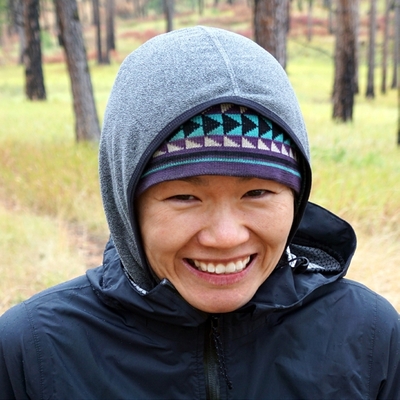
Jessica Yen’s work explores the intersection of memory, family, culture, language, identity, and history. Her work has appeared in Oregon Humanities, The Drum Literary Magazine, and 1001 Journal, and elsewhere. She is currently at work on a book of creative nonfiction. By day, she writes grants for safety net clinics and edits academic manuscripts for scholars seeking to address health inequities. You can find her online at www.jessicayen.com.
With roots from the Pacific Northwest, Anna Davidson lives in the love of Oakland, CA as a queer female-identifying artist, teacher, mentor, and believer of dreams. She practices in mixed-media collage, photography, and poetry—which has taken life on both the stage and page and most recently, the covers of her first chapbook, Phases of Bone. At twenty-seven, her art and writing is most inspired by women, relationships, connections in nature, and the journey to see strength in every emotion. She is most passionate about invoking spiritual healing, self-love, and confidence within at-risk youth and young women of undermined/oppressed identities and communities through the use of artistic expression. She sees herself one day living amongst the trees and implementing these practices into countless corners of the world. Website: www.adcreativespaces.com. Email: davidsonanna90@gmail.com. Instagram: annnnnajee.
By Lindsay Wilson
By Victor Hugo Mendevil

By Windy Martinez
By Jackie Martin
By Samantha Edmonds
By Jeffrey J. Higa