
Letter from the Editor
By John Hardberger

2nd Place Fiction
2019 Summer Contest
Readers are placed in the mind of a narrator who cannot remember and the result is a story of a life, eked out in bursts and fragments, held together with the momentum of the present. It is a challenging construct that would have failed in the hands of a lesser writer, but the author crafts a beautiful narrative with just the right amount of give and take.
– Lesley Nneka Arimah
It’s strange: I don’t forget that I will forget. Notes clutter my rooms, full of mnemonics, little tricks, pictures, signs. But especially lists. “Write it down. Write it, write, write, write,” you said, pointing at my palm-sized leather notebook. “Don’t let my chamber float away.” This, the first instruction regarding your funeral, unsettled me, so I fell back on habit; I uncapped the pen kept on a silver chain around my neck, and began that list the same way I’d begun so many others. The way you taught me when I was eight, barely able to stay on the lines: date on top, subject beneath that, deadline when applicable. You’d been my coach, picking up where the doctors left off, teaching me to live with an injured brain, a faulty memory. And, twenty-two years later, I was helping you cope with your own affliction.
“I want things done my way, Sweetie,” you reminded me.
“You’re fine, Mom,” I said. “The treatments, maybe another round…”
“My way,” you repeated, stubborn. “It’s my time. My turn.”
We spoke of death in this way, not of fears or meaning, but of flowers and hymns. You said ‘chamber’ with a long, unnatural drawl, attempting to sound like a southern lady, but we were not a family of refined southern tradition. We were pure “New” Florida. No tidewater manners or piedmont heritage for us. We suffered mosquitoes and humidity without the languorous façade of white linen and hand fans, we burned and itched like tourists, but that never stopped you from daydreaming of cotillions and mint juleps.
“Details matter,” you said. “People notice the little things. You’ll do fine.”
What if I don’t get it right? My voice, my worries, stuck in my throat. It – death as a thing- there is no pronoun for what death really is: A formless deity, a concept beyond comprehension, because the moment we reach it, we lose our ability to reason. It was not about mortality for you, but a milestone with rites. Tasteful and tangible steps closer to Dad and Carol. Carol, a child angel. Dad, a forgiven devil. You assigned such sacrosanct arrangements to me, your remaining daughter – the saved but broken twin – knowing exactly how much you asked of me. I would inevitably make mistakes, and you trusted me anyway. You had a faith I lacked.
Deathbed
Hospitals were once for the impoverished and abandoned. Asylums. Sanatoriums. Residency in such an institution was to be avoided. Now, walls lined with art, hospitals exude a middle-class sophistication that allows patients the privilege of forgetting. Forget your fears, the sculptures and stained glass say, for this is a place of healing. Only the unfortunate die at home, blinds twisted shut against the sunlight, waiting for a neighbor’s complaint and a landlord’s key in the lock. That, you’d say, was no way for a lady to pass.
Dying in the hospital seemed safest. I watched your interactions with the staff until I understood- safe meant certain. Fate, not misfortune. At home, death would go unchallenged, or worse, be a half-done thing: choking, fading, helpless and unhelped. Whereas, among these persistent nurses, even a cardiac arrest could be reversed with adrenaline and electricity. You’d know they’d give every effort. And there would be a man of God nearby. Any god, any man. You preferred men in critical situations and always felt secure with a man nearby, even if he’d caused your anxiety. When the end came, you were calm, and I did my best to mirror your poise.
It played out just as you’d thought, as you’d seen on TV dramas: orders, actions, extreme measures. The nurses’ movements were practiced, like the pit crews I saw when Dad took me to Daytona the year before he passed. It was my 15th birthday and I knew you wouldn’t come with; you hated cars. Neither of us shared his attraction to the sport, but I hid my nerves and followed his lead. I adored him the same way you did, drawn to his cold, controlling charisma, willing to accept that the accident wasn’t his fault.
As the mechanic-like nurses worked on you, I stood in the doorway. I took sharp inhales in through my nose and felt the wail of loss settle like a resting dragon. Your eyes closed, but you must have felt the hands and heard the voices. I know you appreciated their professionalism. They gave you a chance, a chance Carol never had in our wreck of metal. I don’t remember that night, but it inhabits me, sadness so heavy it dampens my emotions like rain pulling down dust.
Transfer
You’d said, “I’d like to know you’re taken care of, that’s all.” Not really your last words, but the last ones I recall clearly. Those words came back to me, echoed, because I knew I still had to take care of you. From the moment they declared the time of death, I was meddlesome and calm, explaining your wishes, refusing to be ushered away. I stayed to observe the transfer. Your requests dealt with ritual and appearance, but to get to those I had to attend the messier aspects of your posthumous state.
The transfer team assessed everything of importance. This meant your weight (125 pounds, no additional team member needed), your disease (not infectious, no additional gear needed), and your state of decomposition (early, no additional gear needed). They documented your clothing and valuables. I told them you’d crocheted the headscarf yourself, but this was not of importance, and therefore went unnoted. You’d taught me how to crochet at least five times, and I still couldn’t cast off. Or maybe that’s knitting? The transfer crew didn’t know either. They attached the ID tag. Colette. One L, two Ts. I made sure.
I followed the van to the funeral home, chewing my thumbnail during the long, nerve-wracking drive. They moved you onto a stretcher under a plush, navy blue cover. You disliked that color, but you would’ve liked the fabric, the coziness, the weight of the blanket, heavy like the ones you tucked up to our chins at bedtime. Both your girls, side-by-side, till there was just one. Did you realize that each night after the accident you smoothed my hair twice, and placed two kisses on my forehead? I wished I could make myself be Carol for the second kiss but was never quick enough. Nine years old, too old for magic, but my mind, so damaged, needed it.
At the funeral home, they placed you on a body tray, elevated your head on a concave block. The transfer supervisor explained in a quiet voice that this would prevent purging. I thanked them, even though I knew they didn’t do it for you, but for themselves, to make their day easier. Cleaner. The undertaker arrived, a stack of dark towels in hand. Perhaps he did not trust the block to protect him from blood and bile. He said I should leave, so I left.
Shroud
You joked about the clothing so much that I handed you the pen. “You write it the way you want it,” I said. I didn’t have your sense of humor. You gave the pen right back. “No need for shoes!” You laughed until you coughed, but I was still skeptical because you’d always preached complete, head-to-toe matched outfits, insisted. So, there it is in your perfect, unhurried cursive:
Dark purple silk shirt (button it up, put the pearls over the collar).
Black slacks, the ones with the cuffs.
No shoes, hon!
“Wasn’t that a hoot!” you said. I agreed, but you shook your head in a way that let me know I was forgetting something. “Thanksgiving, remember?” I didn’t, so you told me about the year we went to the mall after Thanksgiving dinner, part of a massive throng, hoping to get leather ankle boots at half price. But the frazzled clerk shooed us out, repeating those words over and over to each customer: “No shoes, hon. No shoes, hon.”
The mortuary was equipped with a state-of-the-art lifting machine, for dressing. The undertaker let me help him roll you instead. More respectful. He asked if I would like to help with the undergarment. For a moment I was at a loss; underwear wasn’t on the list. The assistant, a college intern with her hair in loose pigtails, held out something that looked like a diaper. “Oh,” I said. “No.” Despite all my research, there were a few things I didn’t expect. I turned away until I heard the zip of the slacks. Under whispered guidance from the undertaker, the assistant managed the socks. When the undertaker asked her for the eye caps, I turned away again.
I gave them your cosmetics bag, each item inside unused. “Like this,” I said, handing over two pictures I’d taken of you a week earlier. The first one you posed for, the second one I took furtively, when you were not smiling, in case that would be more helpful. Natural. Expressionless. At rest. The lipstick, the shade you loved, made me think of half-healed bruises. The assistant took the bag but said, kindly, they had a very good restorative artist on staff. My resolve weakened, and I could go no further. I knew they would suture your mouth shut. I knew enough about plugs and fluids. I knew that the color palette of the so-called “restorative artist” was not one of springs and summers. I looked instead at the instruction: Lipstick = Chanel, la raffinée, the new tube. Make sure to apply two coats.
I am sorry, Mom. I tried to bear the unbearable as well as you did. Fix the unfixable.
I wonder if this is how Dad felt, coming home every day, refusing to let us abandon the house he’d selected for us so carefully – a home near the water, in the sun – waiting for forgiveness that can comfort but never cure.
Prayer Cards
“The Lamb of God—not a serious one. Something cute,” you said. I wrote it as you dictated. Don’t make the lamb too serious. Not the stained-glass motif or the medieval tableau. A photorealistic scene of two little snow-white lambs on a sun-drenched emerald hillside. ‘Safely Home’ on the reverse side: I am home in heaven, dear ones, so happy and so bright.
The sunshine of my childhood, I can remember—so many days of it, enough for you, me, and Carol. The Three-Cs we called ourselves. Dad, an inelegant ‘Terry,’ wasn’t one of us. We-Three-Cs, out in the sun, under the endless, elevated cloud-skimmed sky, skipped across brown pine needles and sharp fronds discarded by low palms, our feet burned by hot sand. We-Three-Cs, out to the shaded porch, where our rescued cats with newborn kittens mewed and cuddled. Carol insisted we care for every momma cat until the kittens were old enough to sell, at least eight weeks. We Three Cs Cat Care. Even after the accident, you and I kept at it.
I’d cry when I couldn’t recall the names of a new litter, so you made up a game. Counting fingers, start with the thumb. Thumbelina. Index finger? Indiana Jones. Middle finger? Middleman. Ring Around Rosie. Pink Panther. Tom Thumb. Indigo. And so on. Sometimes we kept the kittens ten weeks. I called those extra days Carol Days.
“I didn’t know what to do, at those times you thought you were her,” you said, voice light but words thick from the morphine.
“What do you mean?”
“The first day home from the brain trauma rehab place. You looked in the mirror and thought you were Carol. You were so happy. ‘Mommy, I found her!’ you said. I had to tell you again, and again that she was gone. How many times I broke your heart telling you. The doctors said it would resolve itself.”
I held your hand, Mom. You slept. One hundred questions collapsed inside me.
Interim
Everything was scheduled and paid for. Dad had always been organized and planned ahead for everything. His pension and the accumulation of insurance payouts were generous. Other than volunteering at the Humane Society, making your arrangements was the closest thing. I’d had to a real job. I waited, alone at home, for four days, working a jigsaw puzzle to pass time. Service and funeral in one day. Simple. You’d hoped for an overcast day, like a movie set in New England. I’d written it down, but scratched it out later, so that only two items remained on that list:
Service and funeral in one day:
Cloudy, overcast.
Stay home.
“What do you mean, stay home?” I’d asked.
“Stay home. Relax. Do something else.” You patted the narrow space on the edge of the bed and I sat. “I don’t want you to be so sad.”
“Mom, I should be there.”
“Oh, no ‘shoulds.’ Good enough to know you’ll be beside me someday. With all of us.”
You said something else, something I didn’t write down, maybe what you wanted for dinner or something that seemed irrelevant. In these half-memories I feel forewarned, as if communicating with a ghost. I shouldn’t have stopped with what you wanted, but also asked why. I can guess. Perhaps you thought I’d embarrass myself, become moody and flustered; the emotions would cause time to blur more than usual. That I might think the service was Dad’s, relive the confusion I experienced at his wake, slam the lid down on you too. But it wasn’t how you thought: I didn’t blame him for anything. Reconciliation had taken years. To reconstruct our bond, he’d take me to the dock every Sunday morning— to watch the fisherman head out—until finally it became a routine I could predict and recall. And then he had the heart- attack. I was angry, not at him but at my love for him. For it forming too late.
“Do something nice,” you said. “For yourself. Take care of yourself now.”
Casket
210 pounds, 18-gauge steel, high gloss exterior, adjustable mattress, satin pillow and cashmere throw blanket. A warranty and a guarantee not to leak. You picked out the casket from a brochure, but if you noticed the guarantees, you didn’t let on. I don’t know if the manufacturers intended to protect against leaking in or out, but I know the leaking out would’ve concerned you most. You skirted the tangible horror of death. You must have worked hard to push it out of mind after Carol’s and Dad’s.
“Your father hated to even hear me pee, even after twenty years,” you said. “Imagine what he’d think of all that nasty rot right next to him?” You paused, maybe catching an unsavory thought before it formed. “Bad enough your nails keep on growing—did you know that? They grow. Hair and nails, or so they say. Check my fingernails. Manicure. Add that to the list.”
Viewing
Stuffed armadillos hung on the wall, peanut shells covered the floor. In the sandy yard behind the bar, a lethargic alligator pushed his snout against the chain-link fence, more neglected pet than attraction. I didn’t want a beer, but I ordered one anyway, because I couldn’t sit for free. I sat there defiant and contrite-hearted because I had not stayed home, as you instructed. I couldn’t stay away from your service, and this was the best view of the funeral parlor. A few cars arrived, some shiny and dripping condensation from the tailpipes, others rusted, with windows rolled down to catch the humid breeze. As the mourners made their way past the drooping begonias and blooming shrimp plants, a man with a smooth and practiced manner shook each hand. His dark suit looked out of place next to the chipped stucco portico and stubby sago palms, but he was appropriately somber. Exactly what you’d want. I pushed the beer away. I couldn’t stand the smell.
A red-haired woman, wrists laden with beaded bracelets, sat next to me and looked me over, evaluating my black dress and bunned hair. With barely a pause, she began to speak to me a if I’d been expecting her. She told me about a funeral she saw in India. “All colors and banners,” she said.
“Sounds more like a parade,” I said. She nodded, then told me another story. Something about Thailand and an Italian boy, and a dare. She tapped the edge of my notebook to get my attention. “Why aren’t you over there?” She pointed at the funeral parlor.
“I’m not even supposed to be this close,” I said. We snacked on peanuts and I told her more than I thought I could, even about the ban from the burial. “Maybe she thought I couldn’t handle it,” I said. “There could be other reasons. Trying to remember is like staring into shadows.”
The woman placed two shots of tequila in front of us. “Yeah, you can handle it,” she said. “But you shouldn’t have to.” As the mourners returned to their cars, she grabbed my hand. “Let’s go.”
Guest Book
“Don’t make a fuss,” you said through a mouthful of ice chips. “Don’t roll those eyes!” It was too late; my eyes had already rolled. I’d never heard of invitations for a funeral. You explained it as more of a request card. You didn’t like the idea of an obituary or other public announcement. Dad’s had brought in a crowd. Too many handshakes.
The people you wanted to be there:
Jack (Your favorite nephew. A mischievous kid I never liked.)
Harold (Your next-door neighbor. After his wife died, he visited to do crosswords with you; two old friends measuring the moments of life, one obscure riddle at a time.)
Nancy & family (Your best friend and coworker of thirty years. Her kids call you Auntie Colette. She visited you in the hospital as much as I did.)
I waited for more names, but you were done. You didn’t want to bother too many people. Who would be bothered? The cousins who surf at Cocoa Beach and deep-sea fish in the Keys? Your black sheep nieces, who tour artsy northern cities as a fire eater and a fortune teller?
“What about them?” I asked you.
“Incense is tacky,” you said, moving on without answering. “Roses would be nice.”
Gravesite
“Don’t let my chamber float away. Write that down.”
I told you that even here, a mere fifty feet above sea level, coffins weren’t popping up and spilling zombies into the canals. “Don’t be crass,” you scolded, with a little slap to my knee. “Anyway, I don’t aim to be the first. Put me in the garden, so I stay put.”
County regulations require the “garden” to have 12 inches of soil above the “burial container,” so I arranged for 18. The extra room above could be arranged, but side by side had to be tight. You are next to Dad and Carol. Plots are expected to fill up within twenty years, and waiting lists become complicated. Dad bought the family plots so long ago, for all of us, but the rules could change. Will I make it in time? They call it overcrowding, as if imposing on the dead. Neighbors closing in, shoulder-to-shoulder, claustrophobic. Memory can be that way—congested, jumbled histories and faces.
Tipsy and dizzy from the tequila, I stepped onto the gravel entranceway of Ocean Side Cemetery, from the car of a red-headed stranger. She waved her beaded arms, urging me forward. Forward I went. I hugged, I cried, I hugged everyone again. I picked an armful of roses from the memorial display, stumbled over the carpet that incongruously covered the disrupted sod. I sat on Carol’s gravestone, cradling the flowers like a baby. The clergyman spoke his words for you, the poems I’d given him on your behalf. I stayed there, silent and still, watching your plans unravel.
Headstone
You romanticized headstones, thought of them as garden ornaments rather than death markers, so you easily rattled off the specifics for your own. Yours would be a portal stone: Salisbury pink granite, laser-etched gates of heaven, angels calling you up, a beam of holy light. Another facet of your beautiful denial – your chamber was not a coffin, but an elevator to God’s penthouse. I wished I could’ve seen it the same way, but maybe I was too cynical. I learned of corporeal death too early, too fully, so that it became normalized, or least unspiritual.
One story you told often. I was nine, a year after the accident, and the exterminator came for the annual check for mice, possum, and whatever other critters might nest near our vine-covered home. He asked if you’d smelled anything unusual. You hadn’t, but I, eager to help, piped-up that I had smelled something terrible. Having always wanted to explore beneath the weathered planks of the screened-in porch, I volunteered to find the source. In that stifling crawl space, I slid into three dead catfish, dragged from the river and ripped by raccoons, eyes and gills and scales rotting down to worms. I had nightmares for weeks: A little girl’s bones, displaced fish turned inside out, short-furred kits shivering in the night.
Footstone
I admire anything with a concrete history, even the archaic fact that in England, footstones mark the graves of felons and murderers. I didn’t tell you those sort of facts, that was the agreement. You picked what sounded nice, and I let it stay that way for you. Nice. “Stone or bronze?” I asked.
“Stone! Stone! They’ve got to match,” you said. “All of them. Match!” You lost your patience that day. The nurse told me to let you rest for an hour. When we resumed, my handwriting was particularly neat. I tried to concentrate and keep with the escalating details.
Granite (match headstone—Salisbury pink)
Flat marker (extra permit?)
Smooth. Polished border. Roses. (laser)
‘Devoted Wife and Mother’ ‘Beloved Daughter and Sister’
Get one for Dad’s grave.
What was Dad’s supposed to say? What polite lie did you ask of me? I can’t remember, even as I revisit the list, each preceding item with a tidy checkmark next to it. I’m sure you told me, repeated it, waited, watched me write. Did I fake it? Doodle? Retrace a parenthesis instead of taking down your wishes, knowing that if I didn’t spell out your love for an unkind man it would not be memorialized? Anything I erase would fall away. My misplaced love, your dependence, our blindness could evaporate. We would remain, and your name could go on, independent and strong.
Eulogy
I knew the treatments weren’t working because the doctors told me. Did you know that you were dying without being told? Could you feel it? I tried to protect you from the bleak updates and morbid plans, but I couldn’t guard you from what was occurring within your own body. Surely you felt changes, like the aura before migraine, a seizing of the abdomen before monthly blood, an ache before fever. So many intuitions you taught me, but not this one. Not the final one. Grief reduces people to simpler senses, to indecision and timidity. Yet, in my own way, I am devoted to the truth. I never forget that I will forget. Notes and lists order my life. I remember you trusted me.
I made a calendar, until the habit becomes memory, and I visit the cemetery twice a week. Colette, devoted Mother. Carol, beloved Sister. Terrence, our Rock. Death is not a failure, not a weakness. We are all here, together.
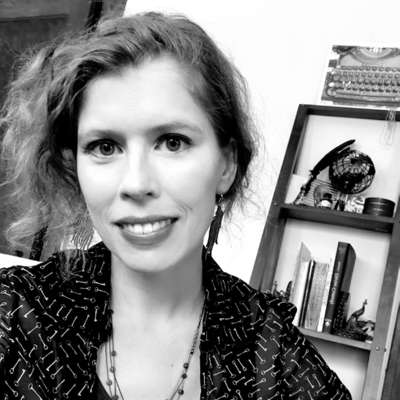
Robin Rozanski’s writing has appeared/is forthcoming in A cappella Zoo, The Austin Review, Thrice Fiction Magazine, Iron Horse Review, and elsewhere. She has an MA in creative writing from the University of Central Florida and is a teaching artist at The Loft Literary Center in Minneapolis. Her work explores damaged mind-body connections and has been supported by fellowships and residencies from InterMedia Arts, Tofte Lake Center, New York Mills Cultural Center, and Kimmel Harding Nelson Center for the Arts. Find her on Twitter @RobinRozanski.
Mitch Marty is the Associate Editor of Blue Mesa Review. “Albuquerque, New Mexico” was originally published in Barren Magazine, Issue 8.
By Lindsay Wilson
By Victor Hugo Mendevil

By Windy Martinez

By Jackie Martin
By Samantha Edmonds
By Jeffrey J. Higa