
Letter from the Editor
By John Hardberger

My father came undone with his tie. It took six years, the full unraveling. I first noticed it one morning during my junior year of high school. My father and I didn’t talk much. He was immersed in his work as the head clothing buyer for a local discount menswear chain, traveling the world in search of bargain-basement coats and ties he could gobble up in bulk and sell to office workers aspiring for bigger offices with better views. But when he was home, we ate breakfast together—me, hunched over my bowl of granola, him similarly hunched over his blackened pumpernickel toast. That morning I sat across from him and, looking over my bowl of soggy grains, I noticed something wrong with his tie knot. It lacked that little dimple in the middle he was always so careful to produce, the supple spot like the hollow of the knot’s throat.
The rest of his outfit seemed up to the usual snuff. Dark gray suit, rich green gabardine tie, cream-colored shirt, polished burgundy brogues. As he flipped through the Times with one hand and played with the charred crumbs on his plate with another, I asked him if he was all right.
“What?” he said, flipping through the paper to the style section.
“You all right?”
He looked up at me like he was just realizing I was there. Remembering he had a kid. “Yeah, peachy keen.”
I’d never heard him use the word peachy before. Or keen. I don’t think I’d ever seen him eat a peach before. He was a meat and potatoes man. But he kept his eyes on his paper and I had a whole day of high school ahead of me to languish through so I left it at that.
These little slips in attire grew more egregious: colors clashed, shirts untucked, starchless collars lay limp and defeated around his neck. These were the indicator lights that the formerly well-oiled and well-dressed machine that was my father—fast-talking, no-nonsense, high-earning, put-up-or-shut-up patriarch—was breaking down. The fractures before the big disassembly. But clothes had not always chafed him. No, in his prime, my old man was quite a sight. You wouldn’t know it now, but he was once dapper, distinguished even in his pajamas, but spectacular in a suit. Granted most people look better in a well-fitted suit, but he had a special sharpness, an exactitude that left people with the impression that he was cut from a finer cloth.
Before my father broke down, back when I was a kid with his heroes intact, my world spun for him. Spun and stopped, too. As a toddler I’d crawl into his closet and try to climb a cascade of ties—knit green or gray wools, regimental striped silks, ribbed failles—the overstuffed closet of a social-climber, a middle-class version of the Duke of Windsor’s own collection with the names of the fabrics exuding refinement and culture and hinting at adventure: Egyptian cotton, Persian cashmere and Harris Tweed from the Outer Hebrides. Rich merlots overlapped saturated indigoes, ornate paisleys dangled next to puckered seersucker. A rack of ties where moods and memories juxtaposed: a light and bright pastel madras for summer barbeques abutted a black tie, a satin slash of shadow in the corner that I’d seen him wear, dignified and stoic, reading Frost’s The Road Not Taken at my grandmother’s funeral. His closet was more colorful and cosmopolitan than the rest of the drab New Jersey suburbs I grew up in. I mean, he was slick. Twenty-five years in menswear had taught him what color belt to wear with what shoes and what club ties not to wear in England. Most kids couldn’t care less about their father’s wardrobe but I intuited the significance of his ensembles, seeing, even then, the need for a layer between ourselves and the world. My last year of middle school, after my fight with Mike Moretti, further cemented my appreciation for them. My punishment could’ve been worse but my father’s suit, like an enchanted fleece, saved me.
It happened like this: I was riding a growth spurt out of the nerd ranks and into middling popularity and there’s always conflict when the social order is disturbed. Mine came in the form of Mike Moretti. We’d been friends once, in third and fourth grade, then drifted apart. Maybe he singled me out to bully because I knew him when he was a sniveling kid ankle-deep in the dolls boys were brainwashed into calling action figures. In eighth grade, like a tropical storm promoted to full-blown hurricane, he became a real menace, punching, stomping, tripping and otherwise terrorizing his way into the upper echelons of our grade’s hierarchy. My peaceful maneuvering into the lower-ranks of the same group galled him. So he began to push. He’d mock me when I told a story or trip me in gym class. Once, while holding what I thought an impressive chin-up, he ripped my gym shorts clean off. My baggy boxers kept the class from seeing my bare ass but it stung nonetheless. Worse yet was when I was trying to impress a girl. Out of nowhere, after working up the nerve to flirt with one, or talk to one—which then felt very much the same thing—Moretti would materialize behind me in the form of a loud, wet fart sound. I still hear the echoing, demoralizing squish of it when I ask a woman out. If I knew an answer in class, he’d call me a nerd. And if I didn’t, he’d laugh and call me a moron. I couldn’t win. The pressure continued to build until his friend, Kyle something, crouched behind me and Mike pushed me over him, a classic ambush. Normally, I’d have shrugged it off. But this time everybody and their mother saw it and there was that pause, a pause you don’t see coming but when it’s there you know it. Everyone knows it. I knew it might set the tone of the next three years of my life, maybe even all of it. So, what did I do? I slugged him. Hard and fast and clumsy, swinging for my tormentor’s face with all I had. I hit him as I sprang up off the pavement, breaking his jaw and cracking a tooth or two. Busted my knuckle, too. Two teachers separated us, thankfully, because when Moretti’s shock at me having the guts to hit him wore off, once he’d swallowed the bits of teeth in his throat, he’d have pummeled me into a stain in the yard, a cautionary smear.
When the crowds and testosterone cleared, I went to see the nurse who plied me with aspirin and sent me off with a perspiring ice pack to the principal’s office. The principal glared at me, a usually chilling look but my adrenaline burned through it. Pain and fear made the whole room throb with meaning, heightening my senses. I felt the ice of the pack in my bones and heard the ticking of the wall clock deep in my brain, like the hands were wired to my amygdala. The doom of waiting for my father. My mother had the afternoon shift at Macy’s where she sold high-end handbags for high-end people to fill with their high-end stuff, so I figured the old man would be called in. I sat staring at a liver-shaped stain in the carpet until my father pulled up.
He got out of his car, purposeful, confident. His charcoal gray suit, expertly-tailored, shifted with him as he walked, rippling like a second skin. He didn’t look somber so much as decisive, armored in an executive’s attire. The principal started in on me afresh as my father approached. He told me I’d be suspended for a week and that I should be ashamed of myself and loads of other things to cow me. But in walked my father, sharp and cold. He reminded me of waking up to that first frost, the way it obscures your window and makes you worry about the coming cold and gloom.
In my father came, undoing the front buttons of his overcoat, and sitting beside me, giving off an air of being inconvenienced yet at ease. I didn’t even squeak a hello. My ears were full of a rattling or a humming and I snapped to attention once questions were directed my way. My old man asked me about the fight. Like a court procedure. A call to order. I nodded yes, I had been in fight. I could only muster simple responses.
“Who’d you get into with it?” he asked, like it was a regular occurrence.
“Mike Moretti,” I said, while looking at my father’s crimson pocket-square. It looked blood-soaked, like deftly-folded and recently-used gauze.
“Tom Moretti’s son?”
I nodded.
“Who started it?” “He did,” I said, then my old man nodded and told me to go on. I recapped my misadventures the best I could. It all tumbled out: I said I punched Mike in the jaw, that I didn’t think too much about it, that it just kind of happened. A reflex. I looked at the liver-stain. It looked like it had grown. “I’m sorry.”
“Let me get this straight. This Mike kid started it by pushing you over? You punched him once, then the fight was stopped? Yes?” he added, nodding in my direction, prompting me.
I rallied round that yes, that nod. “Yes, yes, exactly. Then I went to the nurse and here I am. She said my knuckle’s probably broken,” I said, brandishing the swollen proof.
He turned to the principal and said, “Why am I here?”
His voice was strong, condescending and accusatory. The principal didn’t like the question or the tone, felt the power in the room shifting out of his favor, so he started to puff up. But polyester will never be silk, no matter how much it wants to be.
He said, “I’m called in to reprimand my son for defending himself against a bully? A bully and his sidekick? Frankly, I’m sorry my boy didn’t kick the little shit’s teeth in. Sounds like he’s in need of a good whooping. This is a waste of my time and his.”
The principal was, despite himself, impressed. He asked me to sit outside while the adults talked. Ten minutes later, I was let off with a warning. I’m not sure how my father finagled it, but it might have had something to do with the principal’s snazzy new double-breasted suit he wore to school the following week.
I followed my father out, sent home for the rest of the day. “Did you get a look at that guy?” he asked once we got in the car.
“Yes,” I answered, unsure of what to say.
“Well,” he said, lighting a cigarette with the electric coil of the car lighter.
“Well, he’s the principal?”
“He’s the principal of bad taste,” my father said, blowing smoke at me. “The guy looked like he just stumbled out of a K-Mart catalogue. And his comb-over? Come on. Even his tie looked sad, loose and all frayed like it had been chewed on. I can’t blame you for not taking him seriously. The guy stinks of failure. It’s coming out of his pores.”
But I had taken him seriously. I’d been seriously scared shitless. Though I kept that to myself and just watched my father as we merged on the highway, the neat break of his slacks as they fell on his gleaming cordovan shoes. I noticed a bit of ash on his pants and a small stain on my father’s tie then, like a faded splash of ketchup, but I didn’t say anything.
Yes, my old man was different then, in appearance and action, a man in command. That was years ago, before his company declined and he slipped into slovenliness, the crumpled shirts and wrinkled pants, before he began hiding bottles of booze in the shed and under the passenger seat of his bright red bimmer. Business slowed and my father’s company became more casual as it croaked. I’m not sure why. Let itself go collectively, I guess. After the first round of layoffs, he started going in with a jacket but no tie. He looked naked to me when he left the house without a tie. I mourned for all those colors and textures hanging forgotten in his closet. Around this time, I started seeing girls and getting my act together. I borrowed one of my father’s jackets for the semi-formal and felt like a celebrity, easily the best-dressed guy in the place. A couple of goofs snickered, but I knew I looked sharp. I felt like James Bond, a handsome globetrotter capable of anything.
Later on, he gave up jackets altogether and wore wrinkled button-downs two work days in a row. He looked like an inmate from an old prison movie, pacing the yard in ragged monochrome blues. Once home, he’d peel off his shirt and walk around the house in an undershirt. If I wanted to get laid, I had to sneak girls in the back to avoid his hairy belly bumping into them. Certainly no great mood setter. All that was left of his fine shirts was the lint balled up in the belly-button of his expanding stomach. Lint bound up with his body hair into little bundles that I found lying around the house, sometimes even on the kitchen table.
More months passed and as his clothes came off, we started getting calls from the bank. Calls my father swore he’d handle. When the banks became collection agencies, when the cars had been sold and my college fund liquidated and we were still somehow in debt, he retired his bluchers and brogues. I imagined them out at pasture, lowing in moonlit fields. The darker slacks were taken out of the line-up too. He even benched his penny loafers. Eventually, he was left with drab polo shirts, a couple of pairs of baggy chinos and a pair of dark blue jeans, which he tore off the minute he got home. Sometimes he didn’t even make it home. He probably slid out of his shirt in traffic but I imagined him disrobing in the parking lot of his office building, a clothing buyer who couldn’t stand to wear the stuff.
The final fiasco for my mom was a brunch. After all of my father’s failed interviews, after his unemployment checks stopped arriving and the bank was about to foreclose, she asked her parents over for brunch. Probably to ask for some money. Or maybe just to show them we were still all right. Still a family. My mom had asked my father to pull himself together for one day, one morning, for her sake and for her parents. She had this nice spread laid out: fresh fruit, home-made bialys, smoked salmon, chive cream cheese, fancy coffee. She looked great in a flowery sundress. I wore slacks and a light linen gingham shirt. Very sharp. My father, however, lay in bed all morning smoking and reading the paper. We figured he’d roll out eventually and at least put on his homely polo and a pair of wrinkled chinos. But once the doorbell rang and my grandparents came in he launched himself out of the room in those same overly-seasoned briefs. When he went to get another cup of coffee one of his nuts flopped out of his underwear. A soggy pork rind. My mom noticed, I’m sure, but pretended not too. My grandparents somehow joked and giggled through the brunch. I guess old age had made them accepting. Or oblivious. Mom left shortly after they did. She packed a few things and retrieved the rest of her stuff the next day. One minute I was eating a bialy with lox trying not to look at the blackheads on my father’s shirtless back, the next my parents were getting divorced. And you know my old man seemed happy as a pig in shit sitting there, drinking coffee and spinning yarns about his travels in Italy as a clothing buyer.
My last straw came later, last year when I went to see him with my new girlfriend at the time, Daniela—a real looker, as my father would say. The kind of girl who demands you wear your Sunday best. I thought seeing me put-together, newly enrolled in classes at the local community college, holding down two jobs and arm-in-arm with someone equally composed, seeing that his son was doing all right, making something of himself, that my father would rally round me like I rallied around that yes in my principal’s office years ago.
I was wrong. The place was in shambles. An upper-middle class ranch slowly sliding into poverty. The grass hadn’t been mown in weeks and leaves piled everywhere. As I kicked my way through them, I stubbed my toes on empty wine, beer, and bourbon bottles hidden beneath the leaves. The yard had become one massive recycling bin. A monument to my father’s decline and the blight of the neighborhood. All the manicured lawns around it only highlighted its raggedness. Daniela managed to step over all of the detritus, which is hard in high-heels. She even looked good doing it. The front door was covered in cob-webs. I couldn’t tell if he hadn’t left the house in a while or if he was just preparing for Halloween. I rang the doorbell three times and knocked. No response. The door wasn’t locked so we walked in.The smell of bacon was over everything. There was a faint smell of cigarettes too, under it all, and maple syrup I thought. We walked through the house calling for the old man but no one answered. We heard music finally. Some kind of jazz. I don’t know much about the stuff, but the old man had dusty records in the basement that he never listened to because the record player was ugly and Mom and I don’t care for jazz. Too choppy, like being in an elevator going up and down sporadically, with no sense at all, and no floor to get off at. We followed the music, if you can call it that, out back and that’s where he was. All of him. Out in the open air. Daniela gasped, but I’m grateful she didn’t barf. He didn’t even hear us over the music. Standing there naked and wrinkled and sagging, his butt pale and pimpled, he was twisting low-hanging apples from the tree. There was a bucket at his feet full to the brim with them. I liked those apples as a kid, sitting on my father’s shoulders to pick the unblemished ones off the highest branches. But as I got older, the novelty wore off and they were more trouble than they were worth, tart, bruised, sad-looking things. Fodder for wasps and worms. Finally, we’d just ignore them each fall and close the back windows to the stench of them, shutting out the sweet rot until they turned to mulch the following spring. So there he was, jangly music blasting and driving the neighbors nuts, I’m sure. And naked. Totally naked. Then he turned, apple in hand, and smiled at us through a month-old gray and patchy beard. The thing is—and this is what gets me—I think he was glad to see me actually. His whole body was a sack of grinning wrinkles. Glad, but too stubborn or cracked to put on a pair of pants. Chunks of an apple he must have just crunched through clung to his beard and chest hair.
He held an apple out towards me, his hand trembling in time with the strange staccato snorts of a trumpet coming out of the speakers on the patio table. “Hey kiddo, want a bite?”
“Dad,” I said, my eyes on his left shoulder and off everything else. “Are you forgetting something?”
He stood there for a moment, apple outstretched, considering.
“Clothes maybe?” I said.
He laughed. “Your girlfriend doesn’t seem to like me.”
I turned and saw Daniela was already through the kitchen door on the way back to the car. I hadn’t seen her go.
“What’s with the monkey suit?” he asked. “You two going dancing after this?”
I was wearing a new navy suit with a slight sheen to it. An athletic, European fit. The coat unstructured, the lapels narrow. The current style. “It’s Italian. Are you drunk?”
He shook his head and dropped the apple in the grass. “Take it off.”
“What?”
“You don’t need it. It’s not you. The fit is all wrong. Take it off.”
“Fuck you,” I said. “What’s even wrong with you? Are you having a nervous breakdown? Forget it. Mom was right.”
He walked towards me and I braced for a farewell hug from my naked father but instead he reached for my tie knot and tried to undo it.
“What the fuck?” I said, slapping his hand away.
“Take it off. It isn’t you,” he repeated, and grabbed the tie again.
I pulled away but he wouldn’t let go. He hung on tight and I felt the weight of him pulling me down, the knot like a noose. I shoved him hard so he couldn’t strangle me and he fell in the grass, knocking over his bucket of apples. I stared at him there for a moment, not recognizing the fleshy failure sprawled out in the yard. This man wasn’t my father. I straightened my tie and left, leaving him to his strange jazz and bitter apples.
Poor Daniela was in the car, battling shock. Probably traumatized. I drove straight to the nearest Chili’s and bought her a half dozen frozen margaritas. Despite the goblets of boozy slush and what I thought was some pretty quick-thinking, Daniela never got over it and dumped me a month later. I don’t blame her. I shouldn’t have brought her there. Telling Mom about it, the state of the house, the state of him, was hard for me but I had to. We both agreed we wouldn’t go back there until the divorce was finalized, the house foreclosed upon, and even then, just to pick up leftover stuff. Not that there’s much. I heard he gave most of his clothes to a local thrift store. Sometimes, when I drive through town in the grips of nostalgia, I can almost convince myself I see strangers walking around in his worsted wool suits.
My mother’s lawyer told her my father stopped fighting the divorce. That he was forced to leave the home when the bank took over but we’ve heard little else. I haven’t heard a peep from him since the Daniela incident. Nothing aside from a beat-up box that came in the mail a few weeks ago, a giant, lumpy cardboard and duct taped turd on my doorstep, my name scrawled on the side in red permanent marker in my father’s shaky handwriting. I didn’t open it for a few days, but when I did, I was greeted with the stink of him, cigarettes and his musk. Familiar and repulsive. And, through the stink, a plume of little white moths puffed out. He’d mailed me his ties, or what was left of them. Nine of the nicer silk ones survived, though the heavy winter woolen ones were almost completely digested by the hungry mouths of the moths’ larvae. They ate my inheritance. I took the salvageable ties to the dry-cleaners and, I have to admit, they still look pretty good. I’m even wearing one—a navy tie with white polka dots, a favorite pattern of Churchill’s my old man always claimed—for a job interview I’ve lined-up. A management-track position at an up and coming telecom company, a great opportunity for someone with an associate’s degree in communications. An opportunity, anyway.
Though the other night, when I was trying out my interview suit and tie combination in front of the mirror, I found myself unsure of which knot to tie. I know them all. My father ingrained them in me. The jaunty, caddish four-in-hand. The hedging Half-Windsor. And my favorite, the bold Full-Windsor. I first learned it the night of our football dinner—we were the champions that year, an undefeated and unscored-upon season. I was just a kid, ten maybe, oblivious to the weight the world assigned to trophies and suits, interested only in the game, the movement and adrenaline, the smell of the field and the feel of bouncing off of the hard earth after a successful tackle. My father’s company was at its profit-making peak so I seldom saw him. But he showed up for the dinner. Just in time. We went to the men’s room in this big banquet hall for him to redo the knot my mom had tied.
“Look at this,” he said, “this is a despicable knot. It’s not even a knot. It’s a random tangle of fabric. I’m going to teach you the Full-Windsor. This is the ass-kicking, lady-killing knot of big shots the world over. Watch carefully,” he said. He smelled of cigarettes, liquor and cologne. How he always smelled.
I tried to follow his hands in the mirror as he stood behind me, his head over my shoulder, his hands tying the knot, but they moved too fast and looked weird in the reflection, like they were my hands, not his, but I couldn’t control them. “Dad, I can’t see it.”
“What do you mean you can’t see? You have eyes, don’t you?” he said, tugging down on the tie, hard, to cinch it up.
It felt like fingers closing around my neck. “It’s too tight.”
“Tight is good,” he said. “Tight will keep you honest. Discomfort is the key to success,” he added as he pulled out a Marlboro, hocked a fat green loogie into the sink, and lit the cigarette. The spit and mucous clung to the side of the sink. I ran the faucet to try and wash it down but it wouldn’t budge. “That’s why I’m such a success,” he said, blowing smoke at his reflection in the mirror.
“You can’t smoke in here,” I said, worried my coach would come in and make us run suicide sprints up and down the hallways as punishment. He scowled and asked me if I was his kid or a cop. I fidgeted with the tie but couldn’t undo it. Reflected in the mirror, it looked impossible to undo, looked like it had been there forever, an eternal knot.
“Come on, let’s get your fucking trophy. I bet you’ll get a plaque, too. And one day you can give it to your kids. One day you can teach your own kid how to tie his knot,” he said and flicked his half-finished Marlboro into the sink with the waterlogged loogie.
Now, if I close my eyes, the knot nearly ties itself. Without fail, my fingers feel their way towards the Full-Windsor. Maybe this is my true inheritance. It is a hell of a handsome knot, the anchor of the outfit. I love the way it pulls it all together, the fat focal point of the suit, as good or better than the one my father tied—the full knot, the tie hanging straight, the feel of the fabric, the even tension of it as the crisp silk tightens around my neck.

Kent Kosack is a writer and MFA candidate at the University of Pittsburgh where he teaches composition and creative writing. He is working on a novel and a collection of short stories. His work has been published, or is forthcoming, in Sonora Review, Tin House (Flash Fidelity), the Cincinnati Review (miCRo series), Columbia Journal, Hobart and elsewhere. See more at his website: www.kentkosack.com
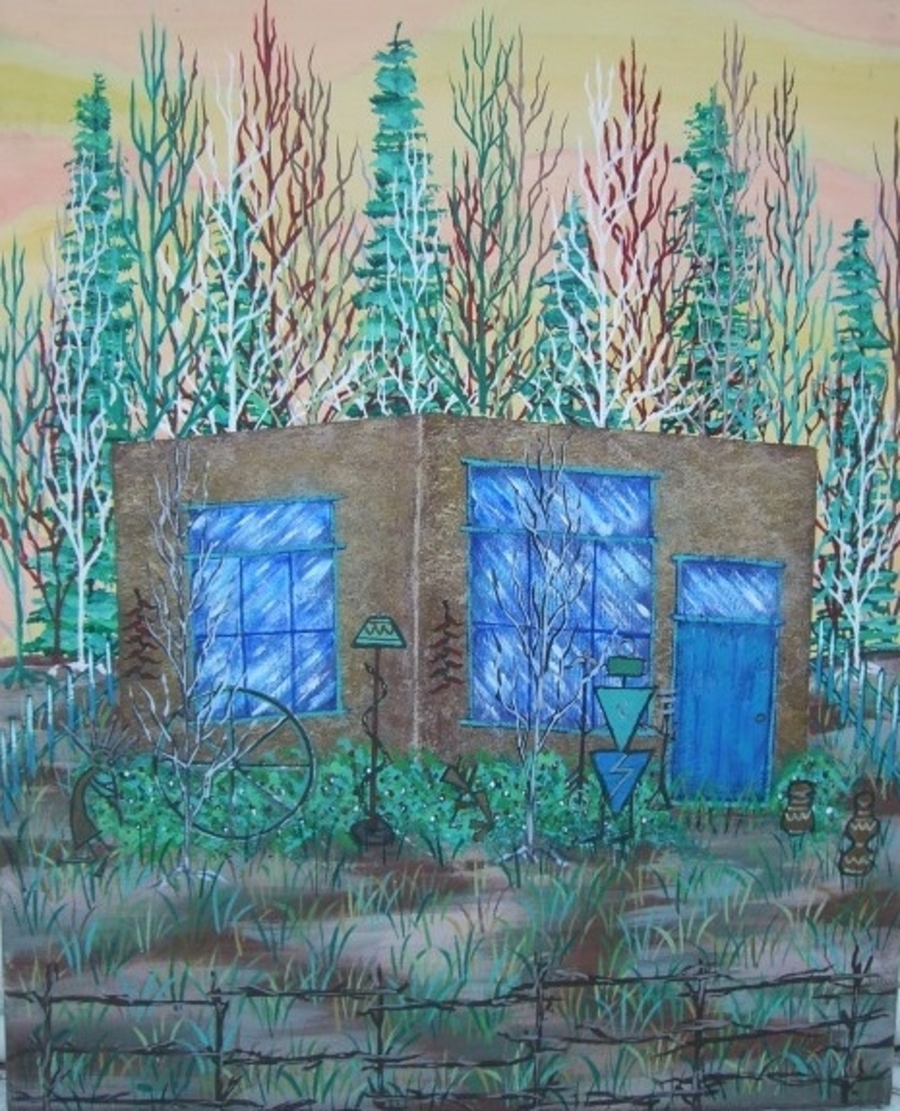
Timothy F Phillips was born on a bitter cold day in January 1963 in the hills of a Northern Pennsylvania in an old coal town. He was coloring on paper before he learned how to read and write, his drawings consisting of the surrounding mountains, valley, and streams with farmhouses. He is now represented at ArtFusion/Fusion Art Gallery in Wynwood Design District of Miami and Artlink Gallery. He has recently been featured in several art magazines like A5 Art Magazine, The Open Arts Forum, The High Shelf Press, ArtDex Art Magazine, Strawlitter Productions, Castabout Art & Literature, and The Oakland Review. He was digitally feature at Musee du Louvre in Paris on July 13th, 2015. He has developed a unique style which is recognized by artists & collectors the world over.
By Lindsay Wilson

By Victor Hugo Mendevil

By Windy Martinez

By Jackie Martin
By Samantha Edmonds
By Jeffrey J. Higa