
Letter from the Editor
By John Hardberger

1st Place Nonfiction
2017 Summer Contest
Where does a young man find his place in the world when he bounces between two points of being (“At home, we were Mexican interpretations of Americans; in school, we were American interpretations of Mexicans.”)? Although the Japanese graphic novel seems like the most unlikely comfort zone, this writer (and perpetual outsider) finds his kin in the anti-heroes and weirdoes of manga literature. Written with an unapologetic edgy tone, this essay builds its own linguistic and artistic landscapes in order to illustrate the nuances of Latinx identities. Stylistically rich and refreshingly unconventional, this essay is both intelligent critique of culture and education, and a grateful nod to those rebellious adolescents whose badge of honor was not fitting in.
– Rigoberto González
I went to a middle and high school smack dab in Texan, white suburbia, like dudes asking girls out to homecoming with mums as intricate as peacock tails, dragging from a girl’s shoulder to the ground with bells, whistles, teddy bears, ribbons, picture frames, clocks, etc. white. Those same schools banned headwear to make sure the Black and Mexican-American kids couldn’t flex that they were in gangs or some shit and forced girls to leave school for the day if their fingertips went past their skirts. Meanwhile, a Mexican-American youth in a nearby high school would be beaten to an inch of his life, sodomized with a pipe, showered in bleach, and left to die in some ditch by his fellow, neo-Nazi schoolmates for allegedly attempting to kiss a white girl on the cheek; he survived the attack but would later commit suicide by launching himself off the side of a cruise ship. His name was David Ritcheson. So it goes. Que dios lo bendiga.
What I’m saying is that as a brown kid in this environment, you try to find a community which will accept you so you can survive the bullshit that is a Texas public education school. My community at the time was composed of: two mixed White/Mexican-Americans (whom I’ll call Ryan and Ross, as they did have white-boy names), two straight-up Mexican-American brothers (Fernando and Miguel), one Honduran-American (Juan, the darkest skinned and most scrawny but surely, the smartest of us all), and myself, a mixed Mexican/Salvadoran-American (whom I’ll still call Reyes). My community was composed of many at its inception with white kids, a black kid, a Jewish kid, (all male, obviously) etc. But time worked its magic and they all found other communities where they fit in better. That is, after all, the greatest lesson of a public-school education: that people wander from one community to the next until they find the one that will give them the love they want; some will rot in communities they think are giving them that love while some, like myself, will wander forever it seems. It happens.
What united this particular group of brown kids was a Japanese trading card game called Yu-Gi-Oh, which was based on a manga which had an anime based off that manga, that we all watched and spent our poor mother’s hard-earned money to buy packs of to get the next holographic card to better whoop the fucking ass of the other in a duel (not to mention all those issues of Shonen Jump and video games that snugly held special edition cards within them.) I was at a particular disadvantage because mi mama was on a single mother’s, house maid’s budget that had barely any room for such babosadas.
“¿Quieres gastar mi dinero con esto?”
“Pero mom, I need this,” I’d whine as she forked over wrinkled cash to the smiling Comix & Cards store owner. Side note: I don’t actually remember what ever happened to all those cards as I have no trace of ever having them; I imagine them fluttering through the air and landing deep in a wet dumpster as my mom cackled with delight after I left for college. Anyways, I had to use skill, pure luck, and a mean-ass poker face to keep up with my friends whose parents could buy them starter decks and pack boxes.
“You sure you wanna make that move, man?” I’d ask with useless trap and monster cards on my side of the field. Sometimes they’d think twice and relent. Then I felt I could win. There are many reasons why a bunch of mostly poor, brown kids played some funky-ass card game where you summoned blonde-haired, big-breasted magician girls and said ridiculous shit like, “I flip summon my ‘Swarm of Scarabs’ and DESTROY your ‘Blue Eyes’ and then I’ll ATTACK your life points for 1,000 damage, MOTHAFUCKA.” Then imagine Ross, a beefed-up, copperskinned baby-face with a buzz cut forced on him by his veteran father, frantically searching the cards in his hand and peeking under his face-down cards on the field to no avail, anger welling up in his blue eyes gifted to him by his mother. “Shut the fudge up and finish your turn,” he’d say because his parents forbade him from cursing. Maybe we played Yu-Gi-Oh because it was something we were allowed to be good at for once.
Our public-school education effectively shamed us into not being brown. The Language Arts teachers never taught any Latino writers, focusing on Greek mythology, Shakespeare, Harper Lee, F. Scott Fitzgerald, etc. When a teacher would see that I was bored with the texts but impressed with my reading skills, they would offer me books from their personal collections, which were somehow worse than the class readings, shit like Ayn Rand’s Atlas Shrugged. I still remember my teacher’s face as I returned her Rand back to her half-read, disappointed in a brown boy who couldn’t connect with a rich, white man’s oppression. Whenever Black writers were taught, either their Blackness was taken from them (like how Lorraine Hansberry’s A Raisin in the Sun was simply a tragic story that could happen to anyone, really) or we focused on how much African-Americans suffered (which essentially painted all the Black students as charity cases, especially after Hurricane Katrina.)
My social studies teachers taught the bullshit that is the Texas Revolution for Independence, completely leaving out that William Bitch May Travis, Sam Shit Houston, and Davy Punk-Ass Crockett fought to maintain their right to own slaves when the tyrannical Mexicans abolished slavery years prior. I still remember the white boys looking back at me smiling, angry at Mexicans for winning the Alamo but proud of their victory at San Jacinto. White people love to justify their violence, especially when it comes to the atomic bomb. I was angry, too, but I didn’t know why. I just knew I couldn’t say anything even though no one told me I couldn’t.
“Santa Anna was just fuckin all the white women. That’s why they mad,” my mom’s friend’s older son in high school said as we played my copy of Grand Theft Auto 3 on his PlayStation 2.
I loved the study of math but the class was fucked up for me, to say the least. For every lesson taught, I then had to translate the corresponding textbook section to the Venezuelan student who only spoke Spanish. Try and imagine a 13-year-old Reyes with blocky, black glasses and something resembling a bowl hair cut stuttering and awkwardly pausing to think of a way to translate what the fuck a parabola is to someone who spoke a different kind of Spanish. It was a proverbial blind leading the blind sort of thing, except it’s just me with outdated prescription glasses.
“La respuesta puede ser A o C y si recuerdas el Pythagoran Theorem,” I’d say as neutrally as possible.
“¿Pues, cual es la respuesta?” he’d always ask.
“No, you have to figure the thing… Es que tú tienes que hacer la matemática.”
He’d then give me this stare as if I were the dumb one for thinking he’d do the math.
“It’s A. Es A.”
“You’re not just telling him the answer, are you?” the teacher admonished me afterwards. This is way before I learned the basics of interpreter ethics. Way before I knew I was doing work for free, another brown boy’s education on the line.
“That sounds like a lot of bullshit,” Juan would say as we got ready for a class we took together called ‘Adolescent Literature,’ where we read whatever we wanted for one period a day. He was right. On many levels, in fact, because there I was, a 13-year-old boy doing the teacher’s work to help another brown boy while having to make the imaginative leaps to identify with the struggles of white people in the books I was assigned while my mother cleaned their houses as the news called her an illegal, trouble-making, free-loading immigrant. Every year or so, the school gave students a district-wide and school specific performance score with all kinds of percentages for TAAS or TAKS (whatever it was) and drop-out rates and graduation rates and SAT scores and how badly the Blacks and ‘Hispanics’ are doing. It was the nightmare (or dream) of George Bush’s No Child Left Behind America where numbers, not students, were of the utmost importance and when the low numbers stand for you and your people more than you can stand for yourself, you grow to become angry. The white teachers loved to praise me, “You’re one of the good ones, Reyes.” Then I’d look at my brown brothers and sisters and wonder what was wrong with them. “Can we be good at anything?” I must’ve asked myself over and over again in some angry, teen language that is lost to me now.
Meanwhile, the school would be compelled to ban the wearing of hoods on hoodies and kept a low tolerance for gatherings of non-white students. I remember Ross, Juan, Ryan, and Reyes (the brothers had a different schedule) looking for a table to sit at during lunch because our usual spot was taken by a group of future college Republicans who informed us they could sit anywhere because hey, this is America. When we told an assistant principal, he shrugged and agreed with them. When we finally found another spot to sit, it didn’t take long until another group of white boys complained and got us booted out. When we used the same logic from before on the same assistant principal, he didn’t care and threatened to write us up. So, there we were, not allowed to be peacefully brown but we obviously weren’t white. When I would tell mi mama of all this, she said I had to toughen up, take it, and move on, to not make any trouble and do what I could to get by. Teen Reyes didn’t understand, especially when he’d been taught about Rosa Parks and Martin Luther King Jr. every Black History Month to stand up for what’s right, but did what he was told like un buen hijo. It would be years later before Reyes, before I, could understand that mama lived every day of her life like this as an undocumented American. It would be years before I read and learned from W. E. B. Du Bois’s thin veil, years before I studied Gloria Anzaldua’s concept of la frontera, years before I started realizing that I was neither fully American nor fully Mexican. At home, we were Mexican interpretations of Americans; in school, we were American interpretations of Mexicans (poor Juan, the Honduran American who could not fit in even more). White supremacy manifests itself in different, fluid ways in our current society. The worst of it comes from well-meaning people, the ones who think forcing children of color to act white and learn whiteness is helping them. That, however, is for another essay. For now, and then, the Japanese stuff will make do.
In that ‘Adolescent Literature’ class, Juan and Reyes read mangas where human beings were allowed to be superhuman and extraordinary, winning games of life and death with pure skill, towering intellect, and some good old fashioned milagros, not to mention all the blood and gore and cleavage and panty shots and curse words and other porquerias that pubescent boys could get down with. Mangas like GetBackers, Hellsing, Berserk, FLCL, Battle Royale, Trigun, and whatever Shonen Jump was featuring that month (like Yu-gi-Oh), gave us epic stories and battles that didn’t necessarily have morals or teachable moments or other boring shit like that (okay, in retrospect, they do but the teachers wouldn’t touch the stuff and that was enough for us). Yeah, each graphic novel had ‘good guys’ and ‘bad guys’ but they were anti-heroes and straight-up weirdos like: a defeated Count Dracula who now works for the British Empire to fight the last remnants of a Nazi battalion composed of werewolves, zombies, malandros, etc.; an alien raised as a human who becomes a doofus outlaw gunslinger with blonde hair and blue eyes in a postapocalyptic earth who makes sure to never kill anyone, including his enemies; and a meek, little nerd who becomes possessed by an Egyptian pharaoh when provoked. If all of these sound super badass, it’s because they were. But what was off about all of these characters was that they were supposed to be white.
Think about it. Many anime and manga characters are more-or-less fair-skinned, blue-eyed, and blonde haired like Sailor Moon (aka Usagi Tsukino) and Sailor Venus, Vash the Stampede, Super Saiyan Goku, Yugi (sans the blue eyes), etc. In many animes, characters would be dubbed with stereotypically American voices like valley girls, southern debutants, or Brooklynites while the rice balls they ate became hamburgers. It’s sort of a weird translation of Japaneseness into American-ness and vice versa. Yugi from Yu-Gi-Oh is an especially odd case in that he is supposed to be an Egyptian prince, or at least, the spirit that possesses the protagonist is; yet his skin is white and he has spiky-ass yellow and red hair (all while voiced by a white man.) In later renditions, much after I stopped watching and playing, he would have a noticeable tan, an orange-ish brown skin tone while the other Egyptians depicted in the show had stark brown skin with normal, black hair. It’s a mystery how an ancient, Egyptian prince would somehow look exactly the same as a young, contemporary Japanese teen. What isn’t a mystery is that the writers and illustrators probably just didn’t care. It’s a Japanese interpretation of whiteness and blackness, in a way: Yugi is not quite Japanese but he sure as shit isn’t black or white either. (Wander around any comic-con and see black cos-players catch racism for being dressed up as Japanese characters, but white people are the standard for cos-play. Assbackwards.) It’s in this nebulous space that my friends and I existed, translating our identities from our parents and from our schools and from America to ourselves and vice versa. We were brown boys not allowed to be brown in public, after all. Carajo, man.
What was super cool about Yugi is that he kind of represented who we were on a subconscious level. Yugi starts out as a meek, little boy that when provoked, becomes this badass genius who can defeat anyone in any game of logic and chance. This runs counter to many American narratives of superpowers, like the Incredible Hulk, who starts out as normal people but become these uber versions of themselves who can pulverize you into dust. As brown kids in white suburbia, we weren’t allowed that sort of narrative; my friends and I were potential gang members and constantly at risk of becoming drop-outs and stealing opportunities from more deserving white kids, a paradox that pervades white interpretations of Latinxs: too lazy to work but always taking their jobs.
Anyways, since I lived down the street from our middle school, Ross, Ryan, Juan, Fernando, Miguel, and I walked over to my apartment complex’s courtyard and dueled on this shitty, plastic table where someone had lit a firework and left a large scar of burnt, bubbled plastic. On top of that shitty, plastic table we had wars, we had combat, we had death, we had revenge. We argued abstractions like, “I attack your life points directly, which increases my monster’s attack by 1,000.”
“Dude, that monster got 0 attack though. Your monster only gains attack points if you do damage. 0 damage is no damage, so you don’t activate the effect.”
“0 is a number though. It’s still an amount, it’s still damage. 0 damage is still damage, technically.” “Technically, you’re a dumbass. 0 is the absence of something. It is nothing.”
“Look, fricker, 0 is a number, is it not? Theoretically, it’s an amount. Like, 0 degrees is still an angle. 0 is a number, it’s a numerical digit. You can count down to 0. I did 0 damage to you. 0 damage is still an amount, punk.”
“This motherfucker. I’m not arguing if it’s a number or not, I’m arguing that it’s not fuckin damage. If I paid you 0 dollars for a game, I didn’t pay you anything, dumbass.”
So on and so forth, until one of us gave up so the duel continued. I blame the TAKS testing. The smack talk though—the smack talk was savage, often in the form of vulgar similes aimed at our unsuspecting, beloved mothers to rile the other up so turns became focused on forming rebuttals and not on how many cards are on your side of the field, if they should call your bluff on that face down trap or magic card and attack your life points directly, if they should let that shit you said about their mom slide.
“Your mom is like a cheeseburger, dude: big, greasy, and worth a dollar.”
“Yeah, but your mom is like a vacuum cleaner: she sucks, blows, and they put her back in the closet when they’re done with her.”
On even exchanges like those, you maintained the status quo and the game continued as whatever. The uneven exchanges though, the uneven ones were the ones to watch out for. For example, let’s say you were winning by 3,000 life points and had an Archfiend Soldier and a Jinzo on your side of the field while the poor chump across from you had no monsters, three facedown cards that were useless or else they’d have used them by now, and were constantly checking them over and over again, reading the effects more carefully each time, like a broken contract.
“Yo, just admit you’re losing, man. It’s ok to lose to someone like me.”
“Just shut the fuck up and let me think.”
“Just pass on your turn and let me win. You don’t have to be a little bitch about it.”
“Now’s not the time for your pompous shit, dude. Just let me fucking think.”
“You’re wasting everyone’s time with your little bitchness,” you’d say before a few deep breaths were had, before a few tears were choked back, before a non-apology had to be issued so the game could be continued.
“I’m sorry, alright.”
“It’s cool. Just… it’s cool.”
“I’m also sorry you’re a little bitch.”
“Fuck you.”
It all reached a breaking point when Ross and Miguel were in the middle of a heated duel. Let me start off by saying that we were all insecure of ourselves, in case you couldn’t already tell. It’s just that Ross and Miguel were a perfect mixture of insecurity, the moisture of Ross’s pompous relishing of his winning situation combined with the warmth of Miguel’s anger rising from his wounded pride to form the oncoming perfect storm (side note: I aced the shit out of the TAKS Science portion, got a fuckin commended performance). You see, when Ross was winning a duel, he rubbed it in like a body massage, made damn sure every part of you knew every other second that he was the man. On the other hand, Miguel was a pretty quiet and reasonable guy until you poked at his flaws over and over again. The moment where shit got real was when Miguel had nothing on his side of the field and Ross had like a Blue Eyes or some shit, Miguel’s 1,200 life points to Ross’s 4,000. Ross went in for an attack.
“I attack your life points and end this embarrassment of a duel.”
“Fuck that. I activate Scapegoat,” Miguel said as he flipped his only face down card. Scapegoat lets you put four tokens on your side of the field that defend you from getting your life points attacked directly, in case you forgot. Each attack relieves you of a said token until you have no more. Miguel used these little chicks he had for tokens, yellow poofs with black dots for eyes and orange foam for beaks. Whenever they were attacked, Miguel would just take them off the field and put them back in his tin box where he kept his cards.
“I attack another one of your little chickadees.”
Ross loved to make motions for his attacks, like Fist of the North Star dramatic motions where he’d point to your face to indicate he was ordering a mythical dragon to blast your ass with an ultra-beam of light (I don’t mean to make that sound judgmental. I did that shit, too.)
“Alright. Just finish your turn.”
“You mad cuz I killed one of your little chickadees?
Aw, you’re some kind of big momma chicken?” Ross would ask before making some ridiculous clucking sounds.
“Just finish your fucking turn.”
“I end my turn. Good luck.”
Miguel drew a card from the top of his deck, eyes closed. He brought the card to his face and opened his eyes: it was a Cosmic Queen, a pretty badass card you could only get if you ate McDonald’s; however, you need to sacrifice two monsters to summon it and even if he could, Cosmic Queen only has 2,850 attack points to Blue Eyes’s 3,000. Miguel was essentially fucked, signaled by a tsk, exhaling loudly through his mouth, and saying, “This is some booty.” His older brother, Fernando, came to his side and inspected of Miguel’s cards, carefully reading their texts like a lawyer.
“That’s why I told you to put that trap card I gave you in your deck, estupi!”
“Man, it’s too late for that shit now, ain’t it?” Miguel said after punching Fernando on the shoulder.
“Ya! Imma tell mom!” “Aw, is momma chicken having a domestic disturbance over there?”
“Yo, shut the fuck up,” Miguel said.
“Shut up and finish your turn so I can win already.”
Now, there are certainly better ways to be a winner or a loser. One can win with grace and withstand the inevitable barbs from the loser, understanding that at that particular moment in time they, the winner, are ok, on top, and able to sleep knowing every decision they’d ever made up to that point in their life was correct. On the other hand, no one likes to lose, no one likes feeling that things will have to change soon. What things? Who knows. Defeat stings hardest during the examination of each and every flaw in your being. It’s a search that could last forever. What happens next is best described by a word from the ancient and very dead language Latin: hubris.
“Fuck you. Your turn.”
Ross drew his card, barely looked at it, summoned a Beta the Magnet Warrior, and went into an attack phase he won’t be able to take back.
“Beta attacks your last stupid, little chickadee,” Ross said before he picked up the yellow poof and tossed it at Miguel’s face like a lit cigarette. Other than the obvious disrespect, remember that Miguel has 1,200 life points. Beta the Magnet Warrior has 1,600 attack points and Blue Eyes has 3,000. That means Ross could’ve attacked with Blue Eyes first to destroy a Scapegoat token and end the game modestly with a final attack from Beta. Instead, Ross chose to destroy that chickadee with Beta with the full intention of finishing the game with a vulgar celebration of power over weakness by attacking with Blue Eyes White Dragon, pointing directly at Miguel’s heart to signify that the ultra-beam of light was directed at Miguel’s soul. I might’ve done the same. Perhaps we all would have. It doesn’t matter though. Because that yellow puff would be reciprocated with Miguel’s fist being driven into Ross’s jaw.
I remember shouting. I remember the two stood up and grabbed each other by the shirt. I remember looking at Ryan and Juan with a look of what-fuck-are-we-going-to-do; they shrugged and giggled. Fernando was trying to calm his brother. The laugh of hundreds of cicadas echoed in the Houston heat. Ross and Miguel let go of each other’s shirts. They stared each other down, heaving. I slowly approached them to see if there was anything to be said, to be done. There wasn’t. It just seemed like the right thing to do. But almost immediately someone said something, I don’t remember what, like it was too quiet for my ears only or in some language lost to me now. More fists were thrown and I found myself holding Ross back while everyone else let Miguel get in a punch or two extra on Ross’s jaw, busted it open with blood trickling out like a loose faucet. No one stepped in: Fernando supported his brother, naturally, while Ryan and Juan sat back and watched. I remember asking them about it later.
“Why didn’t you guys help?”
“Because Ross was being an asshole,” they said in agreement.
It was then that I learned even within communities as niche as ours, there can be cracks. Those cracks can spread until the whole thing crumbles, which is exactly what happened to us. Fernando and Miguel didn’t come back to play, obviously. Ryan and Juan didn’t want to invite Ross to duel anymore. They still wanted to use my place though, so I was having to decide between them and Ross coming over to play. Being simple, I thought, ‘two is better than one.’ I helped ditch Ross by not inviting him over anymore. Ryan, Juan, and I kept dueling but found it boring not too soon after, dueling each other until we knew the other’s decks by memory. No one else wanted to join us and we were damned if we played Magic: The Gathering. Our dueling days disintegrated along with the school year, where we all hung out with each other in different contexts, but never together again.
Looking back, I understand now that that disintegration was inevitable. After all, what is more toxic than boastful hegemony, the very kind machismo celebrates? Much like how much shit we talked to each other during duels, it only became an issue when one had a steep advantage over the other. It’s like a school run by white administrators and white teachers forcing youth of color to learn white history and failing them for not memorizing it verbatim while demonizing their mothers, uncles, grandfathers, friends, etc. When a person is held down, silenced, and given no reprieve, what else can happen other than the struggle to escape? Than violence? Than hatred? Resentment? Revenge? When oppression does not relent, violence is the final catalyst for change. If that scares you, then good. I’ve been scared for a long time. We have to change something because this isn’t working. Not for me. Not for many. There has to be something else or things will get worse. I feel it. But maybe that’s vain of me. I’m not sure. I try to do my part, teaching writing workshops and organizing readings for young POC with WOC, listening to voices more oppressed than mine (and there are many). It feels overwhelming. It never feels like enough.
My nephew attends a high school that was named after Confederate general Robert E. Lee (until very recently) that still leaves out Latinx and Black stories even though the demographics of said school are overwhelmingly not white; my nephew will be tested on white history and if he fails, he will be held back and forced to spend more years of his life to make sure he learns it which can cost him scholarships and jobs and even more years of his life unlearning all that bullshit. When I went to grade school, our stories weren’t being told; as of this writing, there were textbooks being introduced to the Texas school board that taught Latinx struggle as inherently anti-American. It took some of the greatest Latinx/Chicanx scholars and minds to refute garbage and drivel, perhaps a metonym on the greater conversation of race in America. We have a president who inspires anger in our young people as they live under constant attack from their own government, emotionally, mentally, and physically. Though I see hope in our youth, I sometimes wonder how much it will be tested. How many of them will inevitably lose hope, because that’s just how tiring la lucha is. I think about my beautiful nephew, who is brown, black, and Native American, and how much this administration will use that against him, now more than ever.
Can I say things have gotten better since I was in public school? I went to graduate school for an MFA and found many of the same issues, just in a more conceptual, policy driven form that’s subtle yet stinging. I went to an undergraduate program that only taught white, Eurocentric readings and philosophers. As a writer, I submit to contests and journals and see white people accepted in droves with sprinkles of people like me. I don’t know. You tell me. I feel like I’ve been wandering ever since.

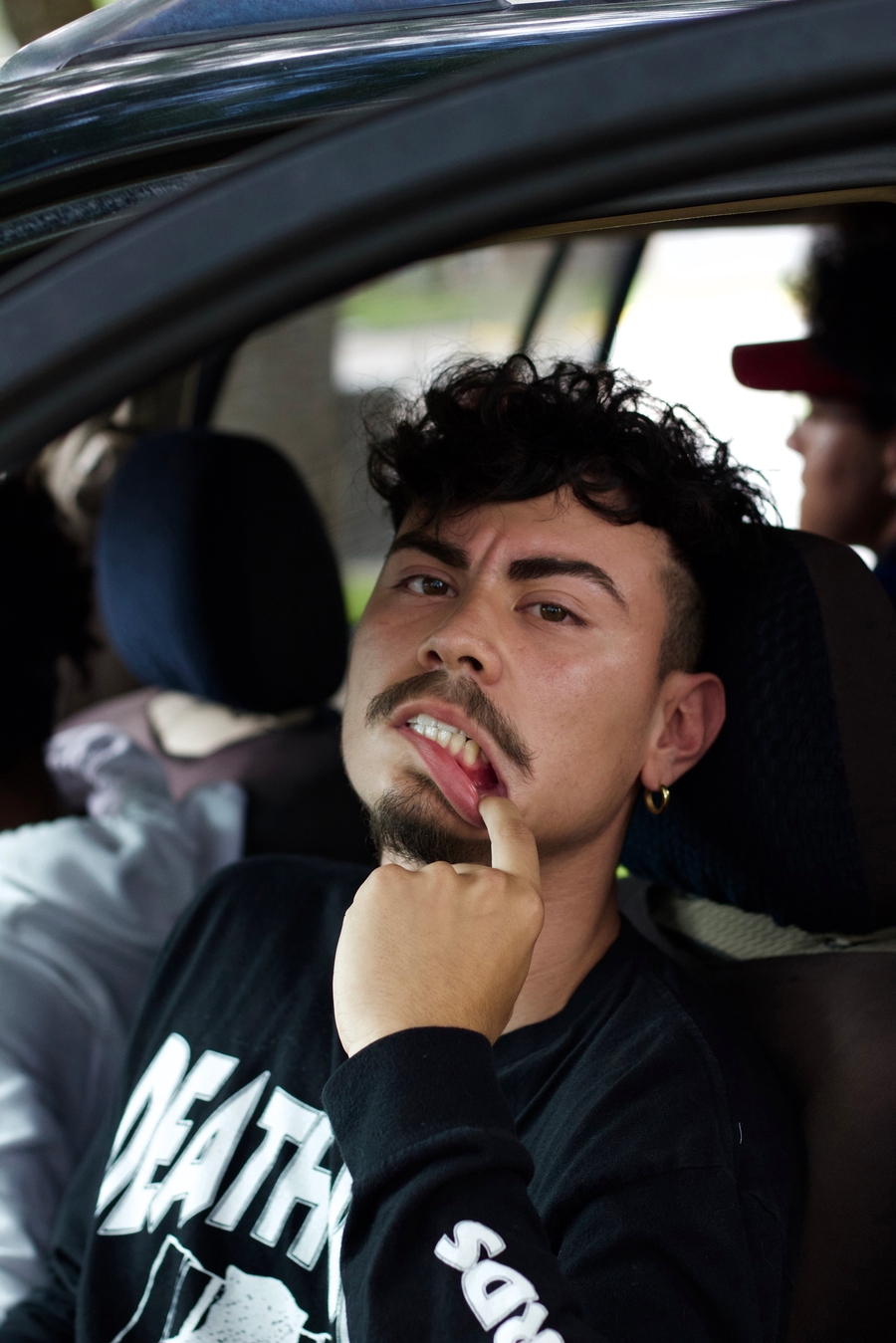
Reyes Ramirez is a Houstonian. In addition to having an MFA in Fiction, Reyes received the 2014 riverSedge Poetry Prize, the 2012 Sylvan Karchmer Fiction Prize, and has poems, stories, essays, and reviews (and/or forthcoming) in: Houston Noir, Southwestern American Literature, Glass Poetry Press, Gulf Coast Journal, Origins Journal, The Acentos Review, Cimarron Review, riverSedge: A Journal of Art and Literature, Front Porch Journal, the anthology pariahs: writing from outside the margins from SFASU Press, and elsewhere. You can read more of his work at www.reyesvramirez.com.

By Lindsay Wilson

By Victor Hugo Mendevil

By Windy Martinez

By Jackie Martin

By Samantha Edmonds

By Jeffrey J. Higa