
Letter from the Editor
By John Hardberger

Imelda keeps the hand bundled in a shimmering red silk cloth, the kind that glows a swell of orange when held to the sun. She chose the color because the blood on the wrist had hardened to a deep brown. She wants to remember the blood that licked her knife when she sliced into the white flesh. The knife she’d bought a year before, after taking a self-defense class. She wants to remember how she fought off the boy before she cut off his hand. How, in the dark of her dorm room, he pinned down her shoulders with his knees, pushing her head into her favorite stuffed animal.
She tried to forget all that months ago, after she realized she couldn’t be tested with a rape kit because he never penetrated her. And after the residential director’s lip twitched when he said she couldn’t move rooms until an investigation was conducted. And after the bruises on her neck ripened in reverse: from purple to green to yellow. And after she nearly told her parents over spring break, but her father—who had been recently promoted to a well-respected position at what Imelda liked to call the “Chocolate Factory”—couldn’t stop talking about how wonderful everything was, that finally they could move to that house they’d always dreamed of in Hershey, the one with the turrets and skylights. And after the boy who assaulted her passed her in the HUB with a hand that was not his—a hand that she was certain he’d designed himself because earlier in that horrific night the previous spring, he’d told her about his interest in genetics and robotics, how the cross between the two fields was up and coming. He was going to go to grad school for this research. He’d already won awards in national competitions.
Imelda thought about telling the Title IX administrator that she had proof in the form of the boy’s real hand, but when she’d revealed her secret to her roommate at the time, the girl had said, You’re crazy, you’re crazy, and went to stay at her girlfriend’s dorm until Imelda moved out. Imelda also knew the position the severed hand could put her in. There would be the question of the order of events. Had the boy—whom she had gone on one date with before—the freshman biogenetics genius at the largest university in Pennsylvania, attacked her first, or had she committed violence against him initially? One could argue the hand was proof of criminal mutilation. The Title IX administrator only further expounded her fear by stating that she would have to proceed through a hearing if she wanted the boy expelled. But that wasn’t what she wanted. She just wanted an apology; she wanted a realization that he’d hurt her, violated her boundaries.
That wasn’t how the school’s legal system worked. A hearing would destroy Imelda. The administrator said she understood. For the first time since the horror had occurred, Imelda was bestowed kindness. The administrator encouraged her to attend counseling sessions, drafted an email to all her professors excusing her for any absences due to the assault, and assisted in moving her across campus. Imelda thanked her profusely and lied about going to therapy. She didn’t want to think about the boy anymore. His presence had completely taken over her life.
She did receive a strange miracle in the aftermath, though. She could not—still cannot—hear the boy’s name. Not because she doesn’t want to but because his name will not physically compute in her brain. People will say his name and begin violently coughing, or they will open their mouths and all Imelda will hear is static. She feels guilty, like she should be afraid of it, but her inability to hear it has been a reprieve for many months.
Still, she keeps the knife in her pocket. She keeps the hand under her bed. Her anger, the person she is now, cannot be divided from its carpals.
#
The following summer, the heat sediments under Imelda’s scalp. She hopes it doesn’t cause the hand to smell. Only one tiny A/C unit clanks away in the apartment she shares with four other girls. For a month, she will be studying sculpture in an accelerated summer course at the university. She found a sublet off campus near the pizza place that sells mush on a slice for one dollar. She thinks that in this new environment, away from all the pain of the last six months, she can remold herself.
Her roommates—Rose, Lilly, Iris, and Daisy—drape their clothes on their beds and paint their lips a deep aster. Imelda doesn’t know any of them, and because the school’s population is forty thousand, she hopes that means her history is nonexistent to them as well. After the assault, she lost all her friends, either through mistrust or alienation. Imelda used to be like these girls (and she still wants to be), so she too extracts her makeup bag and swipes her eyelashes with mascara. Lilly offers her a crop top to wear when they announce the girls are going clubbing. Imelda hasn’t gone out in forever, but she imagines the dancing bodies, the starry eyes over dirty beers. She shoves her suitcase with the hand in it under her bed, ready to step into the bursting night.
#
Every story has a world, and every world has rules. The rule in this one is that memory lies in the body. Even the parts that are removed from its original flesh. That means the hand in Imelda’s suitcase remembers the boy. It’s determined to find the bone it was once fastened to. Imelda cannot let the hand return to its body. If it does, then the boy will become whole, taking away the one piece of proof of how he violated Imelda. She always keeps her knife with her in case she needs to prevent the hand from escaping.
The night Imelda and her roommates go out, she leaves the knife beside the hand in her suitcase. The hand grasps the handle. It knows the world outside Imelda’s room is filled with danger.
Reader, in this story, truth finds its way back to people.
#
After their night out, Imelda finds herself especially close to Daisy. Raised by marine biologists, Daisy spent most of her summers sailing around the coast of Maine. “My first taste was salt in the wind,” she says. Imelda imagines ocean spray flushing her cheeks.
She also finds herself drawn to Louis, a boy in her class who joined them at one of the clubs. He was kind to her that night, never once asking her to dance nor touching her, just listening intently. When she told him where she was from, he asked, Do the streets really smell like chocolate?
She laughed. Of course, she said. She’d never felt a boy’s smile move her before, and, ridiculously, she thought of swan wings in her belly.
Back in their apartment, Daisy doesn’t pry about Louis. Instead, she talks to Imelda about her family. “My father doesn’t really understand me,” Daisy says. “He expects me to be ambitious and prove myself to the world like he did through his studies, but I don’t know if I want that.”
Imelda identifies a kinship in Daisy’s homelife. She confesses how her father wants her to fit into a box of his own making. He was immensely upset when she told him she would be going to a school that was notorious for its party culture. He lectured her about all the bomb threats on campus. When Imelda returned home for breaks, he treated her like a fish or a bird, something totally different than the daughter he once had. All men seemed to. Just earlier that summer, her father took her and her mother to a party hosted by the Chocolate Factory. While her parents were mingling, she sat at a table, drinking water and staring at the tablecloth. One of her father’s colleagues walked up to her and said, Boo. When she glared at him, he laughed and said, Cheer up, honey. Later, her father was chatting with this same man while they picked up their coats, and he told him how his little girl was about to move into an apartment for the first time. His colleague said, Well, she’s a little spitfire; she’ll be fine. But the way he said “spitfire” implied that he did not find her cold glare, the one she’d inherited after the assault, so admirable.
“I wish we could escape it all and sail the sea together,” says Imelda.
“One day, the waves will rock you to sleep,” says Daisy. “I’ll be sure of that.”
The more time Louis and Imelda spend together, the more she feels comfortable with the idea of him holding her, the moonlight pooling on her sheets. They eat Happy Happy Joy Joy ice cream from the creamery and spend time watching the birds fly over the arboretum. They kiss, and the swan wings flutter within her.
Always, Imelda asks Louis if they can take things slow, and always, he reassures her. Life before all this seems so far away now. Even the hand in the suitcase seems like frost fading in the morning sun.
#
Louis invites Imelda over for dinner. Someone he became friends with at the end of last semester is visiting, and he wants Imelda to meet him. Louis tells her the name, but she immediately forgets.
Imelda curls her hair and dons a dark green dress. The apartment is alive before she enters it, voices vibrating from the stairwell. In the entryway, Louis kisses her and swivels her to the center of the room, right in front of his friend. Imelda’s breath catches. The boy with the hand that is not really his hand. He sticks it out to her, his palm rubbery and cold.
She sprints to the bathroom. Locks the door. The mirror in front of her blurs. Louis knocks and she opens, tells him she must have eaten something rotten and needs to go home. As they leave, the boy with the fake hand watches her.
On the other side of town, the hand is finally confident enough to depart. It unzips her suitcase, clutches its middle and ring fingers clumsily around the handle, and hobbles on its index and pinkie fingers out of her room and into the night.
#
Imelda practices saying the boy’s name in a mirror, stutters and stops. She’s angry that she can’t say it. She wants to be able to tell Louis that his so-called “friend” ruined her life.
The name won’t come out. She thinks of Louis cracking jokes with the boy and feels like she’s about to throw up. She thinks about what her father’s colleague called her—Spitfire—and wants to laugh. She can’t even say the boy’s name. How can she burn someone with her words?
The next day, she breaks up with Louis, fully crushing his heart and her own.
#
Several sleepless nights later, Daisy asks Imelda what’s wrong. If Daisy had been one of her other friends, Imelda would have withdrawn without really explaining. But with Daisy, she feels safe, and she wants to tell her everything that happened, unlike before.
So, she does, as best she can, only referring to the boy as “Louis’ friend.” All the panic, anxiety, and sadness rush out of her. When she finishes, snot and tears coating her face, she tells Daisy not to let her see Louis anymore. That it’s best if she keeps her distance because she doesn’t know if she can ever tell him the truth. When she broke up with him, she gave some excuse about not thinking they were a good match. She’s been avoiding him in class, but she fears he will try to approach her at the apartment or somewhere else in public. She also asks Daisy to keep the story from her roommates, worried they will look at her differently.
“I promise,” says Daisy. The words are spoken with a mother’s vigilance. Imelda used to think love was the most rewarding feeling she could experience, but this? This feeling is unlike anything she’s ever felt before. She is believed.
#
Daisy convinces Imelda she needs a night out dancing. A girls’ night. Imelda is hesitant, but she trusts Daisy. She pulls on tight leather pants and a sheer top. Hooks silver hoops in her lobes, shakes her head so they bounce off the bones of her jaw. Something to ground her in her skin.
The fivesome arrive at downtown Beaver Avenue before midnight. A club with purple and magenta lights. The faces around Imelda are clouded like masks, and as she is dancing, she twirls into the arms of a faceless man. His laugh is sour, and the club fogs. The smell is what catches her. The smell of pine and whiskey. She is familiar with that smell.
The rubber hand steadies her. She recoils. “Imelda,” says the boy. He is saying other things, a geyser of explanations, but she cannot hear him over the scream in her head. She darts away, straight to Daisy, yelling, “He’s here! He’s here!”
“Go home,” says Daisy, her voice steady as though she’s been sober all night. Imelda bolts, the sound of the boy calling her name disappearing into the mix of sweaty bodies and clinking glasses. The dark streets warp the buildings around her into trees, tall and menacing and hiding a wickedness in their shadows. She runs, and with her retreating footfalls, she wishes she could reverse time during that night with the boy with the fake hand. She would sew the hand to the boy’s stump, the blood flowing back into his arm, his veins lighting up bright blue. Her knife would slide back under her pillow, and his fingers would pry themselves off of her, roots releasing a stone. He would roll upright onto his knees and zip up his pants. Instead of pushing her onto the bed, he would help her up, his hands hovering over her breasts. She would say, On, on, not, No, no, and he would flick the light switch and the room would illuminate with florescence. They would kiss roughly and softer and softer, and he would take her arm and unlock the door, walk her outside through the streets back to the Uber, back where her friend would be sitting in the car, waiting for her, completely unaware that the boy had been fingering Imelda over her pants in the back seat. He would stop when Imelda pushed his hand away. She wouldn’t have met up with him at the party—this boy who’d aggressively interrogated her because she hadn’t responded to a text he’d sent after their first date—and after several hours, she would hug each of her friends and return home. She’d undress and stand in front of the mirror, her stomach expanding from under her ribs to a smooth pudge. She’d put her knife back in its case under her bed because she wouldn’t be going anywhere, and she’d crawl under her covers naked, cocooned in dreams that were nowhere near as wonderful as her waking life, because her waking life brimmed with late-night movies and laughter and train rides and whispers over the phone.
Back in her room, she pulls out her suitcase. She won’t sleep until the blade is pressed against her sternum.
She unzips the bag, and her worst fear rises like oil in water.
#
The hand wanders through the intramural fields. It sticks its thumb against the goal posts, the diamonds flashing in the moonlight. It shuffles past the dairy barn, scurries at the lowing of the cows. Near a stadium named after an amphibious rodent, the hand comes upon an empty space. Emptiness, and yet, the hand can sense a discord in this earth; the bronze feet that were once welded here are prints of something dark. On Heister Street, too, the same dark feeling emerges. The hand can tell there is a ghost of a man’s face under the painted mural. All around, the shadows of these two men follow. The hand keeps moving. A spasm along the heart line. The body that belongs to the hand is close.
#
Imelda’s roommates do not understand why Imelda is hiding in her room. Only Daisy does not pester her with questions.
“Why did you run out of the club?”
“Why don’t you go to happy hour with us?”
“Why are you so closed off?”
“Leave her alone,” says Daisy.
Rose sniffs. “What’s going on here? You and Daisy share secrets that we can’t be a part of?”
Imelda stares at the fan near her bed. She could easily stick her fingers into the spinning vanes and hack the bone clean through.
“Well, we’re going out,” says Iris. They march off to the nearest bar, their flowery perfume clinging to the drapes.
Daisy sits beside Imelda on her bed, places her head in her lap. Imelda mouths the boy’s name, wishing she could scream it until her voice goes raw.
#
Reader, you want to know the boy’s name. You keep thinking that saying his name, that identifying him as an assaulter, will bring about justice. You keep thinking, When Imelda says his name, the police will come. When Imelda says his name, he will apologize. When Imelda says his name, his family will disown him.
Another rule of this world: names leech onto people. With them comes a history. Imelda’s name will not be said without the boy’s next to hers. About what he did to her. You will think of this story, and you will summarize it: This is the story of ___ sexually assaulting Imelda.
Imelda wants to say his name because she thinks she has to. That saying the name is how she will heal.
Reader, do you think it is so easy?
#
Imelda is coming back from class when she hears them. Her roommates whispering about her. Daisy has been on campus all day, and Imelda has avoided the three other girls. But she can’t anymore, not when they are saying things like:
“She’s causing so much unnecessary drama.”
“I think it has something to do with that guy at the club. The one who spoke to her.”
“Do you think they slept together?”
“I bet they did, and I bet she had feelings for him and is ashamed to see him.”
“Yes, I can see—”
“His hand is fake,” says Imelda. The girls fall away from their circle and try to give an explanation, but she talks over them. “His hand is fake. I cut it off.” Imelda doesn’t know how she manages the words, but, surprisingly, relief washes over her when she speaks the truth.
Lilly says, “What are you talking about?” And then Imelda sees: They are looking at her like she’s deranged.
The front door opens, and Daisy startles at the circle around Imelda. She takes Imelda to their room. She doesn’t ask what’s happened. She places a shell to Imelda’s ear. The sound of waves, like thousands of branches blowing in the wind.
#
The day before their final, Imelda’s sculpture professor invites the class to a farewell dinner at his house. He lives in what looks like just another fraternity mansion from the outside, but on the inside, it is the complete opposite: no mysterious stains, no mountain of dirty dishes in the sink. Gold and red wallpaper cling to the dining room walls, and high ceilings swoop over the guests’ heads. He is grilling burgers on the patio, and his wife is bringing out trays of salad—leafy and potato—and fresh fruit. Louis is standing on the other side of the patio table, drinking beer and talking to the boy with the fake hand. He must have brought him as a guest. Imelda’s roommates drift away, and Daisy says, “Say the word, and we can leave.”
Imelda nods and grabs a plate. Their professor pauses his grilling. “Before we dig in, I would like to thank whoever left this incredible piece of art on my desk earlier this morning.” He lifts a glass case, and Imelda’s paper plate, with all the berries and wet potatoes, falls to the concrete. The hand, the boy’s hand, curled around the knife. She looks at the boy, his mouth open.
“It’s mine,” Imelda says, her voice shaking.
“Imelda, you’ve done amazing work!” her professor says. “What material did you use to make the skin?”
“No, the knife. The knife is mine. Not the hand.” She points to the boy who has fallen closer to the fence, the exit. “The hand. The hand is his. I cut off his hand.”
All eyes are on the boy. “She’s crazy!” he says. “Cut off my hand? Look, isn’t this my hand?” He holds up the fake hand, the silicon rubber looking so real, fleshy.
A shatter. The glass case is broken, the hand with the knife galloping on two fingers across the patio table toward the boy. People scream, falling back from the table. “Imelda!” yells Daisy, because Imelda is running toward the boy too, and a second before the hand flings itself into the air, Imelda snatches the knife out of its grip. She cleaves the blade into the wrist of his fake hand, and it falls from where he’d suctioned it to his skin, flattening it to the floor. She pins the real hand down with the edge of the knife against the table. The boy’s stump, the jagged pink scar gnarled around its skin, gleams like a molar.
His name almost erupts from her mouth. So close, a seed sliding around on her tongue. But if she says his name, what kind of root will form around her life? She will forever be in the context of this boy. And Imelda knows she is more than context. For once, she sees herself as a dragon, breathing flames over the boy’s legs, arms, face, everything that he is.
She bites down hard on his name. Lets it go to dust.
#
Endings come naturally for some stories, but for this one, there is only a long, long corridor that takes many forms. In this world, one may think an ending has occurred, but then they open another door and find there is still work to be done.
In this ending, a boat rocks near a Maine beach. A girl clutches a hand that belongs to a boy who ran into the night after a dinner party. Her friend squeezes her shoulder.
Reader, perhaps you are disappointed. You want a story of vengeance. That is the genre of this kind of narrative. But life is more complicated. Imelda is tired of thinking about this boy. She wants to be free. She wants the rest of the world to think only of her own name when they remember her.
Here is what Imelda tells herself to do for now: remove the cloth; bind granite to skin. She drops the hand burdened by stone into the depths of the sea. It will fade quickly from the light, the water going from aqua to indigo to black. Some say no one will ever find the hand again. Imelda doesn’t believe this. The hand will always try to come back. Even now—look: it stretches its fingers up from the sandy floor.
But she is the only one who knows the exact location of the hand. Every now and then, she will think of it covered in barnacles and seaweed, hoping it’s rotting closer and closer to the bone.

Casey Reiland’s work has appeared in or is forthcoming from F(r)iction, HAD, trampset, On the Seawall, and elsewhere. She has an MFA in fiction from the University of Wyoming, and she resides in Somerville, MA. You can find more of her work at caseyreiland.com or her latest musings at @caseyreiland.bsky.social.
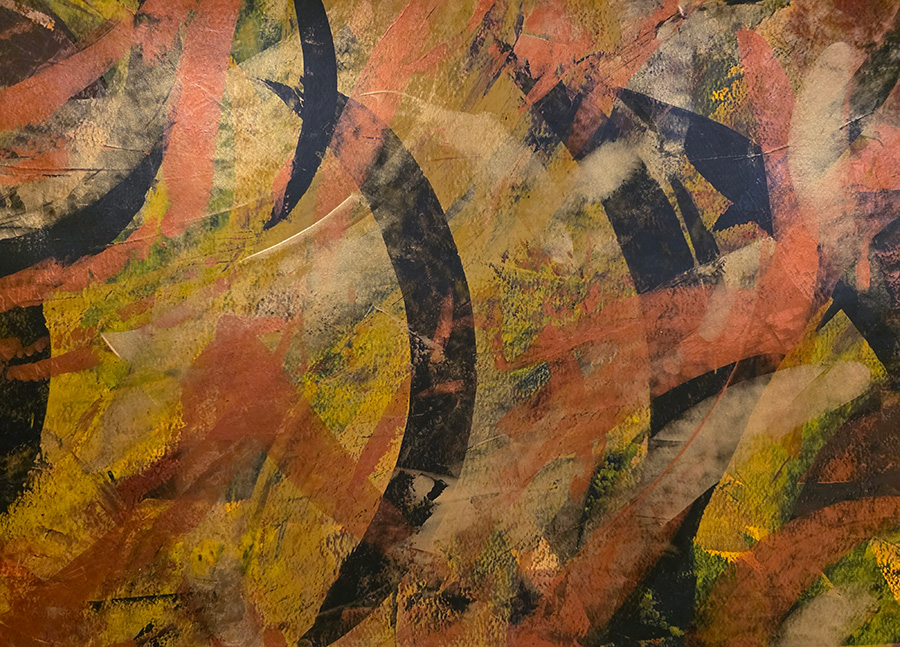
Ellen June Wright is an internationally published artist, poet, photographer, and former language arts instructor, known for her abstract expressionism. She studied art and art history at Rutgers College as an undergraduate. Wright’s dynamic watercolors have been published in journals online and in print, most recently: Abstract Magazine: Contemporary Expressions, Lolwe, Harpur Palate, Ponder Review, New Plains Review, Beyond Words Magazine, Kitchen Table Quarterly, and NOVUS Literary Journal. Her work was included in the 2024 and 2025 Newark Arts Festivals and featured at the gallery at the HACPAC in New Jersey. She is an admirer of the works of Stanley Whitney, Mary Lovelace O’Neal, Frank Bowling, Howardena Pindell, Cecil Cooper, and others.
By Jose Oseguera

By Meghan Sterling

By Ivy Raff

By Marika Guthrie