“If I wanted a different life for myself, if I wanted financial security, or if I ever wanted to own a home, or retire, or even easily afford my existence in the world, then I would need a miracle. John, and the opportunity he presented to sell my body to him, was that miracle.”
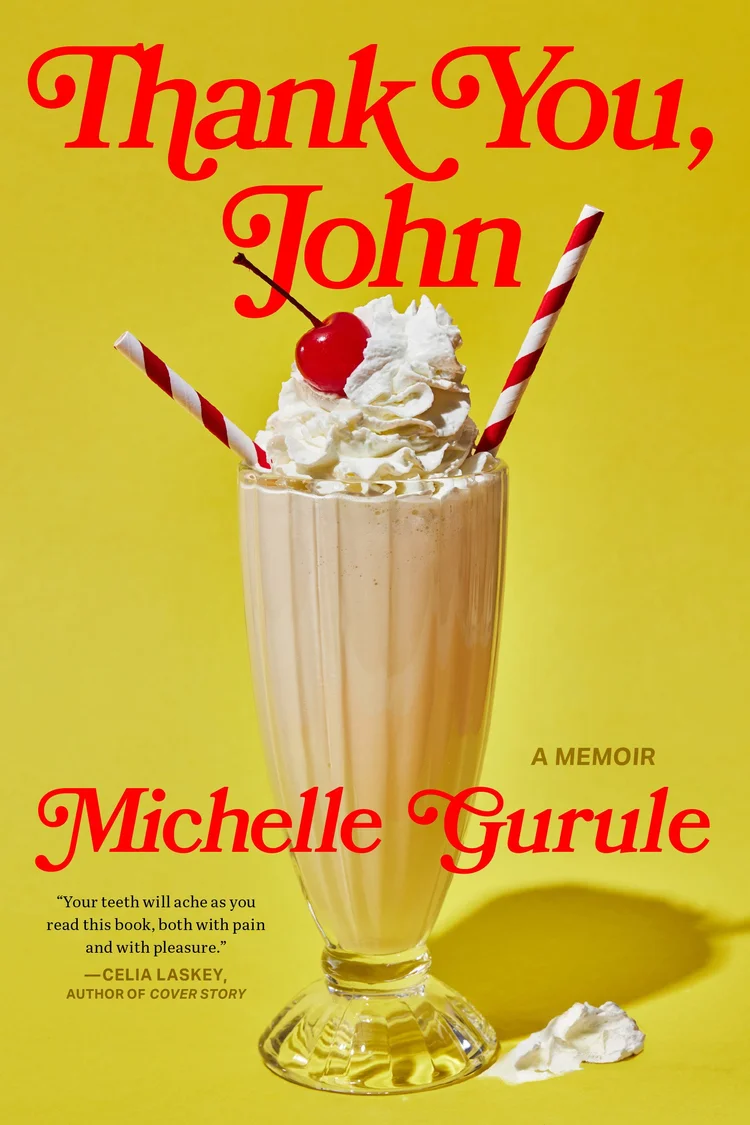
Michelle Gurule’s debut memoir Thank You, John opens with a scene of the author’s first encounter with the titular John, the man with whom she eventually enters into a sugaring arrangement. Sugaring, for the uninitiated, is an approach to sex work wherein one party, the “sugar daddy” or “sugar momma,” provides a material benefit, usually money or gifts, in exchange for dates with the “sugar baby.” The terms of sugaring arrangements vary—dates are not always sexual in nature—but one key element is the pseudo-romantic performance of genuine interest in the sugar daddy by the sugar baby.
The unexpectedly charming interaction between Michelle and John, which takes place in the strip club where twenty-something queer Michelle dances part-time, is hilariously complex: she tells the shy and awkward John about her family, namely her dad who “believes Earth is on the brink of extra-terrestrial takeover” and delves into her interests in “love languages” and Alanis Morisette, whom she admires not only as a musician, but as a self-help guru. John, whose entire life is devoted to work and money, is captivated by the novelty of a girl like Michelle who has, incidentally, let her guard down that evening, priming the perfect conditions for their arrangement.
“Our arrangement existed in a paradoxical state of transparency and fantasy.”
Michelle, tired of the endless toil of her working-class life, chooses sex work in hopes of funding her modest dreams: pulling her loved ones out of chronic survival mode, graduating college with minimal debt, and maybe, just maybe, if the fates should be so generous, becoming a writer. If this sounds like a story you already know, I promise you, it’s anything but.
Thank You, John isn’t about sex work so much as the intricacies of power, modern-day working-class survival and capitalism’s insistence that we betray our physical, mental, and spiritual well-being for profit—more often than not, someone else’s. Unglamorous self-sacrifice doesn’t only apply to sex work, as Gurule is quick to point out: her own father grew up working on migrant farms as a child, and John, though wealthy, has worked his personal life so far out of balance that he has to pay for intimacy. It may seem like John has the upper hand in the dynamic since he’s got the money, but Michelle doesn’t flinch from the fact that she’s capitalizing on his loneliness. The realities of sex work—and all labor—are not cut and dry, good versus bad, empowered versus disempowered.
“To pull my whole family aboard my lifeboat, I would have to sell my body to John for the rest of my life.”
Between its crisp narrative voice and tight story design interspersed with seamless takes, Thank You, John is an entirely immersive read. I might be biased as an MFA student, but much of the creative nonfiction I see coming out as of late is of the essayistic or hybrid variety and can come across, in my opinion, as academic peacocking. I’m talking hyper-intellectual lyric essays drawing profound connections between the lifecycle of a mayfly, a cultural moment and a childhood experience, and something Baudrillard said. That isn’t to say Thank You, John is without intellectual marrow: Gurule expertly folds cultural criticism into her story without compromising narrative momentum.
As someone who also comes from a poor, working-class background and knows what it’s like to walk around for more than a decade with a mouthful of rotten teeth, I appreciate Gurule’s ability to bring feminist theory, the examination of power, and capitalist exploitation down to earth. We need more books like this: one that is brazenly honest, for everyone, and above all, funny. Lord knows we need to laugh in times like these.