Glen 2.0
By Brad Barkley

It seems difficult in the present moment to talk about art and writing without acknowledging the many forces acting against them. There are the cultural currents shifting our country further into authoritarianism, enabled by our anemic mass media and often feckless political opposition, yes, but even more so: the specter of a technology that threatens to render both obsolete, looming above it all. I’m talking of course about large language models, the primary form of artificial intelligence in wide use today. These algorithms rearrange existing language and imagery according to prompts and patterns, without regard for the human artists who actually created that language and imagery in the first place. The appeal of this technology is its offer to take the work out of art-making, allowing anyone with a creative idea to realize it effortlessly. At least, I gather that that’s the appeal. I don’t personally see the removal of struggle from the artistic process as something desirable, or even genuinely possible. And I don’t think anything that results from these technologies, at least at present, can really be called art.
In the Star Trek: The Next Generation episode “When the Bough Breaks”, a group of children is abducted from the starship Enterprise by the people of a planet called Aldea, who have lost the ability to have children of their own. The Aldeans are kept isolated and safe, their planet hidden from the rest of the universe by an ancient computer called the Custodian. The Custodian does many things that seem to make the Aldeans’ lives easier: in addition to cloaking their planet, it gives them art-making tools that allow them to realize their ideas directly, without need of skill or practice. When they share these tools with their kidnapped charges, the Aldeans are surprised to find that the children quickly get bored with them. The children realize that while there’s a momentary pleasure in spontaneously generating art from their minds, there is no satisfaction in it. Long-term fulfillment, where creation is concerned, comes not only from results, but from process. Ultimately, in order to reproduce and perpetuate their society—to truly live—they have to abandon their Custodian’s stewardship, ceasing to rely on the technologies that hinder growth in the name of safety and ease.
I suspect there are many ways in which our society and its technologies mirror those of this fictional planet, but I really hope that we can reach a similar conclusion. I hope—in the naive way that sci-fi shows like Star Trek invite us to hope—that we can see these technologies for what they are: things that weaken us rather than making us stronger. The continued existence of independent, grassroots publications like Blue Mesa Review is, to me, a great cause for hope in this regard. They demonstrate that there are thousands and thousands of people—artists, writers, and makers of all kinds, but also, crucially, readers and viewers—who find value in the labor of creation, in the terrifying, vulnerable task of trying to make one’s self known. Art without a human element is not art, but hollow aesthetics—mere content.
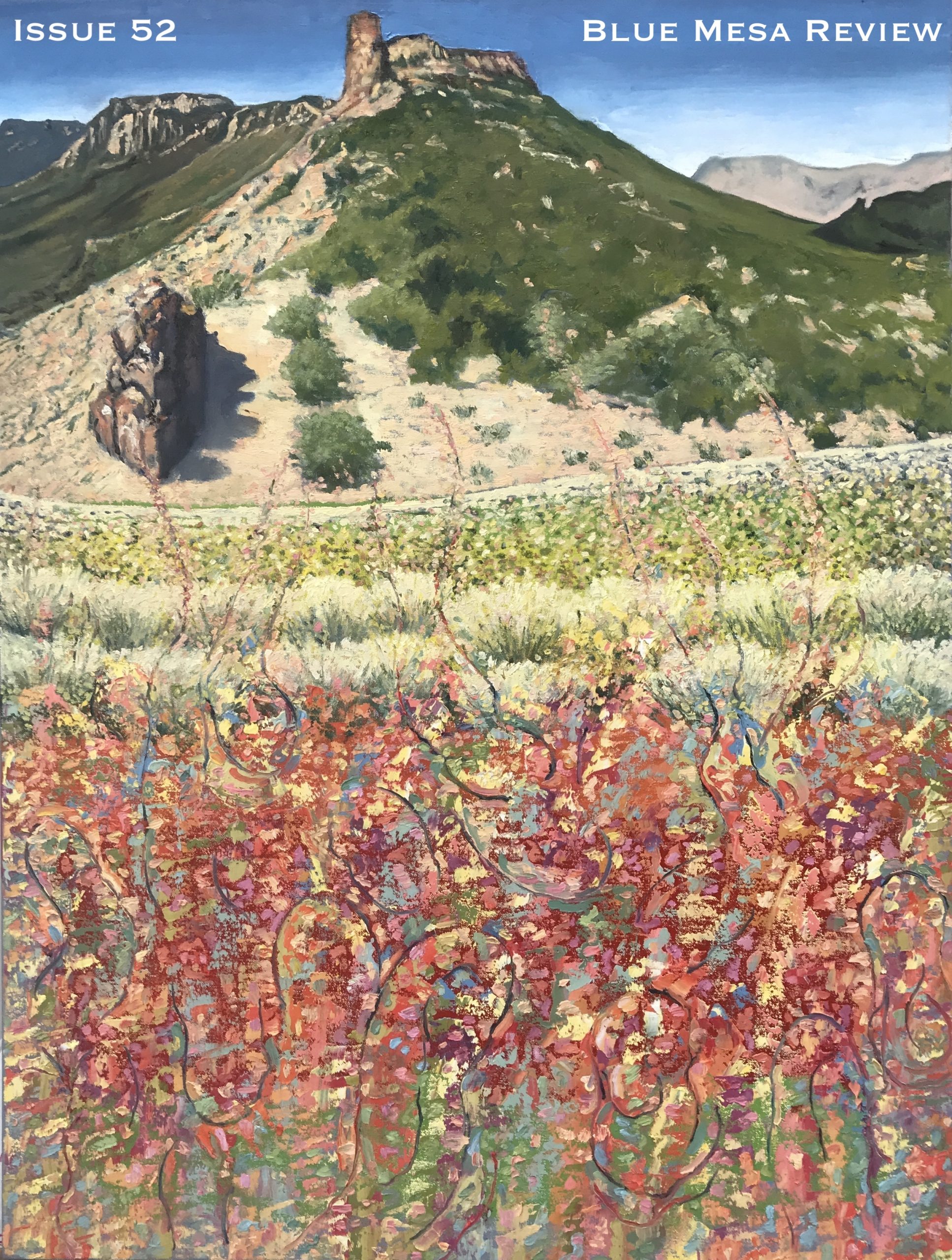
To quote the great songwriter Guy Clark, “There’s no profit in poetry, and that’s what keeps the poet free.” I don’t think Guy’s saying that art isn’t worthy of compensation—unquestionably, it is—but that real artists do not labor for profit, as the proponents of so-called AI art seem to believey. Real artists have no choice but try—by all available means, however human and imperfect—to express that which cannot be definitively said, and thus can never be commodified. In that spirit, I hope you’ll enjoy the fruits of human effort on display in this 52nd issue of Blue Mesa Review. Everything we publish was made by real, live, human artists, and it always will be. Thank you, dear reader, for showing up for it.
John Hardberger is a Texpat writer and radio DJ, now living in New Mexico. He’s a third year fiction MFA candidate at UNM and an alum of the 2025 Clarion Writers Workshop. His fiction straddles fantasy and reality, the mundane and the weird, exploring the liminal spaces between identities, cultures, and landscapes. His journalism has appeared in Chicago magazine, the Chicago Tribune, and Edible New Mexico, and he blogs about arts and culture at voyagerradio.substack.com.
Virgil Suárez is the author of Amerikan Chernobyl and Red Faced Poems, both available on Amazon.
By Jose Oseguera

By Meghan Sterling

By Ivy Raff
By Marika Guthrie