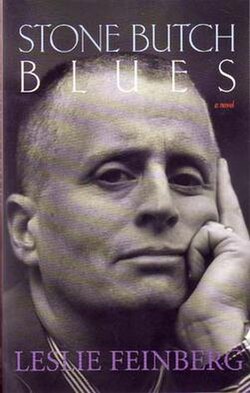
You likely won’t find Leslie Feinberg’s novel Stone Butch Blues in a bookstore, but it is worth the eye strain from the version on Internet Archives or the cost to print out a paper copy. Published in 1993, Stone Butch Blues tells the life of Jess Goldberg, a stone butch lesbian navigating her life in the 1950s. What she navigates includes rape and sexual abuse by police and other characters—scenes that are graphically described and difficult to read. She also falls in love, finds community, and is heavily involved in activism. Feinberg opens a window into lesbian culture in the late 20th century, and hir words still resonate today.
I first read the novel as a young lesbian, only beginning to consider my own gender identity. Jess metamorphosed from lines and dots on a page into a mirror looking back at me. Now, as a trans man, I consider Jess akin to an old friend. I see the shared space that trans men and butch/masc lesbians inhabit, as well as where they differentiate. In the context of ongoing political attacks on the trans and queer community, the piece’s significance is permanently affixed to the back of my mind. I feel like Jess when my niece and nephews point to a gaggle of adolescent boys, calling out “Aunty!”, because that’s what their aunty looks like. I think of Jess when my boyfriend comes home from his security job at the gay bar with a swollen black eye and bruising across his limbs. I see Jess in my past lovers, stone butches and touch-me-nots. Many were relieved when they didn’t have to defend their boundaries or explain that receiving sexual intimacy could be retraumatizing. I think of Jess when I take my weekly testosterone injections, or when I paint my face in drag. I feel her spirit beside me, hoping my joy will reach out and envelop her.
Feinberg ends the novel with a scene describing Jess’s dream, where she finds herself in a hut with people like her: “I felt proud to sit among them. I was proud to be one of them.” I too am proud, proud of my trans and gay communities, of my relationships, and of my right to exist. I’m grateful to the lesbian community for giving me a home and nurturing my self discovery. Lastly, I’m grateful to Leslie Feinberg for naming feelings that I didn’t yet understand. Stone Butch Blues is not a tragedy, but a beacon of hope.