“I remember my mother saying that when she was pregnant with me, she would blow bubbles in our small backyard pool to help my sister learn to swim. ‘You were born disabled,’ she would tell me, ‘because the military put bad chemicals in that water.’ For years, as a child, the bubbles and the military stuck in my imagination: I pictured my mom blowing air into the invisible toxic soup they swam in, and I wondered whether the bubbles somehow made the chemicals worse.”
—Sunaura Taylor, Disabled Ecologies: Lessons from a Wounded Desert
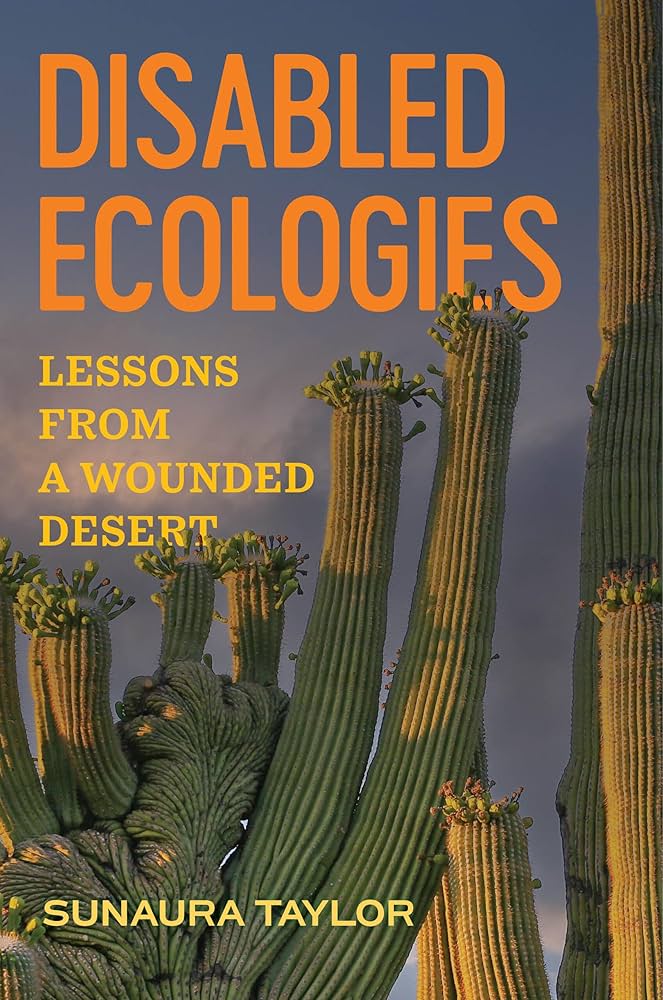
In her second book, Disabled Ecologies: Lessons from a Wounded Desert (University of California Press 2024), Sunaura Taylor returns to her birthplace, Tucson, Arizona, where the Hughes aircraft company dumped 1.25 gallons of chemically contaminated water. These toxins seeped into the aquifer that served a predominantly Hispanic community, infiltrating homes, schools, and businesses. Taylor weaves her narrative with an ecological and disability critique of the environmental harms caused to ecosystems and bodies.
Taylor’s story tells of the complex relationship to the injured landscape, which creates what she calls a “disabled ecology.” This term refers to an environment where humans and ecosystems connect through the shared experience of “injury.” In this perspective, disability is not just a diagnosis or a problem. Instead, it is an entry point to understanding simultaneous harm to humans and the environment. Taylor writes, “…something different–something impaired, precarious, dependent, filled with loss and struggle, requiring assistance, accommodation, and creative forms of care. As a disabled person, I recognize this as a disability” (55). For Taylor, both ecosystems and bodies bear the mark of sickness and injury. They can find connection and solidarity in this experience.
The book challenges prevailing narratives that consider disability and environmental harm as cautionary tales or expendable sacrifices, pointing out that these ideas rely on racialized and ableist logic. Taylor critiques how specific populations—especially marginalized and racialized communities—are considered “pollutable” and prefigured for harm. She refuses this logic of disposability. Instead, Taylor includes the stories from Tucson’s South Side community, where residents have organized for over 75 years to fight back against the contamination of their water. She uses their stories to form her narrative, recounting how pollution was normalized and blamed on these populations. Taylor pushes back on this narrative, telling of the hundreds of people whose lives have been permanently changed by these chemicals and receive no recourse from the companies who abandoned them even though they caused harm in the first place.
Alongside these narratives, Taylor includes her artwork, a series of paintings and drawings that attempt to visualize what is invisible: the aquifer. Her artwork serves as a visual representation of the unseen aquifer, challenging the ways of seeing and relating to nature as one-sided or scientific and instead understanding it as “connected, corporeal, and sensitive” (121). Her paintings offer us a glimpse into an unseen world and allow us to understand the injury to the aquifer and the extending networks of harm to all the human and nonhuman communities that used and depended on the aquifer.
From one desert to another, how do we cope with the blatant disregard for the land and people that are deemed pollutable? New Mexico has a similar legacy of ongoing contamination and abandonment. In Northwest New Mexico, residents still live with the aftereffects of the nuclear age. Stories of thyroid disease, breast cancer, and environmental harm continue. About half a mile from the Murray Acres and Broadview Acres communities, over 22 million tons of uranium waste remain from the milling ore used to fuel power plants and build nuclear weapons (Olalde & Miller). Companies responsible for the pollution seek to abandon these sites, refusing to remove the waste and instead offering buyouts to residents.
Taylor’s framework urges us not to ignore the harm done to our communities. How can we see these as sites of solidarity and reaffirm that this harm matters? The effect of pollution in our water and air is a constant lived experience that New Mexicans interact with daily, and it cannot and should not be forgotten. Using Taylor’s language, how can we view this abandonment as a site of solidarity? How can we demand that the harm and injuries to our communities and ecosystem not be overlooked? As New Mexicans continue to face ongoing contamination, Taylor’s vision reminds us that every site of injury can also be a site of collective memory, struggle, and worldmaking.
Works Cited
Olalde, Mark & Miller, Maya. “A Uranium Ghost Town in the Making.” ProPublica, www.propublica.org/article/new-mexico-uranium-homestake-pollution.