
Letter from the Editor
By John Hardberger


Thirty-five hundred dollars was a lot of money.
“What about insurance?” Glenda asked. “This is why we have insurance.”
Glen shook his head. “An elective procedure,” he told her. “I’m electing to do this.”
“I don’t understand. And we can’t afford this, Glen.”
Glen took his hands off the keyboard and let them settle in his lap, hoping they looked disappointed. She would notice. Glenda stood behind his desk chair but hadn’t even glanced at the video from Tech Labs Body Imaging or asked him to click through the testimonials from satisfied clients. He clicked the video anyway, the gray, naked image of someone’s body scan, some anonymous and fit client, spinning like a fidget toy in a 3D rendering.
“I have money,” Glen said. “I sold my camera gear last month.”
He wasn’t sure why he’d done that—maybe because every Facebook photo his friends took on their phones looked better than anything he’d managed with his Nikon. He’d never had much talent, but he operated under the illusion that better equipment might let him fake it. It never did. Golf, fly fishing, photography, saxophone—gear was just stuff. Like thinking a new fork would make you eat a healthier diet.
“Plus, this place is in….” Glenda leaned over him to squint at the screen, her body warm against his back. “Raleigh? You want to drive two hours and spend our money on this?”
She waved a dismissive hand at the screen, lips pressed tight. Glen let his shoulders slump. He also sucked in his gut, which was hard to do sitting in a desk chair but was something he’d done throughout his life with Glenda, twenty-six years of gut-sucking, an autonomic lie his body forever told.
“I do,” he said.
She shrugged, a gesture that after all these years counted as an enthusiastic yes. She left, and he returned to customer testimonials, watching those gray 3D bodies spin.
His technician’s name was Dr. Takahashi, who clarified during the procedural overview that she was not a technician but a co-owner of the company. Better, Glen thought. Someone with a stake in the outcome. Not that he was scared, just nervous, maybe. The procedure, she explained, was no more invasive than an airport scanner. Except, of course, the emotional invasiveness of seeing your body as it truly is, in 3D, the way everyone else saw it—except you. All we had were mirrors and photos, two-dimensional and forgiving. Like seeing the Grand Canyon on TV… you’ve seen it, sure, but not really.
Never truly seen your body, your face.
Never encountered yourself as a stranger would.
How did anyone stand it?
Glen could not stand it, not anymore.
Dr. Takahashi hugged her clipboard while explaining the equipment in the white-walled room where she’d taken him. A laser-guided low-dose DXA scan would bombard him across 475 data points as he spun on a platform: waist, hips, thighs, calves, arms, stomach, and neck all digitally landmarked and paired with 4K photography. Data packets would be uploaded to a private server. Iterative point reconstruction algorithms would build full-body 3D images from depth calculations. Surface reconstruction methods would refine the image, filling surface gaps for accuracy. And finally—
“I have to be naked?” Glen asked. The word alone made him blush, especially in front of a semi-attractive doctor. “The machine at the airport lets you keep your clothes on.”
She laughed politely.
“Yes, Mr.…” She checked her clipboard. “Shreeve. This procedure looks for the real Glen Shreeve, not guns or contraband. Naked. God’s eye view.”
She smiled. He nodded.
At the front desk, he handed the lady a check for $3500. She handed him an appointment card for Tuesday at 10:00.
Ten days passed. His results were supposed to be uploaded to his account, but every day he logged in—on his computer, on his phone, between insurance clients with their tales of downed trees and flooded basements—and it still read: IMAGES TK. What was taking so long? Dr. Takahashi had used the word “instantaneously” more than once during the tour. The algorithm would “instantaneously” convert his data. His results would be “instantaneously” assembled using their reconstruction methods.
There was always red tape.
Where did that phrase come from—red tape? Some Communist thing from the ‘50s? Depression-era bureaucrat-speak? The older he got, the more he realized he didn’t know much.
Didn’t know anything.
“You must think I’m some kind of whale,” Glenda said that evening as he sat at the computer, refreshing his Tech Labs account.
IMAGES TK.
IMAGES TK.
“What?” he said, turning from the screen. “What are you talking about?”
“You. This.” She gestured. “If you’re so worried about how you look when you look fine, then you must think I’m a whale.”
“I think you’re beautiful,” he said. A phrase from early in their marriage, one he’d vowed to say every day. He hadn’t, not every day, but enough that it evoked nostalgia, for her too, he imagined. Like an adult riding a merry-go-round—it wasn’t fun, but it recalled a time when things were fun. When fun was possible. Like eating ice cream, or driving fast, or staying up till midnight drinking. Things that now just tried to kill you.
“Glen, we’re 53,” Glenda said, as if this were an obscure fact dug up to settle an argument. “We look good for 53. We walk. We take multivitamins.”
“It’s not that,” he said.
She looked at him.
He refreshed the page.
IMAGES TK.
He wanted to explain, but how? Turning 50 was supposed to mean nothing, but it worked like dark magic, rendering anyone in its shadow invisible. He knew this but seemed to be the only one who cared.
“Glenda,” he said carefully, “how do you make sense of yourself as a whole, human person walking around on the earth when that’s something you’ve never actually observed?”
She squinted at him like he was a difficult Sudoku puzzle.
“What are you talking about?”
“You’ve never seen yourself drinking coffee, laughing in a restaurant, walking on the beach. You’ve never really seen yourself, Glenda.”
She shrugged. “Maybe, but I try to be a nice person. I think I have a good heart, and—”
“No, I don’t mean the inside. You’re the only person who’s ever really seen your inside. But your body—everyone but you has seen that. Don’t you get it?”
“Glen, I…. You’re not making sense. I see myself all the time. We have mirrors. My phone is full of pics of me, of us. What is this about?”
Me. You. Us. We. That was the whole of their world. No kids—not for any reason, they just hadn’t. He couldn’t recall if they’d ever decided to regret that.
“We aren’t cartoons,” he said. “Not comic strips.” He refreshed the page.
And there they were.
The blank slots filled.
His stomach fluttered. He turned away, not ready to look.
“What do you mean—”
“Glenda, I need a minute,” he said. “I’ll come find you downstairs.”
“This isn’t over,” she said, turning on her heel. Glen briefly admired how she did that, like she’d practiced the move after seeing it in a movie. Perfect timing and timbre—a small, perfect moment. She’d always been nimble, light on her feet. Was he capable of that? He’d never been a “moments” person. Not a perfect one, anyway.
She left. He looked.
There he was. He clicked to enlarge IMAGE 1—his gray, 3D-rendered body. Arms at his sides slightly raised, spinning like a game show prize. He adjusted the rotation speed, leaned in.
Was that really his ass? He hated to start there—why not admire his perfectly okay elbows or calves? But still, that ass. Bread dough on a cutting board. A drunk prom kid’s wrinkled cummerbund. A gray crayon left on the dashboard.
Dear God.
By the time it spun back around, he’d decided it was objectively ugly. Decades spent walking around with this major, ugly region of his body that barely registered on his mental self-map. His beer gut turned out to be a thick pudge wrapping around to his mid-back. A spare tire. He hated that phrase, how it whimsified the visceral fat that would one day kill him.
Love handles. Muffin top.
He leaned back, lifted his shirt, and looked down at his belly—the half of himself he could see, always at this odd drone-shot angle. He tilted and rotated the on-screen image, getting views he’d never had before. His ass, the wings under his shoulder blades, the backs of his thighs, the curve of his jaw in real space. He patted his stomach, poked his belly button, which on the scan was stretched by that doughy ring of fat into a disturbing grin.
The enlarged image of himself spun and spun. He noticed details: dimples in the small of his back, a slight bow in his legs, the veins in his narrow feet.
The first word to come to mind? Lumpy.
But it was more than that. Everything looked wrong. Workable, but like factory-rebuilt appliances on Amazon. Just… off. His facial contours were there, but no eyes, no color. His hair was the same greenish gray as his chest, ears, and toes. His hips looked out of alignment, like an old car. Did he pull to the left when he walked? Did people notice?
He avoided the 3D-imaged penis.
He didn’t want to deal with that right now.
But the more he looked, the more he felt that something was deeply off. As Glenda had predicted, he’d wasted $3500. He flipped through the other images—hands on his hips, legs spread, hands on shoulders, legs together. It was him. But not him. Not really. His body, but not. He closed the tab. This made him anxious, though he couldn’t say why.
That evening, he didn’t go back to the computer, but he did cut back on carbs—as much as possible, since dinner was Gianni’s pizza. Glenda didn’t talk to him unless it involved toppings or Netflix. They shared a bowl of popcorn, which sat between them on the couch like a child. Their fingers sometimes touched inside the bowl as the screen lit the room in orange and white explosions.
Minutes after bedtime, Glenda was asleep, snoring, the sleeve of her pink pajamas brushing his elbow. Seeing himself in the images made him think about things he hadn’t in years. Their names, for one—Glen and Glenda. At first, there’d been no end of jokes. Of course, there was the Ed Wood Jr. movie that no one remembered anymore. At their wedding reception, guests joked about monogrammed towels and said, “I can’t tell you two apart,” and “Hey Glen, don’t accidentally change into Glenda’s dress when you leave! Ha. Ha ha ha!” He had laughed too, and for the first year they leaned into it, called each other Big G and Little G, signed their Valentine’s cards that way. Eventually it faded; someone, somewhere told the last joke without knowing it was the last. Now Glen, Glenda—just sounds that meant me and you.
His mind drifted to thoughts about his job—not State Farm, but his first job. On a whim, right out of college with business degree, he’d answered an ad in the paper: WGHP, local channel eight, weatherman needed. No exp. req. They hired him mid-interview, and why not? Handsomeish in a non-threatening way, he could read a teleprompter and enunciate clearly. Two-for-one suits at Men’s Warehouse, weekly haircuts. He loved it when Charlene said, “Let’s check with the Weather Desk for the latest updates.”
He developed his own shtick: “my guy, my gal.” My guy down in Statesville says it’s going to be hot hot hot tomorrow, or My gal over in Winston-Salem tells me they’re expecting two to four inches by morning. Charlene got a chuckle from those, and he imagined his audience did too. He learned to say “precipitation in the form of rain” instead of “rain” because it sounded smarter. He loved gesturing at the green screen, watching himself on the offstage monitor. In the studio, in front of the green screen, he was just a guy pointing at nothing, batting at air like a kitten; on the monitor, he was a confident weatherman explaining fronts and pressure systems with precision.
He’d adored that job.
Then they fired him.
For a simple reason—he wasn’t a meteorologist. Every station had one now, his producer had said. The nature of the business. Viewers wanted experts, not talking heads. He’d thought of Charlene—a Comm major, not a journalist—but he didn’t argue. He nodded, shook the man’s hand, tried to be the Bigger Person. He’d always missed that job.
Missed the green screen, himself on the monitor with nice hair.
He missed his guy and his gal like they were real people.
At 3 a.m. he got out of bed. His Fitbit lit up, counting his steps. Downstairs, a swipe of the mouse brought the screen to life, his 3D images spinning. It was oddly tranquil, like watching manatees on TV.
“I want to understand,” Glenda said behind him. He startled and looked up. Her pink pajama sleeve billowed as she pointed at the screen. “I mean why, Glen? Help me get this.”
“I feel trapped,” he said. His words in the dead of night felt like invasions of privacy. “I always have.”
“In our marriage…?” she asked.
“No,” he said. “Not that. In myself. When I look in the mirror….Is that really me? Did I get stuck in here by accident?”
“So am I,” she said.
“So are you what?”
“Trapped inside myself,” she said. “So is everyone. That’s the deal. You get out when you die. One day you’re in a nursing home bed, and you float above it and see yourself. Your consolation prize for dying.”
He smiled. He’d forgotten how funny she could be.
“I guess so,” he said.
“So you want to die?” she asked. “Is this a cry for help?”
“I don’t want to astrally project. I don’t want to die. This isn’t esoteric. I just want to see my real self in the world. I want context for how I think about things, how I see them. I want to look and think, well, heck, that Glen looks like a nice fella.” He shrugged, not looking at her.
“That’s what you want?” She crossed her arms.
He shrugged again, his words inaccurate. This was as close as he could get.
“Well, then, that ain’t it,” she said, gesturing at the screen. “You’re not gray. You’re not ten inches tall. That’s an image on a screen, Glen. At least with a picture on your phone someone could ID it as you. That’s not you.”
“But these are 3D images,” he said.
She shook her head. “They’re 3D renderings. The images are 2D.”
He stared at the screen, barely nodding, too embarrassed to meet her gaze. She was right. That’s what had been bothering him. He was right back where he started.
He watched his slumpy ass and grinning belly button spin. At some point Glenda sighed behind him, headed upstairs, and left him there.
Three days later, he was back in Dr. Takahashi’s office, after telling the receptionist it was an emergency.
“I’m not sure how we can help,” Dr. Takahashi said, glancing over his open file without reading it. “We delivered as agreed.”
“Not making trouble,” Glen said, though he was. He tried explaining what he wanted, but had no better luck finding the words than he’d had with Glenda.
She clicked and unclicked her pen, then slid it into the pocket of her white coat. Stitched there in blue letters, her full name: Dr. Janet Takahashi.
“I don’t know,” he finally said. “They were just images.”
“We’re an imaging company,” she said, smiling.
“Of course,” he said. “I…yes.”
“Mr. Shreeve, what you’re describing might exist, if I understand you,” she said. “But it’s prohibitively expensive.”
“More than the images?”
“Ha,” she said, a half laugh, half word. “Way more.”
She spun her monitor around, typed, clicked.
“This place,” she said, “Pentamix3D. They can 3D print anything: houses, a boat. And you, based on our scans.”
He nodded, looking at the website’s pictures of buildings, a sailboat, a very lifelike Christmas tree, a Labradoodle.
“Realistic?” he said. “I mean, the people?”
“I’m told. Never seen one in person, but we’ve ordered two for clients. They were thrilled. Pentamix3D’s composite polymer renders individual hairs—arm hairs, leg hairs. Pores. Every wrinkle and blemish, polymerized,” she said.
“Who bought the two?”
“That I can’t tell you.” She leaned in, and so did he. “But,” she said, “one of them, you’d know his name. Very famous in the tech world. Household name.”
“Wow,” he said.
“He murdered it,” she said. “Stood it in the backyard of his compound, and he and his friends shot it up with…whatever those scary guns are.”
“That’s crazy,” he said. “How much is it?”
“Mr. Shreeve, please. Go home. We did our best, and you might find what you’re looking for in the images alone.”
He nodded. “How much?”
“A little north of thirty-seven thousand. Depending.”
“On?”
She retrieved the pen from her pocket. “Add-ons. AI voice patterning, articulated limbs. You have choices.”
He nodded, letting out a slow breath. It was impossible—unless he dipped into his 401(k), pushed back retirement a year or two, sold the motorcycle he’d ridden twice in ten years. Maybe.
The crate arrived on a Friday. He signed for it, wobble-walked it into the den. The front popped loose with a claw hammer, revealing what looked like yellow foam insulation—a brittle shell from which he’d soon give birth to himself. His hands shook. He took a minute, then peeled it away.
“Just take it as is,” he told himself. “Sit with it. No judgment.”
Glenda, of course, was gone.
After he’d come home from Dr. Takahashi’s office, he told Glenda about it, showed her his 401(k) paperwork, the Facebook ad for his motorcycle. She nodded, pursed her lips, and went upstairs. He’d thought it had gone better than expected until a half hour later, while he browsed the printed people and pets on the Pentamix3D site, he heard the front door click and her car start. Then a text: staying at a hotel for a few days. Then a second: at least.
This happened to couples—one person grows in a new direction, and their partner just can’t or won’t follow. She’d come back. He’d explain. She’d understand.
Glen cleared the few pieces of foam shell stuck to the legs, and there he was. His doppelganger. Blue eyes fixed on the middle distance, a slight smile he didn’t remember making. He manipulated the arm into a shy wave, then waved back.
“Welcome,” he said, glad he’d paid extra for articulation.
His polymerized self was naked, except for a pair of jockey shorts made of white paper. Strange choice—too flimsy to count as clothes, so the paper underpants were there… for modesty? To protect from scuff marks?
But here he was, caught up in minor details again. Paper underpants, who cared? As Dr. Takahashi had promised, the realism was astonishing—leg hairs, his scar from jumping the creek at eight, the kink in one eyebrow people mistook for inquisitiveness, the dimple in his chin that Glenda used to kiss. The polymer felt like skin, only room temperature. It—he—had a new-car smell, and his hair needed to be combed. Or just pushed into place, which Glen did. He looked better than the renderings—friendlier, more proportional. Dad-bod. Weekend warrior. He breathed easier, patted himself on the back.
Glenda needed to see this. It was really something.
After stashing the eggshell and crate on the porch, he settled into his chair to read the owner’s manual. Standard warnings to avoid heat sources, to articulate the arms only within a natural range of motion. The AI speech protocol could be activated by saying HELLO in a loud, clear voice.
“HELLO,” Glen said
“Hello,” the voice replied, robotic, female. “Let’s program your Pentamix3D AI voice simulator. What name would you like to call me?”
He had to think about this. Glen? Too confusing. Glen Jr.? Glen the Second? No and no. Glen 2? He liked it—Glen 2.0. Another iteration, a second chance.
“GLEN TWO,” he said into its chest.
“Hello,” it said. “I am Glen Two.” The words came out “Glentoo,” all one word, but he could fix that later. The voice prompted him to repeat a series of words, to allow the AI to accurately reproduce his voice.
“Bird,” Glen repeated. “Symphony, hot dog, spoon, wedding, cyst, cold, noodle, egregious, fountain, sippy cup, love, shoe, parrot, hand grenade….”
The list dragged on.
As the last step, Glen had to repeat his name. Then, silence. Almost awkward, until he reminded himself he was alone, had been for a month now.
“Hello, Glen. I am Glentoo,” it said. The voice was real. Really real. Not like hearing yourself on tape or on an app, not like hearing yourself inside your head, muffled by cartilage and bone. This was his voice, the one clients and Glenda heard. The one on WGHP, talking about precipitation in the form of rain.
He laughed. It wasn’t a bad voice at all.
“Would you like to talk?” Glentoo said.
Arm still raised, paper underpants still clinging to him. The manual said Glentoo’s AI could record and play back anything Glen said (perhaps a cherished memento for loved ones), or could simply talk on any range of subjects as long as Bluetooth and Wi-Fi were connected.
Glen could hardly breathe, he was so excited. What to do next? What would he want to do if he were Glentoo?
Well, he’d want not to be standing around in paper jockey shorts.
He tore off the paper pants and stepped back to look. He should have lowered the hand because standing around naked and waving looked a little pervy. Still, not too bad, overall. Sure, he needed to lose weight. And yeah, it had been chilly in the lab, which created opposing influences on his nipples and penis. But he looked okay. In clothes? Likely totally okay. Normal. Nondescript.
Which, at 53, was almost a win.
The Men’s Warehouse suits hung in the back of his closet, covered with plastic bags. Glen never wore a suit to the State Farm office, just polo shirts and button-downs. The suit jackets didn’t hang right on Glentoo, but they did button. He looked good, and a little talc helped with the tasseled loafers. He straightened the tie.
He wished Glenda could see him.
“Looking good, Glentoo,” he said.
“Thank you, Glen,” it replied.
Then he had his best idea of the night.
He wobble-walked Glentoo to the flatscreen, set him in front of a storm map on the Weather Channel. He articulated the arm into a little half-wave, wrist bent.
“Glentoo, record,” Glen said. “Thank you, Charlene. Well, folks, hang onto your hats the next few days….” Then he stopped. He couldn’t remember how to talk about the weather. The bars and circles on the map meant something, but he’d only ever repeated words off a teleprompter. Now, nothing came to him.
“Thank you, Charlene. Well, folks, hang onto your hats the next few days,” Glentoo repeated. “Thank you, Charlene. Well, folks, hang onto your hats the next few days. Thank you, Charlene. Well, folks, hang onto your hats the next few days. Thank you, Charlene. Well, folks, hang onto your h—”
“Glentoo, stop,” Glen said. “Glentoo, speak about the weather. Give us a forecast.”
So what if he couldn’t remember? He was at that age, forgetting things.
“Atmospheric conditions indicate a high-pressure system dominating the region, resulting in clear skies and minimal cloud cover,” Glentoo said in Glen’s voice. “Barometric pressure is at 1025 millibars, suggesting stable weather patterns with little chance of precipitation. Temperature-wise, we’re experiencing a gradual increase throughout the day, with the current reading at 22 degrees Celsius. Wind speeds remain fairly calm, with sustained winds from the northwest at—”
“Glentoo, stop,” Glen said. “Jesus, dude, you sound like a fucking meteorologist.”
Of course he did. He was AI—smarter than anyone. If Glen had sounded like this on TV, he never would’ve been fired. Although that wasn’t true either. He could have sounded like Stephen Hawking and still not been a meteorologist.
The producer had wanted his meteorologist.
This was starting to depress him.
Why had he never told Glenda about the TV job? It had never come up. Not like she was going to say, “Hey, honey, were you ever a weatherman on local TV?” He’d been in insurance for three years when they met, and he never mentioned it. If she recognized him from TV, she never said so. He’d been too embarrassed. Hiding it became another version of sucking in his gut. He acted like he hadn’t existed until the day they met.
“Glentoo….” He searched for the right phrasing. “Talk about the weather in a friendly way. Use the phrase ‘my guy,’ please.”
He sat on the couch with the remote, imagining Glentoo—or himself—on TV, giving the weather on local news.
“Hey! Get ready to kick off your day with a big smile because the sun is shining, clouds are gone,” Glentoo said. “Bye bye clouds! Temperatures are climbing, reaching a delightful 73 degrees by midday. It’s the perfect excuse to break out those shorts, flip-flops, and shades and head my guy outdoors to soak up some vitamin D! So whether you’re planning—”
“Stop,” Glen said. He’d screwed up the “my guy” thing. Maybe it was a dumb joke. Maybe the audience hated it. Maybe that was his only accomplishment in life, a stupid TV catchphrase no one liked or remembered.
If Glenda were here, he would tell her. He still had VHS tapes—dark hair, nice teeth, inquisitive eyebrow, tossing out jokes with the weather. She’d like it. She laughed even at his bad jokes.
He’d tell her how it took years to stop feeling humiliated about getting fired.
Glen wobble-walked Glentoo into the kitchen and fixed a peanut butter and jelly sandwich, his usual dinner. He chewed as he circled Glentoo, noticing details.
His bald spot was bigger than he’d been able to see using two mirrors in the bathroom. His posture wasn’t bad, but he’d been conscious of it during the scan, so that didn’t count. There was a mole on the back of his neck he should probably get checked. He looked good in the suit—better than he’d imagined. Maybe he could wear it and take Glenda on a date? When had they last done that? When had they ever, the dressing-up part?
He missed her. Four weeks with only a daily text: him asking if she was okay, her saying not to worry, that she was staying with her sister in Wilmington for a while.
“Hey, Glentoo,” he said, chewing. “Tell me what love is.”
“Yes, Glen,” Glentoo said. “Love is a biochemical reaction originating in the limbic system, characterized by increased levels of oxytocin and dopamine, resulting from prolonged interaction and shared experiences. It is a complex neural phenomenon that promotes attachment, contributing to the survival and propagation of the species. From a computational persp—“
“Stop,” Glen said. Weird, hearing himself sound smart, his voice saying words he didn’t know. Glentoo embodied an endless list of things Glen might have been but wasn’t, might have known but didn’t. Speak surgeon, speak astronaut, speak English professor, speak quantum physicist. Or speak logger, pilot, stuntman, firefighter—it didn’t matter. Glentoo was a living monument to all the ways Glen had failed in life, the ways he’d narrowed his existence.
“But…” Glen said, “…you don’t know shit about love. Glentoo, admit you don’t know shit about love.”
“I’ll admit, as an AI, my understanding of abstract concepts like love is based on analyzing data and providing responses from patte—”
“Stop,” Glen said. He drank his milk. The thing was, did he know shit about love? Did twenty-six years of marriage qualify him? Was it just a numbers game? Did he even have words of his own?
For three days he skipped work. Called in sick twice, didn’t bother today. He moved Glentoo into the formal living room, a space they never used, and plugged in his USB. The suit and tie were rumpled, the articulated hand still at half-wave. By now Glen had memorized every bump and wart and scar and mole, every out-of-place hair and ingrown toenail.
Glenda never answered today’s text.
For two days he hadn’t asked Glentoo anything.
There wasn’t much left to say.
One night, after two glasses of wine, he wedged Glentoo against the picture window, between the drapes, staring out—maybe to scare off burglars, to give the neighbors something to talk about.
Hard to admit, but he hadn’t seen it yet.
He hadn’t seen Glen.
Was it the lack of movement? The permanent smile?
He didn’t know.
All that money, and so far it was basically a toy.
Thursday afternoon. Glen sent another call from his boss to voicemail. He wandered the house, paused at the bathroom mirror, first time since Glentoo’s arrival, and tried to remember when he’d last showered, shaved.
He poured a glass of wine and drifted into the den, Weather Channel voices low in the background. Now and then, he glanced through the doorway at Glentoo.
They hadn’t spoken in days.
He was lonely. Lonelier than he’d ever been.
Glenda no longer answered his texts, so he tried calling. She picked up.
“Hey,” he said.
“Hello, Glen,” she said.
Long silence.
“I want you to come home,” he said. “I…please. I miss you.”
Another pause. He almost said, “Speak about returning home,” but caught himself.
“I don’t know, Glen,” she said. “I don’t know.”
“We should talk,” he said. “At some point, no matter what.”
“Yes,” she said. “We agree on that.”
“Come by tonight,” he said. “I’ll go now, get our favorite wine. A take-out from Gianni’s. Please….” His voice no longer sounded like Glentoo’s.
A muffled sound on her end. A murmur of voices.
“Okay, Glen,” she said. “You do that. You run right out and get all our favorites.”
It was already late afternoon. His stomach knotted. He’d buy her favorite wine. The lasagna she loved. He’d rehearse his story about WGHP and being a weatherman. Maybe he’d even dig out the VHS tapes. He’d tell her how it felt to lose something he loved.
He searched in the attic through Christmas ornaments and Halloween decorations. Plastic bins, tangled lights, a broken ceramic reindeer. Finally, he found the tapes, then realized he had no way to play them. If he hurried, he still had time to hit the wine store, shower and shave, clean the house, order from Gianni’s, change out of his sweatpants and t-shirt.
There was time. He tucked in his shirt, grabbed keys, phone, wallet, and headed out.
An hour later he was back. He opened the wine to let it breathe. Took a drink from the bottle. Set the table. Cloth napkins, a candle. Still time to shower. To change. He stripped off his shirt and sweatpants, hustled into the bedroom.
The closet doors were flung open, hangers scattered on the floor, her scent still in the air. Suitcases gone from the back of the walk-in. Clothes. Everything.
You do that. You run right out.
He bolted in his jockey shorts to the end of the driveway, scanning up and down the street for her taillights. Dusk now, streetlamps flickering on. Crickets singing in the grass.
Walking back, he looked up.
There it was: the face in the front window, lit by sunset, by streetlamps, holding the curtains open, staring out into the near dark. A slight smile, shy, real.
There he was.
It was him.
Glen Shreeve, waving and hopeful.
The face of a man in love, waiting for his beautiful beloved to come home.
He’d spent $42,744.73 for this moment.
It was autumn. A slight breeze out of the west. He was nearly naked in the chill. Glentoo wore his clothes, his tie. Glen waved. He was almost crying. The chill made him aware of his body. Somewhere, the smell of a fire in a fireplace. A hearth. Falling leaves. Wine on his breath. Time gathering only so it could exit.
He was, briefly, alive.

Brad Barkley is the author of the novels Money, Love and Alison’s Automotive Repair Manual, named Best Books of the Year by The Washington Post and Library Journal. His short fiction has appeared in Fractured Lit, The Southern Review,Oxford American, Glimmer Train, and The Virginia Quarterly Review, which twice awarded him the Balch Prize for Best Fiction. He has also authored three YA novels from Penguin/Dutton and received fellowships from the NEA and the Maryland State Arts Council. His new YA novel, The Reel Life of Zara Kegg, arrives from Regal House Publishing in June 2026. More at bradbarkley.com.
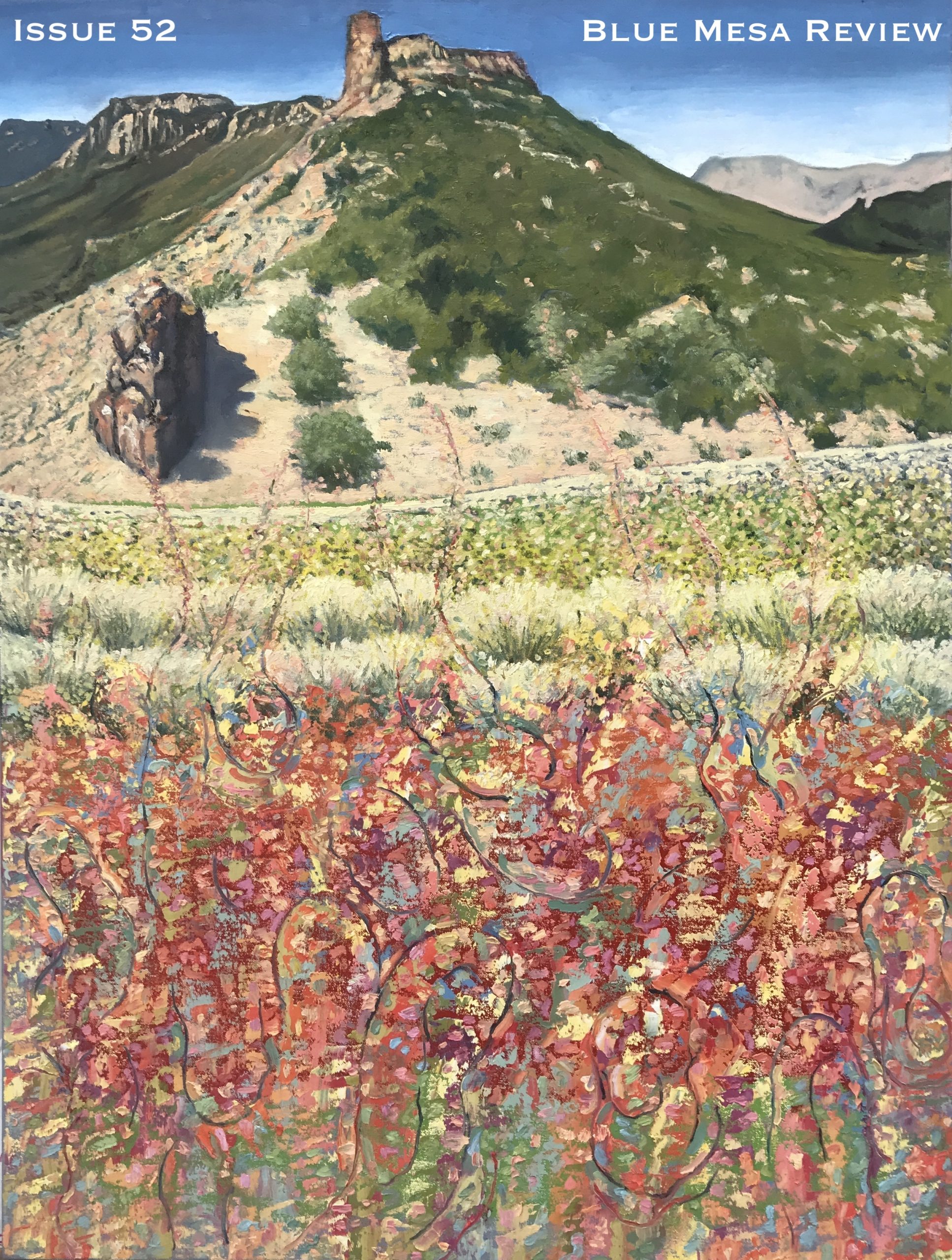
Sandra Slaughter is a German-American emerging abstract expressionist painter based in the Houston, TX area. Her work focuses on emotion, memory and the intensity of human experience through layered texture, movement and atmospheric color. Her paintings have been recognized in international juried competitions with Teravarna Gallery and published in literary issue 57 of Beyond Words Magazine. Sandra creates paintings that merge intuition with storytelling inspired by landscapes, personal history, and psychological depth.
By Jose Oseguera

By Meghan Sterling

By Ivy Raff
By Marika Guthrie