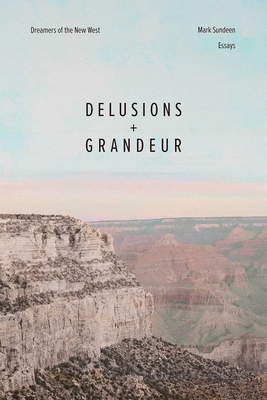
Mark Sundeen, author of Car Camping, The Making of Toro, The Man Who Quit Money, The Unsettlers, and most recently Delusions and Grandeur, has been on my radar for some time. I first read his work years ago when I was an undergraduate student at the University of New Mexico. I was newly interested in the idea of being a writer and I was still trying to decide what that would mean. Not only was I unsure of which genre would be the best proving ground for my ideas, but I was unsure of whether I had any ideas in the first place. I was unmoored and curious when I first read Sundeen’s essay “Holiday Review” (VQR, 2019).
The essay thrilled me. My first exposure to a hermit crab essay, the story was written in the form of an Airbnb review, a stage well set for Sundeen’s wry sense of humor. Carried by his concise prose and gentle voice, the review gives way to a poignant lament that surprised and dominated me. I credit Sundeen’s essay for giving me a sense of direction in those days. I was aware that he was tapping into something resonate and true, and I wanted to do likewise. I have continued to turn to “Holiday Review,” now as an undergraduate writing instructor, to expand my students’ ideas of what an essay can look like and what it can accomplish.
It was with high expectations that I picked up Sundeen’s newest book, Delusions and Grandeur, published in 2025 by University of New Mexico Press. The essay collection, as Sundeen says in the introduction, “spans the first two decades of this century.” While varied in voice and scope of interest, the essays in the collection are all interested in understanding the American west by means of the people who find themselves drawn to it. Sundeen is one such person who found himself drawn to an unconventional way of life in the desert. His love for the land is apparent in the way he speaks of the canyons, caves, and rivers of Utah.
What unites these dreamers and pilgrims and hucksters is the freedom of the landscape, the sense of infinite spirit and possibility in the canyons and deserts and mountains, which reflects back at us our own longing for freedom. Later I found in those grand empty vistas their own brand of delusion, rooted in the widespread yet false belief that one can outrun one’s former self (Sundeen, 5).
Many of the essays are journalistic in their approach. Sundeen follows his curiosity as far as he is able and reports his findings to us in wonderful detail. Whether that means interviewing the politicians and activists at the heart of the Lake Powell Pipeline or Standing Rock protests, speaking to the family and aiding in the search efforts for a young veteran who disappeared into the desert, or sifting through the writings of the late owners of the Hole N’’ the Rock house roadside attraction, Sundeen is determined to follow his curiosity as far as he can. He seems to have no desire to speculate when he can instead track down the person he needs to hear from. Many of the essays in the collection revolve around the people that Sundeen presents to us. While he inserts himself at times, he often maintains some distance from his reportage, allowing for these characters to speak for themselves. He assembles their insights into a narrative with a gentle hand and treats them with a respect that humanizes their perspectives.
Not all of his essays maintain this personal distance. I was most impacted by the final essay of the collection, “The Shinglewide,” largely because of how personal and vulnerable it is. In this final essay, he recounts the history of his romantic relationships over the course of two decades living in Moab, Utah. Sundeen characterizes these years and his approach to relationships as a struggle to believe in his own authenticity. “I had wanted to be a writer, but now I renounced the idea, or at least wouldn’t admit to it, intent on mastering the manual arts instead. If my own story felt phony, the second-best way to be authentic was to be close to people whose stories felt real.” He spends the years renting from and pining after his friend Wendy and caring for the camper turned tiny house that they fixed up together. His reflections on his early love life are made compelling by his honesty, which is ever present even when at his own expense. He writes of one past relationship:
The story I told myself eventually unraveled. I replayed the memories. The night she offered herself to me: I hadn’t declined out of some sense of chivalry. It was because, even as every molecule burned to make a child with her, I couldn’t envision us raising the thing. All I could see us doing was smoking in bed and engineering increasingly innovative paroxysms. Which is what I thought love was (223).
The essay possesses a time-earned wisdom that seeps through Sundeen’s prose. It is this same quality of voice that first endeared me to his work and I was happy to encounter it again in this collection.
Delusions and Grandeur took me places I hadn’t expected to go, and I am glad for it. Sundeen’s commitment to research, activism, and transparency sets a high bar for developing essayists like myself. I am eager to follow Mark Sundeen’s work in the future as well as to go back through his existing body of work. I highly recommend the collection to any lovers of nonfiction and to those who for whatever reason find themselves drawn toward the desert.